Catégories
Geographic markets

Top 20 tourist destinations and source markets

According to World Tourism Organization (WTO) estimates, the number of international tourist arrivals reached 1.2 billion in 2015, an increase of 25% over 2010.* Seen over the longer term, growth has been exponential.

Since the WTO compiles national statistics, methodologies may vary. For this reason, results must be interpreted with caution. In addition, results for the year 2015 were estimated based on partial data for some destinations. This article is an update of the 2011 analysis Global ranking of destinations and source markets.

Constantly shifting rankings

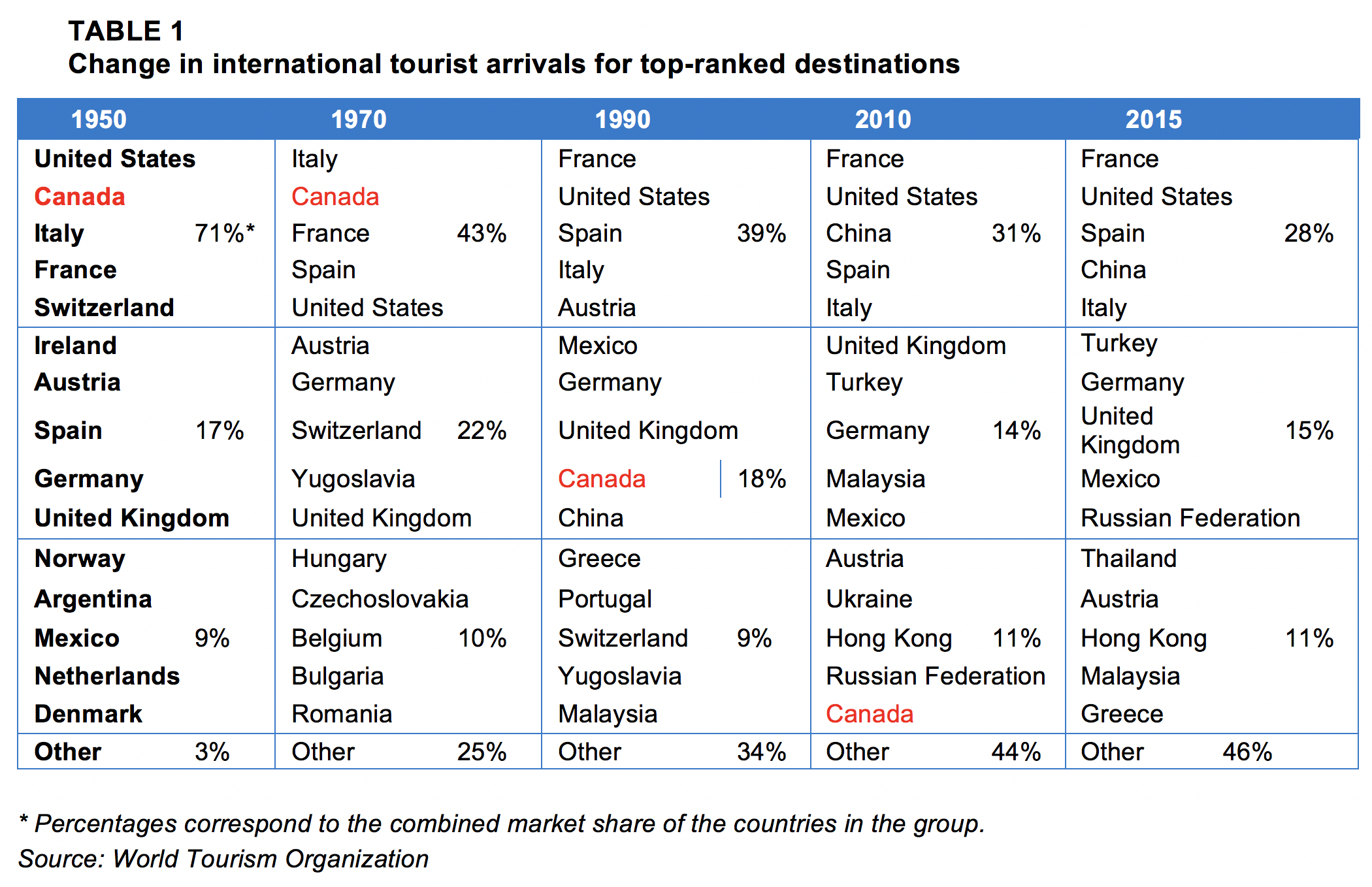
Not only has the ranking of destinations changed dramatically over the years, the sheer number of countries visited by tourists has increased tremendously. Here are some interesting observations about the number of international arrivals at the most popular destinations (Table 1):

  • The top 5 countries in the ranking accounted for 43% of all arrivals in 1970, and only 28% in 2015. Countries not included in the list of 15 top-ranked destinations for international tourist arrivals accounted for 3% of such arrivals in 1950, 34% in 1990 and 46% in 2015.
  • Canada’s ranking dropped from 2nd in 1970 to 14th in 2010 and to 18th in 2015.
  • China has become an extremely popular destination.
  • Malaysia, Turkey and Hong Kong have also made major inroads into the tourism market.
  • The top 5 destinations have remained more or less the same since the year 2000. France attracted more visitors than last year, but its rate of growth is slowing. China closely followed Spain in 2015, and both were right behind the United States.
Tab 1_top_15_tourist_destinations

Copie de WORLD NEWS

Tourism arrivals and tourism receipts: Two realities

Graphs 1 and 2 illustrate the top 20 destinations by international tourist arrivals and by international tourism receipts, respectively. The two rankings differ somewhat. Although France is the number 1 destination in terms of international tourist arrivals, it was ranked 4th in terms of tourism receipts. The United States holds the top position on the latter ranking, well ahead of Spain and China, the next two on the list. While several countries occupy similar rankings in both graphs, others appear in one and are completely absent from the other. Some countries have relatively high tourism receipts for the number of visitors: Australia (42nd in terms of international tourist arrivals), India (40th), Switzerland (36th) and Singapore (26th).


Graph1_top_20_Tourist_arrivals

Graph2_top_20_international_receipts

Although the overall increase in international tourist arrivals benefited all the countries in the top 20, Graph 3 illustrates significant differences among the various countries. Canada recorded growth of 13%, one of the lowest rates among all the destinations, which explains its drop in the rankings. Japan staged a comeback, increasing the number of international tourist arrivals from 8.6 to 29.5 million in 5 years. This increase is due to some external factors (depreciation of the yen and economic growth in China) as well as Japan’s decision to deregulate its aviation industry and facilitate visas for travellers from China, Malaysia and Thailand, making the country more accessible. Thailand, Saudi Arabia and Greece also saw significant increases in the number of tourists.

Graph.3_top_2_tourist_arrivals_change

Where do most travellers come from?

The data in Table 2 about tourist-generating countries is expressed in terms of international tourism expenditures as published by the WTO, not in terms of the number of trips. Total spending grew from US$495 billion in 2000 to US$986 billion in 2010, and then to US$1.26 trillion in 2015, for an overall increase of 154%. In 2015, 28 countries recorded international tourism expenditures of at least US$10 billion, while only 10 countries did so in 2000.

China has experienced explosive growth in international tourism expenditures, increasing 1240% in the past 10 years. Although a large part of this growth can be attributed to intraregional travel, China is still a huge outbound market. Chinese travellers spent an estimated US$292 billion outside the country in 2015. In comparison, travellers from the United States (the number two source market) spent US$113 billion and Canadians only US$29 billion. In Canada, the number of travellers from China in 2016 surpassed those from France, which was ranked 2nd. Other countries in the Asia and Pacific region also significantly increased their international tourism expenditures (Republic of Korea, Hong Kong and Singapore). It is crucial to continue efforts to develop direct flights with this region.

Germany, the United Kingdom and France occupy the next positions in the ranking. Japan moved from 5th in 2005 to 19th in 2015. Although several countries have seen a drop in their international tourism expenditures, the case of Japan is the most dramatic. Canadians spend a lot on international travel, ranking 7th.

Tab2_tourist_generating_expenditures

Focus on attractiveness and accessibility

International tourism continues its fantastic growth, attracting more and more travellers. Remaining competitive is a challenge for everyone. Although distances are less daunting than before, Quebec does not enjoy close proximity with major outbound Asian markets, nor does it benefit from the presence of low-cost flights linking it to a number of neighbouring countries as is the case in Europe, in particular. Efforts to increase destination attractiveness and accessibility are thus doubly important.

Source of image on page one: Pexels

Catégories
Issues Trends

What can we expect from the tourism bubble in the next few years?

What are the major influential factors that will affect tourism supply and demand this decade? For a start, China and India are poised to become major players as they increase their presence in the travel marketplace.

  • Climate of uncertainty
    The political, economic, climatic and health crises of the past few years have shown us that the travel industry, particularly the airline sector, can become very vulnerable and that no destination is immune from these threats.
  • Rising oil prices
    More gas price hikes are expected in the next few years. Since the price of oil affects tourism-based businesses in myriad ways, travel costs will rise. This situation, coupled with risk factors, could lead to an increase in intra-regional travel. Poorer countries will be hurt by higher transportation costs and require special assistance.
  • Security procedures to facilitate travel
    A country’s methods of providing security and protection for travellers play an important role in its position in the global tourism marketplace. In the coming years, these methods should be harmonized.
  • Increased wealth in both existing and emerging markets
    Economic prosperity drives tourism growth. Existing markets will continue to increase their wealth. Among emerging markets, China and India will experience the most growth. Experts anticipate problems due to overcrowded airline routes.
  • Development of both multilateralism and regionalism
    South-South alliances will develop and create more equitable relations. The current trend towards political and economic consolidation in major global regions will restructure the overall globalization movement. Asia will become an economic centre to watch. As a result, tourism, as well as transportation structures and costs, will be profoundly affected.
  • Technology in the forefront
    Whether we are talking about developments in communication, the convergence of the Internet, cell phones and television or the rollout of new aircraft models, technology will continue to play a primary role in the evolution of the tourism industry.
  • Demographic changes
    Concentrated urban populations and family/work dynamics continue to modify travel behaviour. The populations of large industrialized countries are aging, meaning that more baby boomers will have the time and money to travel. However, some experts have reservations about the amount of discretionary income available to retirees for travel.
  • Increased consumer power, thanks to the Internet
    When it comes to accessing information, prices and reservations, the centre of power has shifted from tourism professionals to travellers themselves. Consumers are very comfortable with the Internet and the decisions it enables them to make.
  • Improved quality of life as a travel incentive
    Travel is seen as an element that can help improve one’s quality of life, whether it is used for adventure and discovery, personal growth, relaxation or to get a new lease on life.
  • Heightened competition
    In an attempt to stimulate economic growth, every city, region and country will be looking for a piece of the tourism pie, creating a context in which branding strategies are key.
  • Promotional strategies involving public-private partnerships
    These types of partnerships are especially common in countries with federal or highly decentralized political systems.
  • Ongoing mergers and acquisitions
    The hotel industry, airlines, distribution network and tour operators will continue their trend towards consolidation.
  • Infrastructure deficiencies
    When it comes to infrastructure, the major Western countries lack the planning needed to respond to the coming international growth. It requires several years’ lead time to expand airports and build more hotels.
  • Booming products
    Green tourism, spa tourism and health tourism (surgery and convalescence) are becoming increasingly popular. Although these are examples of segmentation and specialization, mass tourism is in no danger of disappearing.

  • Flirting with China and India

    Even though China and India are enormous potential markets, there is a long list of countries competing for their business. Over 170 destinations are using their charms to attract Chinese and Indian travellers. Despite these efforts, travellers from emerging markets often follow the same pattern as they start to venture outside their country. They begin by traveling in groups and are most likely to visit neighbouring countries. Afterwards, Europe and North America (particularly the West Coast) are added to the list of destinations and the number of individual travellers increases.

    Not everyone behaves the same, however. Chinese travellers like to feel safe by finding people who speak their language and can provide familiar food. As a result, they will be attracted to foreign countries that boast major Chinese communities. As for travelers from India, their travel experiences have made them more likely to travel alone, anywhere in the world.

    All the same, those who wish to appeal to these travellers are well-advised to get busy.

    Tourism in general likely to continue its upward climb

    If we look at the past fifty years or so, although its growth curve may have had a few blips, tourism is not ready to collapse. And yet, even though international demand is expected to grow by 4.2% annually, there are also more and more regions vying for travellers.

    Sources:
    – Baumgarten, Jean-Claude. President of the World Travel & Tourism Council (WTTC) and a guest lecturer for the Cercle de tourisme du Québec, April 20, 2006.
    – Désiront, André. Interview with Jean-Claude Baumgarten following his remarks to the Cercle de tourisme du Québec, April 20, 2006.
    – Frangialli, Francesco. « Défis pour un nouveau millénaire, » Le Devoir, April 1 and 2, 2006.
    – Sarrasin, Bruno. « Temps de ruptures et continuités, » Le Devoir, April 1 and 2, 2006.