Catégories
Customer segments

Girlfriend getaways

A flourishing market

Although we were unable to find recent statistical data on women’s travel, a 2013 American Express survey reported a record number of trips involving female friends or family, with 56% of female travellers saying they had taken a « women-only » trip.

This booming customer segment led to a 230% increase in the number of US businesses specializing in women-only travel between 2008 and 2014, according to Marybeth Bond, author of the Gutsy Traveler blog and a women’s travel expert.

This booming customer segment led to a 230% increase in the number of US businesses specializing in women-only travel

Although Intrepid Travel, a small-group tour specialist, reports that 63% of the 100,000 reservations made through its Website in 2012 came from women 25 to 39 years old, those aged 60 and over make up a large proportion of female travellers. Now retired, they travel because they have the time and the resources.

According to Kelly Lewis, founder and publisher of Go! Girl Guides, guidebooks for female travellers, women are looking for more active travel experiences or those that involve volunteering. However, health and safety still remain key concerns. Let’s take a look at the tourism industry’s efforts to adapt to this lucrative market.

Girlfriend-friendly hotel packages

Many « girlfriend getaway » hotel packages feature traditional spa and massage sessions like the one at the Auberge Godefroy in Bécancour, the Hotel Spa Watel in Sainte-Agathe-des-Monts, and the Auberge de la Montagne Coupée in the Lanaudière region. The girls’ getaway at the Auberge and Spa West Brome even includes a chick flick and popcorn! Other packages like those at the Courtyard Marriott Niagara Falls and the Andrew Pinckney Inn focus instead on shopping and food.

For something a little less traditional, the Wellness and Workout Weekend in Charlevoix at the Le Germain Hotel in Baie-Saint-Paul invited women to a fall weekend of hiking on the surrounding trails. The full package included a yoga session, hiking, thermal spa experience and a lecture about nutrition.

If a little adventure and entertainment is what you seek, several member resorts of Resorts of Ontario offer activities like poker lessons, courses in cocktail mixing or jewellery making, an extreme course, paintball, hiking and mountain biking.

filles resort ontario

Source: Resorts of Ontario

Is the distribution network targeting the girlfriend getaway market?

Not exactly. However, it does offer products for groups of women with similar interests like outdoor activities or adventure travel. Wild Women Expeditions has been catering to women for over 25 years with a host of outdoor activities like canoeing, kayaking, rafting, biking, hiking and horseback riding on nearly every continent.

World Expeditions, which specializes in small group adventure tourism, has seen a substantial increase in the number of female clients over the past 20 years, with this group rising from 38% of its clients in 1996 to 54% in 2016. Even on the most challenging itineraries, such as mountaineering or long-distance mountain treks, women now represent 30% of the group. Because of this, the tour operator has developed a brand new range of women-only active adventures that will launch in 2017

Destinations promoting girls’ weekends

The Chattanooga Convention and Visitors Bureau began marketing packages designed specifically for women in 2010, a year after the state of Tennessee launched its promotional campaign aimed at female tourists. Its girlfriend getaways include spa treatments, jewellery making, winery tours, meals in local restaurants and, of course, shopping, all with a « behind the scenes » aspect that offers something out of the ordinary.

Seetorontonow, the Tourism Toronto Website, clearly features its girls’ weekends, offering three itineraries involving luxury, spa, food, shopping, museums and entertainment.

femmes bar Toronto

Source: Tourism Toronto

A girlfriends’ fishing trip – why not?

To promote hunting and fishing activities to urban women, the Association des pourvoiries de la Mauricie launched the « Trip de filles » radio campaign that ran from February 29 to March 11, 2016. Female listeners had to answer questions about wildlife to be eligible for a chance to win a package for four offered by the outfitter Le Seigneurie du Triton.

Orvis, a fishing and outdoor equipment retailer in Vermont also runs a school and organizes trips. To celebrate its 50th anniversary this year, Orvis is offering a women-only fly-fishing trip to Belize’s largest island.

trip filles Mauricie

Sources: Pourvoiries Mauricies

Even the sharing economy is getting in on it

A product of the sharing economy, the Website Copines de voyage posts new travel products each week, offering those interested a platform to discuss potential trips with other interested parties before even making a reservation. Once the minimum number of participants has been reached, the trip is confirmed.

In 2015, nearly two million Canadian women 18 years and up travelled in Quebec. Why not take a greater interest in offering them a range of products and services, including girlfriend getaways? Give it a try and see what happens!

Image on first page: Pixabay


Catégories
Geographic markets

Top 20 tourist destinations and source markets

According to World Tourism Organization (WTO) estimates, the number of international tourist arrivals reached 1.2 billion in 2015, an increase of 25% over 2010.* Seen over the longer term, growth has been exponential.

Since the WTO compiles national statistics, methodologies may vary. For this reason, results must be interpreted with caution. In addition, results for the year 2015 were estimated based on partial data for some destinations. This article is an update of the 2011 analysis Global ranking of destinations and source markets.

Constantly shifting rankings

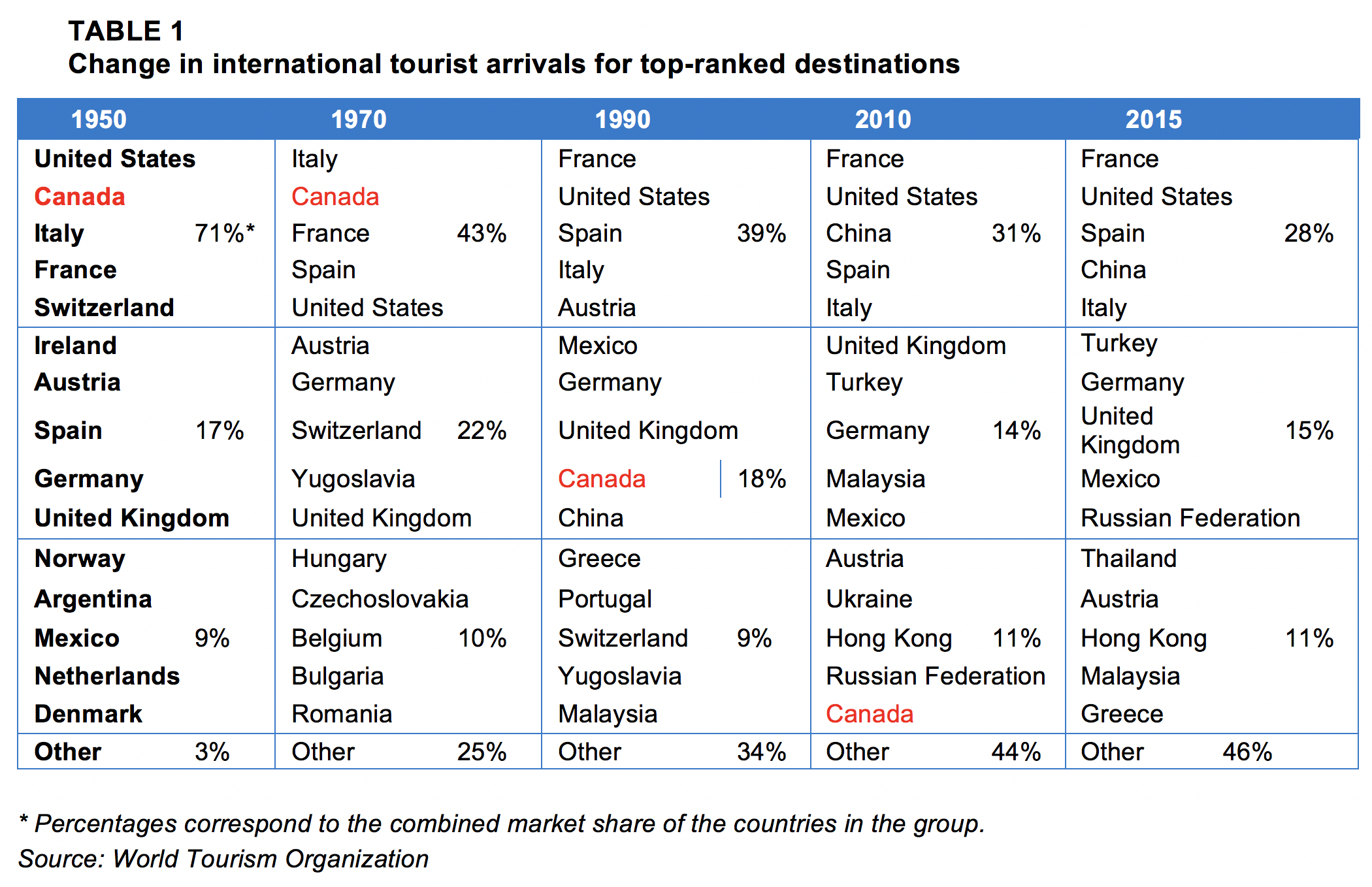
Not only has the ranking of destinations changed dramatically over the years, the sheer number of countries visited by tourists has increased tremendously. Here are some interesting observations about the number of international arrivals at the most popular destinations (Table 1):

  • The top 5 countries in the ranking accounted for 43% of all arrivals in 1970, and only 28% in 2015. Countries not included in the list of 15 top-ranked destinations for international tourist arrivals accounted for 3% of such arrivals in 1950, 34% in 1990 and 46% in 2015.
  • Canada’s ranking dropped from 2nd in 1970 to 14th in 2010 and to 18th in 2015.
  • China has become an extremely popular destination.
  • Malaysia, Turkey and Hong Kong have also made major inroads into the tourism market.
  • The top 5 destinations have remained more or less the same since the year 2000. France attracted more visitors than last year, but its rate of growth is slowing. China closely followed Spain in 2015, and both were right behind the United States.

Tab 1_top_15_tourist_destinations

Copie de WORLD NEWS

Tourism arrivals and tourism receipts: Two realities

Graphs 1 and 2 illustrate the top 20 destinations by international tourist arrivals and by international tourism receipts, respectively. The two rankings differ somewhat. Although France is the number 1 destination in terms of international tourist arrivals, it was ranked 4th in terms of tourism receipts. The United States holds the top position on the latter ranking, well ahead of Spain and China, the next two on the list. While several countries occupy similar rankings in both graphs, others appear in one and are completely absent from the other. Some countries have relatively high tourism receipts for the number of visitors: Australia (42nd in terms of international tourist arrivals), India (40th), Switzerland (36th) and Singapore (26th).


Graph1_top_20_Tourist_arrivals

Graph2_top_20_international_receipts

Although the overall increase in international tourist arrivals benefited all the countries in the top 20, Graph 3 illustrates significant differences among the various countries. Canada recorded growth of 13%, one of the lowest rates among all the destinations, which explains its drop in the rankings. Japan staged a comeback, increasing the number of international tourist arrivals from 8.6 to 29.5 million in 5 years. This increase is due to some external factors (depreciation of the yen and economic growth in China) as well as Japan’s decision to deregulate its aviation industry and facilitate visas for travellers from China, Malaysia and Thailand, making the country more accessible. Thailand, Saudi Arabia and Greece also saw significant increases in the number of tourists.

Graph.3_top_2_tourist_arrivals_change

Where do most travellers come from?

The data in Table 2 about tourist-generating countries is expressed in terms of international tourism expenditures as published by the WTO, not in terms of the number of trips. Total spending grew from US$495 billion in 2000 to US$986 billion in 2010, and then to US$1.26 trillion in 2015, for an overall increase of 154%. In 2015, 28 countries recorded international tourism expenditures of at least US$10 billion, while only 10 countries did so in 2000.

China has experienced explosive growth in international tourism expenditures, increasing 1240% in the past 10 years. Although a large part of this growth can be attributed to intraregional travel, China is still a huge outbound market. Chinese travellers spent an estimated US$292 billion outside the country in 2015. In comparison, travellers from the United States (the number two source market) spent US$113 billion and Canadians only US$29 billion. In Canada, the number of travellers from China in 2016 surpassed those from France, which was ranked 2nd. Other countries in the Asia and Pacific region also significantly increased their international tourism expenditures (Republic of Korea, Hong Kong and Singapore). It is crucial to continue efforts to develop direct flights with this region.

Germany, the United Kingdom and France occupy the next positions in the ranking. Japan moved from 5th in 2005 to 19th in 2015. Although several countries have seen a drop in their international tourism expenditures, the case of Japan is the most dramatic. Canadians spend a lot on international travel, ranking 7th.

Tab2_tourist_generating_expenditures

Focus on attractiveness and accessibility

International tourism continues its fantastic growth, attracting more and more travellers. Remaining competitive is a challenge for everyone. Although distances are less daunting than before, Quebec does not enjoy close proximity with major outbound Asian markets, nor does it benefit from the presence of low-cost flights linking it to a number of neighbouring countries as is the case in Europe, in particular. Efforts to increase destination attractiveness and accessibility are thus doubly important.

Source of image on page one: Pexels

Catégories
Marketing @en

Marketing and the Human Factor

The human factor in the sharing economy

Lately, tourism marketing has been saturated with the human factor, as companies capitalize on tourists’ apparent fondness for stories that make them dream, stories with a human element that they can identify with. That element is played up in the latest messages from the sharing economy’s biggest players: think of Airbnb’s Mankind campaign, urging travellers to see the world through the eyes of an innocent child. Or, what about Uber’s “What’s Your Destination?” ad, reminding us that “we’re all going somewhere”, or BlaBlaCar’s Members stories, yet another instance of so-called “humanized” communication?


Source: YouTube


 The human factor in destination marketing

Many tourist destinations are now presenting real-life moments and allowing viewers to meet actual residents. London is an excellent example of this trend, along with its series of video clips entitled The London Story, in which Londoners talk about what makes their city unique.


Source: VisitLondon

Another example – this one more daring – is the short video I hate Thailand, which tells the story of a young traveller whose bag is stolen, but whose happy ending shines a light on the Thai people’s generous and open spirit. Closer to home, the #MTLmoments campaign, launched by Tourism Montréal in May 2013, invites Montrealers and tourists alike to capture spontaneous, everyday moments and share them on social media.

retour_humain_Mtl_momentsSource: Tourism Montreal

California showcases the state’s unique character through a series of short (2- or 3-minute) videos on its farmers and the soil they work. The clips show testimonials by specialists in different fields, demonstrating their in-depth knowledge of and profound love for their work.


Source: YouTube

The main message of South African Tourism’s new #MeetSouthAfrica campaign is that you don’t just VISIT South Africa, you MEET it by meeting its people. Through videos, a blog and Instagram photos, visitors see the country through the eyes of South Africans; the spectacular scenery stays in the background, taking second place to the conversations.


Source: YouTube

VisitHolland has produced about ten short (less than 60 seconds) videos inviting tourists to experience the city as a local, by showing its inhabitants in a variety of situations: falling in love, waking up in the morning, enjoying local specialties or sharing their traditions. It also reveals the many faces of its people in two videos, Faces (see below) and Kids.


Source: YouTube

 In an attempt to debunk the myth that Finns are cold and reserved, VisistFinland uses a section of its website to describe the intrinsic qualities of its people, against a backdrop of stunning visuals. The northern part of the country, known as Lapland, invites users to meet locals who share their interests and get their insights about the region they call home, and then follow their advice for a successful travel experience.

Lapland

Source: OnlyInLapland

 The human factor in hotel marketing

As a means of enticing travellers and stirring their emotions, several large hotel chains are now focussing on the human factor and the experience rather than the hotel environment or the room itself. In this spirit, Marriott has created the Marriott Traveler website, a sort of unofficial tourist guide to destinations like New Orleans, Chicago, Orlando, with headings like culture, family, fashion, food & drink, Zen and so on, populated by texts, photos and videos by residents or other travellers. There’s the Tour of New Orleans with Chef Tory McPhail, for instance, or how to find the best pizza in Chicago. 

Some luxury hotel groups are also adopting an approach that centres on the human factor and the experience. Rather than focussing on its 10 hotels, the Maisons et Hôtels Sibuet website suggests 13 different kinds of experiences over four seasons for their guests to enjoy. 


Source: Sibuet Experience

 The human factor in product marketing

After making a series of “How To” videos showing visitors how to dress for the company’s various activities, how to drive a snowmobile or dog sled, etc., Lapland Safaris (a destination management company) is now revealing the company’s human face. In its recent tourism experience videos, Faces of Lapland Safaris introduces twelve employees who work in different areas of the company and ending with the words “With a human touch”: a great way to create some positive feelings and a sense of brand loyalty.

 
Source: https://www.youtube.com/watch?v=89RcJPZN0Kw

 The human factor in the Distribution Network

An example of this is the home page of Thomas Cook’s YouTube channel, which has 30 videos, the most recent of which (that make up a good half) focus much more on the human factor than on the destination itself.

Thomas_Cook

Source: YouTube


There are sure to be many more examples to come. If you are one of the many who are starting to put a human touch on your marketing messages, make us happy and share them with us!


Source of the header image: YouTube


Catégories
Marketing @en

Choosing the Most Outstanding Attractions

Rather than letting potential visitors browse through hundreds of offers to get a feel for the place, destinations are taking a more proactive approach. They have started showcasing only their flagship products to inspire visitors, spark the imagination and get them dreaming. Visitors to the destination’s website will learn at a glance what makes that place distinctive, and will create an enduring mental image for themselves.


Selecting Means Rejecting

Trying to focus on everything the destination offers decreases the impact of its message. However, crafting a more targeted message designed to create a strong first impression necessarily involves choices. Some destinations have managed this feat brilliantly and are now turning their attention to secondary tourist products related to these primary attractions. Ultimately, the entire tourism industry wins. Here are some examples.

The Seven Wonders of Oregon

In 2013, the Travel Oregon destination marketing organization launched the Seven Wonders of Oregon campaign that focussed specifically on seven of the Western U.S. state’s iconic natural attractions. Thereafter, all the state’s marketing tools and initiatives were centred on those seven attractions. Visitors are encouraged to come or return to Oregon to see them all, in other words, to “collect” them. Campaigns for each of the individual attractions cast a much wider net by presenting the surrounding attractions. The following video describes the idea behind the campaign and provides a teaser about each of the Seven Wonders themselves.

Source: YouTube

One year later, tourism in Oregon shows solid growth:

  • more international travelers (9%);
  • an increase in revenue for different types of accommodation (10%);
  • an increase in the number of requests for information (39%);
  • more traffic on Travel Oregon’s website and its various social media accounts;
  • the economic benefits from tourism reached US$10 billion, and more than 101,000 direct jobs for Oregonians.

In 2014 and 2015, Travel Oregon received numerous awards, including Best Destination Website from the U.S. Travel Association. A brand new campaign, scheduled for spring 2016, will showcase the Seven Wonders of Oregon from a different angle.

Travel _Oregon_7_wonders

Source: Travel Oregon

San Francisco’s Must-See Places

San Francisco Travel, the city’s destination marketing organization, also won awards for its website. Visitors find it easy to explore the city’s many offerings because of the site’s bold new design, effective visuals and suggested itineraries based on specific needs and interests.

The home page gives users a crash course in the city’s most iconic landmarks. Six of them are shown at the bottom of the screen, reminding users at a glance of the city’s strong, well-developed and widely-recognized tourism product, and the must-see places that amply justify a visit to San Francisco.

San_Francisco_Travel_most_outstanding_attractions

Source: San Francisco Travel

Utah’s Mighty 5® Campaign

If you try to say you’ve got something for everyone, your message gets lost and you end up saying nothing at all. So says Alex Fuller, Creative Director of the ad agency behind Visit Utah. She also explains the importance of not getting stuck in a rut, of boldly leveraging an established asset and sticking to your message. The idea of promoting the destination through its national parks is not new, but the message and the proposal are: turn Utah’s five national parks into one destination, one product, one challenge: something to check off your bucket list, like seeing the Grand Canyon. Check out the video ad for the Mighty 5® Campaign.

Source: YouTube

This campaign put Utah on tourists’ radar, especially at the international level. For the past 10 years, Utah’s tourism has grown by 44%, compared with a mere 35% growth for its neighbours. According to Vicki Varela, Utah Office of Tourism Director, Utah is now officially “on the map.”

Staking out a Strong Position

Other destinations are also relying on selected themes to position themselves effectively, as Greenland has done with its The Big Arctic Five campaign. There is also the trend of offering must-see or must-visit attractions that make planning easier, especially for those about to embark on their first visit. Notable examples of this trend are Visit Copenhagen, Destination British Columbia (British Columbia’s destination marketing organization), and the Québec City region.

Every stakeholder wants their advertising campaign to accurately portray their product. But, all too often, by trying to please everyone – members and visitors alike – some destination marketing organizations diminish the impact of the region’s distinctive attractions. As demonstrated by the aforementioned examples, you can win big if you grab the potential visitor’s attention, and get on the list of dream destinations, by focussing on just a few brand identity assets; the rest will happen at another marketing level.


Source of the header image: Visit Utah ou Travel Oregon

Catégories
Accommodation etourism and technology Marketing @en

The Troubling Trend of Increasing ‘Web Marketing Ineptitude’ in Hospitality… by Max Starkov

The Québec Tourism Intelligence Network is pleased to present some highly relevant thoughts about online marketing of hotels, written by special collaborator M. Starkov, consultant in Hospitality eBusiness Strategies.

Throughout our nearly 15 years of hotel Internet marketing experience, we have been consistently concerned about the increasing level of disparity between savvy Internet/Mobile marketers in hospitality and travel, and the Internet/Mobile Marketing-inept players in the industry.With the advent of social media in recent years, Web 2.0 technologies and the mobile Web, this disparity has accelerated dramatically.

On one side there are the extremely Web-savvy:

  • Online travel agencies like Expedia, Travelocity, etc.
  • Most major hotel brands’ e-commerce departments
  • Airlines
  • Some e-commerce departments at smaller and mid-size hotel and resort chains
  • Some very bright individuals at the marketing departments of full service hotels, resorts and casinos

On the other side there is everybody else, which unfortunately means the majority of hospitality executives and sales and marketing professionals.
HeBS defines “Web Marketing Ineptitude” as the lack of hands-on experience in Internet marketing and all of its formats: website re-designs, SEO optimizations, search marketing, email marketing, strategic linking, banner advertising and online sponsorships, social media and Web 2.0 and more recently, mobile marketing. In addition, this ineptitude also indicates a lack of understanding of best practices and latest trends in the direct online channel.

In the 1990s, it was “normal” that only a few hospitality and travel marketers were proficient in the online channel.  Less than 3% of travel reservations in the U.S. were booked online back in 1999. In the 2000s (in 2001, online travel bookings reached 5.4% of all travel reservations in the U.S.), hospitality marketers and the major hotel brands began to pay closer attention to the Internet channel. In the years that followed, Internet travel adoption increased dramatically and in 2009 alone over 55% of all travel reservations in the U.S. will be online (45% of all hotel reservations) to the tune of a staggering $116.1 billion (eMarketer).

Yet, to our dismay, over the past 15 years the level of Internet marketing expertise in the hospitality industry has not kept up with this remarkable growth. On the contrary, we are witnessing whole new generations of hospitality executives and marketing professionals who are unfamiliar with Internet marketing in general as well as best practices and trends in the direct online channel.

This problem has been exacerbated by a) the social media and Web 2.0 phenomena, and b) mobile marketing. Both of these new marketing and distribution channels introduced an entirely new level of complexity and skill set requirements, as well as new best practices and trends.

  • Social Media have changed how customers plan and purchase travel, how customers access information, and how customers perceive the credibility of information. How can hoteliers create/monitor/take advantage of the social media “chatter” around the hotel, target receptive audiences, and ultimately stimulate hotel website visits, interactions and bookings? What type of Web 2.0 and interactive features and functionality do you need on the hotel website?
  • Mobile Web is expected to surpass the traditional Web within the next five years. The promise of “immediate, anywhere and anytime” Internet access, instant information and transaction capabilities, location-based services and personalization are some of the key factors for the “explosion” of the mobile Web. Hotel guests–past, current and potential–are increasingly becoming mobile-ready and hoteliers have to respond adequately to this growing demand for mobile services. This is the reason why hoteliers and travel marketers need to have robust mobile Web initiatives in place, including mobile brand websites, mobile apps, m-CRM and mobile marketing.

Why Is There a Growing Web Marketing Ineptitude in the Industry?

There are many reasons for this “Web Marketing Ineptitude” among the ranks, but here are some of the most important:

Franchised Properties:

  • Many major brands control all Internet marketing initiatives at the corporate level, including property-level initiatives, thus depriving staff at the property from any meaningful experience in Internet marketing.
  • We have seen a trend among small/mid-size chains to establish small but vital e‑commerce departments. In many cases, these companies outsource whatever online marketing they do to outside vendors. Here again, when outsourcing, they make a crucial mistake by not demanding professional development to be part of the Internet marketing vendor’s responsibilities. This results in Internet marketing expertise not being disseminated to the properties in the process.

Independent Hotels and Resorts:

  • The biggest concentration of Internet marketing knowledge is at this level.
  • Many big full-service hotels and resorts have some form of in-house Internet expertise. However, due to staff turnover and constantly decreasing budgets, these properties tend to have a very spotty Internet expertise retention rate.
  • Smaller hotels and resorts are most vulnerable due to limited budgets and difficulties with hiring and retaining employees with expert knowledge.

Destination Marketing Organizations (DMOs) and Convention and Visitor Bureaus (CVBs):

  • These organizations boast some of the brightest Internet marketing stars and some of the most inept marketers.
  • In many cases among DMOs and CVBs, ignoring Internet marketing best practices is not even a matter of budget size, but a result of inertia and commitment to traditional advertising formats.
  • The government or quasi -government nature of CVBs and tourism offices does not help with the hiring and retention of Internet expertise.

So What Is the Verdict?

HeBS believes there are different levels of Web Marketing Ineptitude in the industry regarding three important marketing media: Traditional Web, Social Media/Web 2.0 and Mobile Web. Here are our estimates of the ineptitude rates in each of these media:

Internet Marketing/Traditional Web

  • Nearly 15 years of existence of the traditional Web
  • Internet Marketing Ineptitude rate in hospitality:  65%

Web 2.0/Social Media Marketing

  • Nearly 5 years of existence of social media
  • Web 2.0/Social Media Marketing Ineptitude rate in hospitality:  90%

Mobile Marketing/Mobile Web

  • Nearly 10 years of existence of Mobile Web but in reality, the Mobile Web in the U.S. exploded with the introduction of the first iPhone in June 2007.
  • Mobile Marketing Ineptitude rate in hospitality:  97%

Conclusion

Hoteliers should strive to gain a crystal-clear understanding of what the best practices and latest trends are in hospitality Internet marketing: what works, what doesn’t, and why. Hoteliers should recognize that they do not have all the answers in-house and that there are thought leaders and other proven industry experts who can help them and their property stay competitive in these economic times, preserve and increase market share, and generate the highest website revenues and ROIs.

Hoteliers should take a hard look at how Best Industry Practices are being utilized by their corporate offices or major brands, as well as by the hotel’s Internet marketing vendors. Almost 15 years after the first online hotel booking, best practices have been established in practically every aspect of hotel Internet marketing. Hoteliers should not allow their Internet marketing vendors to “learn the business on the hotel’s dime.”

The prospect of professional development should become the main criterion when choosing an Internet marketing vendor.  Hoteliers should hire experts who are able and willing to teach the hotel and staff best practices and keep the hotel appraised of the latest direct online channel trends.

Hoteliers should work only with Internet marketing experts who can help them acquire new core competencies and adopt best industry practices in the direct online channel. 

They should provide crucial professional development as well as guide the hotel’s direct Internet marketing strategies, online brand building strategies, e-CRM, website re-design and SEO optimization, search and email marketing, social media and mobile marketing initiatives.

Catégories
Sustainable tourism

Understanding the certification jungle

Welcome to the jungle of quality labels and certification programs! There is certainly a lot to choose from. Are these marks of recognition a sign of quality, a guarantee of success or simply a marketing tool? Do travellers care about them and can they distinguish among them? The following article explores many of these questions and provides a few answers. It was prepared by Michèle Laliberté of the Tourism Intelligence Network of the ESG-UQAM Chair in Tourism (University of Quebec at Montréal):

Everyone wants to boast a mark of distinction

Among the most prestigious international distinctions is “UNESCO World Heritage Site.” The European Union recently announced plans to develop a similar quality label as a way of developing culture and heritage tourism and enhancing its prestige and educational value.

Europe abounds with a variety of eco-labels, Tourism Australia has launched an ecotourism certification program, and the Quebec adventure and ecotourism sector boasts a quality program managed by the Bureau de normalisation du Québec. The Ministère du Tourisme du Québec is restarting its Démarche Qualité Tourisme total quality program. Under the aegis of the World Tourism Organization (WTO) and with funding from both the Quebec and Canadian governments, the World Center of Excellence on Tourist Destinations (CED) recently opened in Montreal. It is currently developing criteria to measure the excellence of destinations.

In the US, five hotels are proudly displaying their certifications from the US Green Building Council. Every year, the World Travel & Tourism Council (WTTC) hands out its Tourism for Tomorrow Awards and is currently studying the possibility of establishing an accreditation for organizations which meet sustainable development standards. In Quebec, Grands prix du tourisme recipients proudly feature their awards in their advertising campaigns. And, although primarily a marketing association, the prestigious Relais & Châteaux hotel chain, synonymous with luxury, is not open to just anyone.

And the list goes on. Classifications, certifications, social labels, quality labels, labels of origin, eco-labels, major awards, luxury banners… if recognition is what you seek, there is certainly a lot to choose from!

It goes without saying that growing consumer awareness of the environment and the negative impacts of tourism has led to an inevitable reassessment of tourism practices. Certification is one way to prove one’s commitment and provide a guarantee of good practice. More and more, the principles of sustainable development are key to establishing criteria and creating new labels.

Advantages for businesses

Committing to a certification program or total quality approach is not easy. It is very time-consuming and can even lead to a complete overhaul of work processes. In a business climate where customers are demanding and often enjoy a wealth of options, more and more companies are looking for a seal of quality, recognition or distinction to:

  • improve their services and product quality
  • reassure consumers and provide a guarantee
  • distinguish themselves from the competition
  • enhance their visibility and reputation
  • access new markets
  • improve business practices and increase productivity
  • and, to some extent, reduce the negative impacts of tourism

Even certification has its failings

The stars used to rank hotels are undoubtedly the most recognized travel rating system in the world. But who awards these stars? They can come from tour operators, the hotel itself, recognized organizations with very different criteria from one region to the next, or even – with the advent of Web 2.0 – internet users (also read:
You haven’t heard the last of Web 2.0!).

As a traveller, how often have you lamented the disparities in evaluations from different regions and the lack of uniformity among the various programs? In fact, many organizations would like to establish an international certification system, but this may only be a pipe dream.

The challenges? How can international standards take into account the realities of different regions, and how can mass tourism products and niche tourism products meet the same standards? How can a community have a say in the decision-making process, and how can small businesses rally the technical, financial and human resources to take on heavy, costly procedures?

These same questions apply domestically as well. To be “certified” means to ensure that something is true, to provide a guarantee of… what, exactly? Many companies, having understood the promotional benefits of certification, will go so far as to declare themselves certified, even if they are not. This is not uncommon in the case of various “eco” products.

Ambiguous surveys and an ideological debate

Can a “seal” truly influence consumer choices, and do travellers care about evaluation criteria when selecting a certified business or do they simply have faith in the “seal”? Do travellers know which criteria distinguish a 4-star hotel from a 2-star hotel? And do they know that rating systems differ from one country to the next?

In response to these questions, here are some survey results to answer these questions and point out some contradictions:

“Green” programs are definitely very popular! A survey by the Hotel Association of Canada shows that 60% of Canadians feel that membership in an environmental program is a major factor in their choice of hotel. In Quebec, this percentage is 72%, the highest of any Canadian province. Many other surveys illustrate the popularity of environmental programs, both in Canada and around the world.

If something has a “green” label, then it must be good! Various surveys indicate there is still a high level of confusion and lack of understanding when it comes to eco-labels. Consumers support certifications and quality labels, but they are rarely able to distinguish among them or understand their true meaning.

When travellers are on vacation, their principles take a break as well! On one hand, an Orbitz survey reports that 63% of people would pay more to stay in a “green” hotel and 67% attach importance to the “eco-friendliness” of a destination. On the other hand, according to a Starwood survey, most Americans leave their environmental conscience at home because 70% of frequent travellers state they do not waste water at home, while this percentage drops to 18% when they are in a hotel.

Although respect for the environment is now an integral part of contemporary mores, vacations are associated with freedom and a lack of restrictions. Consequently, high principles and good habits also go on holiday. Consumers are exhibiting an openness and commitment to the state of the environment, but tourists’ positive attitude towards eco-labels is not a guarantee of environmentally responsible behaviour.

Says Marie-France Turcotte, “Certifications have the potential to make a modest contribution to meeting a major challenge, that of changing business practices and tourist consumer habits.” So, the question is, should travellers purchase a product on the pretext that it is certified, or do we need to become accountable as travellers, companies and social actors? The answer is, no doubt, both.

With the growth of certifications, businesses will probably face the same dilemma they do vis-à-vis distribution channels: which one will improve their position in the wonderful world of competition, increase their visibility and make them the chosen one of consumers? Start strategizing!

Sources:
– Boyd, Christopher. “Green Hotels Are Cleaning Up – Embracing an Eco-friendly Philosophy Resonates with Tourists,” The Orlando Sentinel, July 9, 2007.
– Breaking Travel News. “Survey: US Travelers Stress Eco-friendly Travel,” April 12, 2007.
– Delisle, Marie-Andrée and Louis Jolin. Un autre tourisme est-il possible? Presses de l’Université du Québec, 2007, 144 pages.
– ehotelier.com. “Survey: Most Americans Drop their Green Habits when They Check-in to Hotels,” July 10, 2007.
– Le Figaro.fr. “Vers une liste du ‘Patrimoine de l’Europe’,” May 22, 2006.
– Hotel News Resource. “As Hotels Focus on Environmentally Friendly Programs, Awareness among Hotel Guests Lags,” July 24, 2007.
– Hotel News Resource. “Leaving Home often Means Leaving Green Routines behind according to New Survey from Element Hotels,” July 10, 2007.
– HSMAI. “Asian Hospitality Leaders at HSMAI Roundtable Call for Standardization of Ratings System for Asian Hotels,” July 17, 2007.
– Karantzavelou, Vicky. “Six out of 10 Canadians Want To Stay at Green Hotels,” [www.traveldailynew.com], June 10, 2005.
– Parnières, Émilie. “Le tourisme responsable: Convergence de deux démarches de labellisation,” Veille info tourisme, May 2005.
– Salerno, Neil. “Stars & Diamonds – Do They really Matter any more?” Hotel News Resource, January 31, 2007.
– Turcotte, Marie-France. L’écotourisme entre l’arbre et l’écorce – Labels et certifications d’écotourisme et de tourisme. Le contexte et la portée, Presses de l’Université du Québec, 2006, p. 348-369.
– World Travel & Tourism Council. “Big Companies Must Show how Green They Are,” November 24, 2006.

Catégories
Management

Is your destination in decline?

« Tell me who visits your destination, and I’ll tell you whether it’s in decline! » This was the bet made by Stanley Plog when he developed his model of matching traveller profiles with phases in a destination life cycle. When a destination is visited by large numbers of tourists, it has reached a critical phase in this cycle; to avoid decline, destinations must understand that tourism growth must be planned and controlled.

The life cycle of a destination: from discovery to decline

There are five different traveller profiles in Stanley Plog’s model: from venturers to dependables. According to Plog, these various tourist personality types are associated with phases in a destination life cycle because the type of tourist who visits a region indicates the area’s level of development, and in some ways determines its life cycle. Figure 1 illustrates the various phases in a tourist area’s life cycle (TALC), which were developed by R.W. Butler, Ph.D, in 1980.

Figure 1

MLa_talc


Discovery
During this phase, a little known destination is visited by the first venturers in search of new discoveries and unexplored areas. Through word-of-mouth, the area begins to attract more tourists.

Discovery – Development
Once venturers have begun exploring a destination, they are followed by near-venturers. This creates the first major wave of visitors who – because they are more demanding in terms of services – initiate real development.

Development
With the destination’s notoriety growing, the media, always looking for something new, show up in the region and enthusiastically report on its charm and cachet. This then « condemns » the destination to rapid growth and the arrival of so-called centric travellers. Growth continues and everyone is happy: the number and value of hotels increases; jobs multiply; government coffers overflow with taxes; many areas are enhanced; local stakeholders smugly congratulate themselves on finding a gold mine and believe that tourism is the perfect industry to ensure longevity and unlimited growth. By this time, venturers and near-venturers have abandoned the area and mass tourism has arrived.

This phase is crucial because when a destination is really booming, no one cares about planning or controls. For this reason, it is important to take action at this stage to manage development and define a long-term vision.

Maturity – Decline
Riding this wave of popularity, a destination is too often lax in its regulations: the number of hotels continues to grow; fast-food restaurants pop up everywhere; shops, movie theatres and other forms of entertainment multiply; wholesalers develop packages. The area starts to get « touristy » and there is unchecked development. The destination is unable to resist the easy money of tourism and unsustainable development. Under such pressure, the destination loses its distinctiveness and looks like any other destination. The centrics now stop coming and the near-dependables start to frequent the area. According to Plog, if 30% or more of a destination’s reservations come from package deals, the destination has begun a decline that will last for several decades.

Decline
Despite the boom, decline is now inevitable. The destination now only attracts dependables, who prefer to visit and revisit well-established known quantities. Though often more loyal, this clientele spends less, stays a shorter time and is less active. The destination becomes less lucrative. Deserted by the other tourist segments, the market gets smaller. Managers don’t understand what has happened because arrivals kept rising. The destination must then try to differentiate itself and reposition itself in the market.How many times has this happened? Emerging destinations suddenly become popular and then are ignored as travellers head to newly discovered destinations. Over-crowding leads to decline and a different traveller clientele, and then everything changes!

Obviously, Plog’s model does not apply to every destination, but it does provide food for thought. Furthermore, a destination may find itself in a different position on the curve depending on whether one is considering local, regional, national or international travellers.

Can decline be overcome?

According to Michael Leven, a 45-year hotel-industry veteran, only an earthquake can revive a product at the end of its life cycle. One way to overcome decline is for a destination to develop a new product to give itself a boost or reposition itself and change its marketing strategy. As an example, Leven points to the cruise industry, which languished for many years and then successfully rallied by developing products to meet the needs and preferences of different types of travellers, from Antarctic cruises to classic luxury cruises to thematic cruises.

The case of Costa Rica

A group of researchers from the Cornell University School of Hotel Administration used Plog’s model to examine the profile (behaviour and preferences) of American travellers to Costa Rica. From 1999 to 2003, the number of tourists in Costa Rica grew 20%, with Americans accounting for the biggest jump, 30%. The country’s beautiful landscape make it one of the most popular destinations in Central America and it definitely attracts more international travellers than its neighbours (Belize, Salvador, Guatemala, Honduras, Nicaragua and Panama).

With such an increase in tourist arrivals, one would say the destination is in the development phase. The study findings confirm this as well, indicating that the country is becoming more popular with centrics and that fewer near-venturers are visiting now. If Costa Rica wants to continue riding this crest, it must orchestrate its growth so as to avoid excessive or inappropriate development, because it enjoys a high profile as an ecotourism destination.

Plog’s model applied to US visitors to Canada

Although statistics show Americans are travelling abroad in record numbers, the drastic drop in their numbers to Canada could signal the decline of Canada as a destination. On the other hand, perhaps the exchange rate, the price of gas and upcoming heightened security measures are the only reasons behind this dip. Still, near-dependables and dependables (who make up the smallest percentage of the population) may continue to visit Canada, while the centrics (who make up a majority of the population) will abandon it for more exciting or attractive lands. It may be time for Canada to start courting other American states, revamp and reposition its product for its neighbours or even target other clienteles.

Maintain attractiveness, or perish!

If there were a magic formula, many destinations would have adopted it long ago. However, once a destination understands how the life cycle works, it can control development and maintain its ideal position. Here are a few suggestions:

  • Understand what makes the destination attractive and capitalize on its features and distinctiveness
  • Develop new products that reflect travellers’ changing socio-demographics and values
  • Become familiar with the profile of tourists
  • Plan and control development
  • Preserve the original character of spaces
  • Do not allow business to call the shots
  • Orchestrate marketing for the target clientele
  • Encourage locals to take part in the success of the experience (after all, residents don’t want to lose their quality of life and the things that make their community special)

According to Stanley Plog, destinations that do not plan their development are only harming themselves – by losing the charm that attracted venturers in the first place!

Sources:
– Enz, Cathy A. et al. « Competitive Destination Planning: The Case of Costa Rica, » Cornell University, Center for Hospitality Reports, Vol. 6, No. 12, October 2006.
– Plog, Stanley. « Why Destination Areas Rise and Fall in Popularity, » Cornell Hotel and Restaurant Administration Quarterly, Vol. 42, No. 3, June 2001.
– Weiermair, Klaus. « Le vieillissement – Une réalité qui s’impose aux destinations touristiques, » Espaces, No. 235, March 2006, p. 18-20.

Catégories
Management

Meeting DMO challenges

Responsible for developing and promoting tourism in their respective regions, destination management organizations (DMOs) are the backbone of the travel industry. Challenges await them as they consider new funding formulas, adopt new technologies, deal with heightened competition, and adapt to changing consumer needs.

Recognizing the importance of DMOs

Working in an industry composed primarily of small and medium-size businesses, DMOs are – first and foremost – « umbrella » organizations, working in a very heterogeneous environment. First-generation DMOs were simply public organizations funded entirely by government, and although this type of structure continues to predominate, many new forms have emerged at the national, regional and even municipal levels. 

In Canada, the Canadian Tourism Commission is an example of a public/private partnership, just like the national DMOs in the United Kingdom, France, Denmark and Australia. In countries like Germany, Italy, Greece and Portugal, the national DMOs are entirely publicly funded, while some destinations have taken the opposite tack, seeing government intervention as unnecessary and relying instead on natural market forces. This is the model that prevails in the US, the Netherlands and Japan. (In the case of Japan, the national tourism bureau was simply privatized.)

Moreover, a growing number of tourist destinations are establishing public/private partnerships to set up destination management systems. BonjourQuébec.com, an alliance of Tourisme Québec and Bell Canada, is one such example. The WTO and the United Nations Conference on Trade and Development (UNCTAD) both encourage this approach.

Need to adapt

In the constantly evolving world of tourism, DMOs must keep up with the times and adapt. According to Arthur Oberascher, CEO of the Austrian National Tourism Office, the major problem for DMOs is their traditional focus on supply, catering as they do to the interests of their member businesses. In fact, they must better understand demand so they can adapt to consumer needs. DMOs must take on the role of knowledge brokers, acting as information clearinghouses for consumers and suppliers alike. Ultimately, DMO managers, just like hotel managers, should have access to daily activity reports: inventories, customer and spending profiles, financial analyses, etc. As a matter of course, DMOs should be linked 24/7 in a communication network with destination suppliers. Although we are obviously not there yet, this gives us an idea of the direction we should be taking.

Furthermore, increased consumer use of the internet to research tourism destinations and purchase travel products is one of the major changes to the DMOs’ operational environment. DMOs have to consider this new consumer attitude and adapt to the digital information age. According to the WTO, while the majority of national organizations have e-commerce strategies, at least half of regional and local outfits do not.

Case study: East of England Tourist Board

In their desire to acquire market intelligence, DMOs, like those in Austria and the East of England, have begun to redefine their areas of activity. Assuming the role of intermediary, these organizations are acting as knowledge brokers by using information about consumers to help the businesses who provide travel products and services.

For example, the East of England Tourist Board uses Tiscover, a destination management system, to encourage tourism organizations to offer packages on their website. Called UNITE, the platform enables suppliers to easily create packages using a content management system. The tourist board offers ongoing training and support to users as they familiarize themselves with the technical requirements. In fact, the challenge is more cultural than technical, because most small and medium-size businesses are not very familiar with this form of marketing.

Founded in 1991, Tiscover acts as a destination portal for Austria, Germany, Switzerland, Italy and the United Kingdom.

Tourism New South Wales: using e-business application

Many DMOs wonder how to best communicate and transmit their product information to various international markets at a low cost. This was the challenge facing Tourism New South Wales (TNSW), a regional tourist board in Australia.

The tourist guide for Sydney and the New South Wales region is the single most important tool available to consumers planning a trip. Since it would be prohibitively expensive to send this 150+ page document to potential visitors from the Americas and Europe, TNSW instead turned to the private sector, partnering with OnlineDM and Sampson Carroll to publish an international, interactive version of the tourist guide.

This interactive brochure uses mobileBrochure technology, a platform developed by Mobular Technologies.

The format offers a number of attractive features:The documents created are much smaller than traditional PDF files. This means they can be emailed without clogging the bandwidth of either sender or recipient. For example, the email for an interactive 200-page catalogue would generally be smaller than 20 k.

  • The interface is very user-friendly, incorporating pull-down menus, regional content, a search engine, etc.
  • The format is embedded in an email and does not require any plug-ins, attachments or reader software.
  • Unlike hyperlinks, these documents are not HTML messages that redirect the consumer to a Website.
  • User interaction with Mobular documents can be thoroughly monitored; in other words, usage data are saved in real time and may be accessed by the sender through a dedicated password-secured site. With this feature, DMOs can find out how many people have consulted the document, what search terms are used most often, which regions attract the most interest, the most popular pages, and so on.

A number of DMOs – those in Wisconsin, Maine and San Luis Obispo County in California – have made this technology part of their marketing strategy. With vacations increasingly planned at the last minute and traditional travel guides only consulted once travellers are on-site, e-brochures are a logical solution.

Sources:

– Delgado, Joaquin A. and Maggie Bowen. « DestinationFinder: A Travel – Focused Search Engine, Portal and Recommender System for the DMO Marketplace, » talk given at ENTER 2004.
– Gretzel, Ulrike and Daniel R. Fesenmaier. « Information Technology Use and Organisational Approaches: A Comparison of Destination Marketing Organizations in the United States and Canada, » National Laboratory for Tourism and eCommerce, 2002.
– Mintel Group. « Destination Marketing, » Travel & Tourism Analyst, No. 5, April 2005.
– Travel Research International. « Roles and Responsibilities in Tourism Support and Promotion in the Yorkshire and Humber Region, » prepared for Yorkshire Forward, December 2003.

Catégories
Facts and figures Geographic markets Management

Number of tourists or tourism revenues?

Should tourism-industry growth be measured in international arrivals or in economic benefits? Which category would we rather be performing best in? Where does Canada stand in the stats? In a country-by-country comparison, we realized we were on the wrong track in trying to analyze the increase in international tourism revenues in 2004 compared to 2003.

Baffling figures

The World Tourism Organization (WTO) reported that – after declining for three consecutive years – international tourism revenues rose 9% in 2004, while also making it clear that this increase was expressed in local currencies at constant prices, thus neutralizing the effects of exchange rate fluctuations and inflation.

When you look at the 2004 growth of international tourism revenues over 2003 in US dollars (WTO statistics), there is much to be amazed by!

  • Worldwide, the increase was 18.8%.
  • Asia-Pacific posted an increase of 31.8% and the Middle East 24.8%.
  • In Europe, only one country (Hungary) posted growth of less than 10%.
  • In Asia-Pacific, a majority of destinations (12 out of 15 countries) experienced an increase of more than 20%.
  • Canada can be thrilled with a 21.8% increase in tourism revenues.

However, when you look at the 2004 growth of international tourism revenues over 2003 in euros (WTO statistics), there is much to be disturbed by!

  • Worldwide, the increase was 8%.
  • Asia-Pacific posted an increase of 19.8% and the Middle East 13.5%.
  • In Europe, only two countries (Ukraine and Poland) posted growth of more than 10%.
  • In Asia-Pacific, just under half the destinations (six out of 15 countries) experienced an increase of more than 20%.
  • Canada did well with a 10.7% increase in tourism revenues.

In light of these statistics, it becomes difficult to compare revenue growth rates among countries. In effect, if the yen gained more ground against the euro over the year than the Canadian dollar did, the growth rate reflects the change in the exchange rate as much as the change in revenues. It would be fairer and more illuminating if the revenue statistics were produced in local currencies and constant prices.

In which category do we want to perform best?

France was the No. 1 destination in the world in international arrivals, but third in tourism revenues. And not only did France post the worst showing in terms of average spending per international arrival among the top 12 revenue-makers, it performed worse than many other destinations as well. Conversely, the US was third in arrivals, first in revenues, and did very well in average spending (Table 1).

Unfortunately, the lack of statistics on such factors as length of stay prevents a more precise picture of the situation. But other interesting points emerge from juggling the statistics (tables 1 and 2):

  • The US had 38% fewer arrivals but 45% more revenues than France. The tourist visiting the US spent three times more than in France, or $1,616 US versus $544 US.

  • The US and Germany did well in all three categories (revenues, arrivals and average spending).

  • In 2003, Australia was the top performer in average spending, according to the statistics (4.4 million arrivals, $10.3 billion US in revenues, average spending of $2,370 US). In 2004, it was in 10th position in revenues, but did not make it into the top 20 in arrivals (the Netherlands was in 20th place, with 9.6 million). It essentially posted the same revenues as Canada, with four times fewer arrivals than Canada.

  • Japan and Belgium (2003 arrivals data) were in the top 20 in revenues (in 20th was Malaysia, with $8.2 billion US), but did not make it into the top 20 in arrivals. Their ratio of average spending was obviously very high.

  • Although they didn’t make it onto the list of top 20 revenue earners, many countries (Table 2) managed to turn in better performances on average spending than some of the top 20 revenue-earning countries.

  • Hong Kong, Poland, Hungary and Ukraine, all in the top 20 in arrivals, fared poorly in average spending, at less than $500 US.

  • Despite six million arrivals, Tunisia did not manage to generate substantial economic spin-offs, with average spending of just $318 US per international arrival.

  • With average spending of $702 CAD in 2004 (3.3 million foreign tourists and 2.3 billion CAD in revenues), Quebec surpassed the Canadian average.

What should we conclude?

When figures show France can be proud of recording 75 million international arrivals but that it managed to obtain an average spending rate of only $544 US, you have to ask yourself if the statistics speak for themselves, if they should be challenged, if information essential for accurate analysis is missing, if the methodologies were consistent?

An analysis of the data leads to the conclusion that more arrivals do not necessarily equal more revenues. In this vein, many countries would like visitors to spend more.

In the UK, the Office for National Statistics recorded an 11% increase in tourists in 2004 (27.3 million) compared to 2003, and an 8% gain in revenues (£12.8 billion). Despite these positive results, VisitBritain is obviously working to raise visitor numbers, but in particular to boost how much they spend.

Among the leading destinations, Italy had a relatively poor 2004 compared to 2003. The 2.2% dip in the number of overnight stays (336.8 millions) and the 2.4% decline in the average length of stay (4.06) cast a shadow over the revenue picture.

The situation was similar for tourism professionals in Spain, where « fewer tourists and more profitability » has become the new credo of major hotel chains and others in the industry. Government officials also feel it would be better to have fewer tourists, but for longer stays. Visitors numbers advanced 3.4% in 2004 (53.6 million), but revenue volume did not keep pace, constituting a drop in average spending.

In Quebec, the Association touristique régionale (ATR) de la Gaspésie faced a similar situation: while tourist numbers rose, visitors were not staying as long or spending as much as previously. To counter the problem, the ATR increased its presence in promotional markets, invested in training programs based on the client approach, and launched a « Quality » initiative.

Obviously, the methodology and recording of data can differ from country to country, making comparisons difficult. But beyond the figures, the question remains interesting: is the goal to attract more tourists with all the consequences of that, or is it to increase economic benefits in a perspective of sustainable development?

Sources:

– Alves, Jose. « L’Espagne remet en cause son modèle touristique, » Les Échos, No. 19338, January 27, 2005, p. 26.
– McGrath, Ginny. « Britain Needs Big Spenders, » Travelmole, February 9, 2005.
– World Tourism Organization. « Tourism Highlights, » 2005 edition.
– Voilà.fr. « L’Italie a connu une mauvaise année touristiques en 2004, » [www.voila.fr], February 11, 2005.

Catégories
Marketing @en

« Seduce » your clients!

Within ten years, more than half of the world's population will be living in cities. Tourism regions can get ready to capitalize on the business potential represented by stressed-out urbanites. Mutually beneficial relationships could develop between city-dwellers in need of a short-term getaway and the surrounding areas, rich in wide-open spaces and numerous opportunities for relaxation.

Hoping for a magic solution

Most participants who attend conferences, conventions and workshops are hoping to discover the next big trend that will magically solve all their problems. All too often, they are presented with information they already know: growth in short-term trips and nearby destinations, rapid urbanization, extending the tourism season, strong competition among destinations, etc. Is there anything to be learned here?

How about combining trends?

We all know about the rapid growth of urban populations. By 2015, more than half of the world's population will be city-dwellers; by 2020, close to 90% of Canadians will be living in the country's 25 greater metropolitan areas.

« Urbanization » means a large number of tired, stressed-out people, many of whom are desperate to escape to the country and enjoy nature. Rapidly increasing urbanization, combined with the growing trend towards short-term stays, could well be the magic solution we have all been hoping to find.

First seduce, then pounce

Rural areas are blessed with a natural resource that can meet the physical and mental needs of city-dwellers year-round. How can these stressed-out individuals resist the invitation to relax, slow down, drink in the fresh air, escape the rat-race, reconnect, enjoy interacting with others, savour a sense of well-being… these all constitute persuasive arguments for companies eager to attract this kind of clientele.

Some Club Med brochures have been designed with this principle in mind. The first two or three pages flaunt the country's charms and highlight its most seductive aspects. The contact information for the relevant Club Med offices is printed on the final page, to capitalize immediately on the customer's decision to purchase.

Seductive marketing

Your « seduction campaign » will be even more effective if, in addition to highlighting your region's assets, you segment the information based on the lifestyles of your prospective clientele. For example, the marketing strategy developed by the CDT (Comité départemental du tourisme or Regional tourism committee) of Orne, France focuses on the « sheer pleasure » of its weekend getaways:

Experience a weekend of Sheer Pleasure in the Orne region of Normandy, France.

  • If you love golf or riding, click the Great Outdoors icon
  • If you prefer setting your own pace, click the Relaxation icon
  • If you'd rather laze in the sun, click the Beach Bum icon
  • If you're the get-back-to-nature type, click the Country Style icon


The Aube region in Champagne, France is marketing itself as « Aube, the place you've been longing for ». A number of French tourism organizations have used the slogan « Go ahead; indulge yourself » to emphasize the pleasure factor of their weekend getaways, resorts and other tourism products. And, the phrase « No artificial colours or additives » is the perfect endorsement for a region's natural charms!

Perhaps reading these examples has inspired you to develop a strategy that relies less on enumerating the various activities on offer, and more on seducing the potential consumer with your region's unique appeal.

Sources:
– Dany, Carole. « Enjeux et pratiques de désaisonnalisation dans les territoires ruraux, » Agence de communication Cadran Solaire, colloque Imatourisme 2004, Moliets – Landes, France, 5 octobre 2004.
– Laliberté, Michèle. « Boule de cristal, que nous prédis-tu?, » Réseau de veille en tourisme, 31 mai 2004.