Catégories
Geographic markets

Overview of Canadian Outbound Travel

Frequent travellers, Canadians spend a lot when they travel and are open to emerging destinations. However, they also enjoy long-standing favourites, with the United States accounting for nearly three-quarters of their international trips. At the same time, they are strongly attracted to the sun and beach. The Caribbean, notably Cuba and the Dominican Republic, and Mexico have been welcoming growing numbers of Canadians for the past several years. European countries, predominantly France and the United Kingdom, remain favourite destinations. The image below illustrates some key figures.

canadian_outbound_travel_overview

Significant spending

According to a study published by the European Travel Commission, Canadian outbound travel grew by nearly 6% annually between 2004 and 2013. The World Tourism Organization ranks Canadian travellers 7th, in terms of international tourism expenditure: they spent CN$37 billion in 2013 (excluding the cost of international travel), or more than double what they spent 10 years ago.

In 2015, travellers from Ontario recorded the greatest number of trips abroad by far, accounting for 15 million, followed by those from British Columbia and Quebec. Compared to 2014, the number of trips to countries other than the United States increased by over 10% in each of these three markets.

number_of_canadian_trips_abroads_in_2015_figure_1

Favourite destination: the United States

Canadian travel to the United States grew by an average 7% annually for at least a decade, up until 2013. Since then, the number of trips to the United States has dropped, in part because of the changing exchange rate.

As the following figure illustrates, travel to other destinations has grown almost every year. In the last 15 years, the number of leisure trips taken by Canadians outside the country has jumped 92%.

number_of_canadian_trips_abroads_200_2015_figure_2

Sun destinations and Asia on the rise

The Caribbean and Mexico are very appealing to Canadians, attracting nearly 5 million Canadian visitors in 2015. The 4.7% increase in travel from 2014 to 2015 is almost entirely due to the growth of arrivals to Cuba, Mexico and the Dominican Republic. Together, these three destinations account for over three-quarters of the Canadian trips to this region. Figure 3 illustrates this growth since 2012.

number_of_canadian_trips_in-mexico_cuba_republic_dominica_figure_3

Countries in the Asia/Pacific region have also seen an appreciable increase in the number of Canadian visitors, welcoming 2.4 million in 2015. As Figure 4 shows, China, Hong Kong, Japan and Thailand are the most popular destinations.

More European destinations

According to the Conference Board of Canada (based on estimates from 24 countries), Europe received more than 4.7 million Canadian arrivals in 2015. For many years, France, the United Kingdom, Italy, Germany and Spain have accounted for two-thirds of Canadien trips to Europe. However, less traditional European destinations like Greece, Finland and Croatia have been making significant inroads into the Canadian market. Primarily chosen as a summer vacation destination, Europe welcomed 6.2% more Canadian visitors in the winter of 2015-2016, compared to the previous winter.

canadian_arrivals_destinations_2014_2015_figure_4

Independent travellers

Canadians are primarily independent travellers (FIT), opting for personalized itineraries rather than organized programs. For Canadian travellers, the purpose of stay in Europe is not the same as that for other destinations. While 14% of trips to the United States are taken to visit friends and relatives, this proportion rises to 38% in the case of travel to Europe. In addition, the percentage of Canadians travelling for business is higher in Europe than elsewhere.

canadian_travel_purpose_stay_figure_5

Drivers of growth

Several elements will drive the growth of Canadian outbound travel in the coming years:

  • Although it is modest, Canada is in a period of economic growth.
  • Baby-boomers , which represent a significant portion of the population (29%), are gradually retiring. These individuals have a lot of discretionary income and want to travel.
  • The demand for travel to visit friends and relatives is high among Canadian residents from various ethnic communities who travel to their country of origin.
  • Canadians are familiar with digital marketing and are among the most active populations on social media. Destinations are using effective measures in the field of digital technology to increase their promotional efforts, which should stimulate Canadian outbound travel.

Image on first page: ©StockSnap

Catégories
Accommodation etourism and technology

Online Behaviour of Airbnb Travellers

The private accommodation rental market has not escaped the tidal wave of online information that brings us to today’s diversified offer on a number of specialized sites. The PhoCusWright study states that, in the United States, the penetration rate of these online reservations has gone from 12% in 2008 to 24% in 2012. The arrival of start-ups in the collaborative economy, such as Airbnb, and the improvement of already well-established sites in this market, such as HomeAway, have helped accelerate this trend.

This trend gave rise to a new generation of renters, or “New Gen Renters,” whose travel behaviour differs from that of travellers who use other types of accommodation. This distinction was made following an analysis of these travellers, that was based on a PhoCusWright study of their online planning and booking habits. The results of that study are described below.

AL_Airbnb_2_encadre_anglais

New Gen Renters very active online

When planning their leisure trips, New Gen Renters are more likely to search the Web on a mobile device (32%) or a tablet (29%) than other renters (see Graph No. 1). They also more frequently use other sources of information, such as recommendations from relatives and friends, online advertising and promotional emails. The behaviour of other renters more closely resembles that of other travellers who do not rent private accommodation.

AL_Airbnb_2_graph_1_anglais

New Gen Renters browse more sites to compare and choose the various components of their trip

All three categories of traveller primarily access the same sources for their online trip planning (see Graph No. 2). Online travel agencies such as Expedia or Priceline came first, followed by search engines and comment sites such as TripAdvisor. However, New Gen Renters browse more sites to compare and choose the various components of their trip. Almost 40% of these new renters use social media, compared to 11% of other renters and 12% of non-renters. This gap also holds true for travel guide sites and online magazines, news websites and private accommodation rental websites – although the latter category is also accessed by a significant proportion (20%) of other renters.

AL_Airbnb_2_graph_2_anglais

What online content are they looking for?

New Gen Renters have a strong appetite for online travel content (se       e Graph No. 3). They access comments and opinions, professional and amateur photos and videos, and supplier posts to plan at least half of their stays. They are far more likely than other renters and non-renters to view this information on social media.

AL_Airbnb_2_graph_3_anglais

Inspiration and personalization

The inspirational aspect of the site is very important for this new generation. Indeed, 41% of them look for new trip ideas online, whereas this objective is only shared by 28% of other renters and 29% of non-renters. This group is also looking for a more personalized web browsing experience than the other traveller groups, with 27% preferring a site that saves their personal information in order to recognize them on subsequent visits, compared with 12% of other renters and 9% of non-renters.

New Gen Renters are spontaneous

The “other renters” category books its stays further in advance than other segments: 57% do so at least one month before departure, whereas only 41% of New Gen Renters and half of non-renters adopt similar behaviour (see Graph No. 4). In fact, there are proportionally more last-minute New Gen travellers, as 43% of them book less than three weeks before their trip is due to start, compared to 33% of other renters and 31% of non-renters.

AL_Airbnb_2_graph_4_anglais

Keen collaborative consumers

According to PhoCusWright, New Gen Renters tend to use collaborative sites such as Airbnb to book their accommodation. This segment is also attracted by a similar approach to getting around: 21% of these avid users of new technology used a car-sharing app during their stay, compared to a fairly low percentage (6%) of other renters, and only 2% of non-renters. They are also more likely (25% compared to 11% and 6%, respectively) to have used app-based rideshare services such as Uber and Sidecar.

Should the traditional hotel market be concerned?

According to PhoCusWright’s probability calculations based on the frequency of travellers’ leisure trips, it seems that each time a traveller rents private accommodation, the chances he or she will book a hotel room within the same year drop by 24%. Similarly, if a traveller stays in two rentals over the course of the year, the chances he or she will stay in a hotel drop by 50%. In other words, the more often travellers stay in private accommodation, the less likely they are to book a hotel room. While this statement may alarm hotel owners, they should remember that, in 2013, only 14% of U.S. travellers rented a private house or apartment, and only 3% booked a room or a bed in a private home. In fact, it was the least popular type of accommodation.

Fundamental shift or passing trend?

Will the advocates of collaborative consumption – largely members of Generation Y – continue to travel this way as they grow older? It is difficult to predict the future, but one thing is certain: their use of the Internet and an array of technological tools is permanently rooted in their travel behaviour. Accommodation providers therefore have no choice but to react – and adapt to! – this enduring trend!


Image à la une: © istockphoto

Catégories
Accommodation etourism and technology

Who are these travellers booking on Airbnb?

Renting short-term lodging has become an increasingly common accommodation choice for travellers, made popular by the advent of websites such as Airbnb. A survey conducted in the U.S. by PhoCusWright profiles these users and defines their behaviour as it compares to that of other traveller groups.

Methodology

The web survey was conducted in February and March 2014 among 1,880 American respondents who had made at least one leisure trip during the previous 12 months. To be eligible for the survey, they had to have reserved commercial accommodation and planned the trip themselves. The company identified two categories of traveller: those who rented private accommodation (room, house or apartment), i.e., the renters (17%), and those who booked other types of accommodation for their stay (non-renters; 83%).

Young travellers with a good income

A number of factors separate the renters from the non-renters: over half (51%) of U.S. travellers who rented private accommodation during the previous year were under 35, compared to 38% of travellers who booked another type of accommodation (see Graph 1).

AL_Airbnb_1_anglais_graph_1

There was also a definite difference in earnings between the two traveller groups: 33% of non-renters had an annual household income of less than US$50,000, compared to 24% of renters. Also, the proportion of the latter group with incomes between $50,000 and $125,000 is higher than it is among non-renters, indicating that, generally speaking, renters are more prosperous than other traveller group.

Renters travel for longer and are more active

Almost two out of three renters (63%) travelled for one or two weeks during the previous year, while only 43% of non-renters were away for the same period of time. Furthermore, the first group made more trips abroad (42%, compared to 31%).

Aside from flights, renters are proportionally more likely than the other group to book several components of their trip (car rental, package, cruise, train, visit). This fact makes them more active travellers, who tend to do more (see Graph 2).

AL_Airbnb_1_anglais_graph_2The “New Generation of Renters” – a distinct category
Among the travellers who rented a private room, house or apartment during the past year, PhoCusWright has defined a new category of traveller that it calls “New Gen Renters.” Between 18 and 34, these travellers represent 31% of all renters and see themselves as avid users of new technology.

This group spends more on vacations and travels more frequently. In fact, a typical household in this category allocates an average of US$4,338 per year to travel, compared to US$3,743 for the other renters and US$3,153 for non-renters. Furthermore, 27% of these travellers have made at least six trips during the previous year, compared to 15% of the other renters and 9% of non-renters.

New Gen travel behaviour

Several aspects of New Gen travel behaviour distinguish this group from other travellers, such as:

  • They want to explore the destination as much as possible: meet new people and share their experiences with them;
  • They are spontaneous, travelling as soon as they have the means to do so;
  • When staying in commercial accommodation, they seek out stylish, smaller hotels;
  • They like to travel alone or with friends.

Preferred types of accommodation

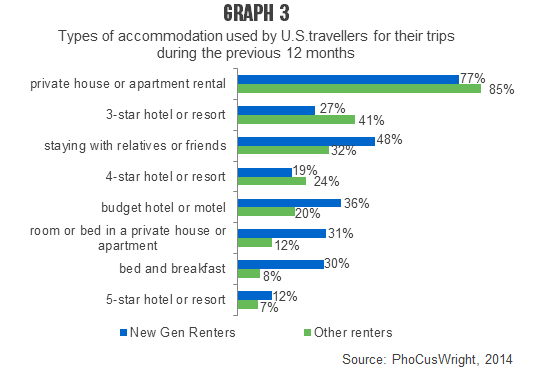
New Gen Renters tend to spend less on accommodation than other renters, since they are more likely to stay in budget hotels, bed and breakfasts or rooms, or else rent a bed in a private home (see Graph 3).

Note that PhoCusWright distinguishes between two types of rental accommodation: the one where the customer rents the entire residence from which the owner is usually absent (see “private house or apartment rental,” below); and the one where the renter only has access to part of the residence, and where the owner is usually present during the rental period (see “room or bed in a private house or apartment,” below). The latter type can be found on websites such as Airbnb, but is completely absent from websites such as HomeAway, that specialize in the first type of rental accommodation.

AL_Airbnb_1_anglais_graph_3

Why choose a rental over hotel accommodation?

The three main deciding factors for all renters are that they can find similar facilities and equipment to those at home, that they have more space, and that the rental can accommodate more people (see Graph 4). However, New Gen Renters particularly like the fact that rentals provide more freedom and privacy than a hotel room, that they offer a more relaxed ambiance, and that they are generally less expensive.

AL_Airbnb_1_anglais_graph_4

How will hotel owners react?

Should hotel owners be alarmed at the prospect of losing part of their clientele to private accommodation? According to PhoCusWright, 82% of non-renters did not even consider the rental option for their trips during the previous 12 months. However, hotel operators would do well to adapt to these New Gen Renters because, although rentals may better meet their needs, they nevertheless use different types of accommodation when travelling.

A second analysis examines the online planning and booking habits of this New Generation, and looks at possible ways of resolving the concerns of the hotel industry.


Image à la une: © BY NC Melies The Bunny

Catégories
Trends

Dance ‘til dawn with party tourism

Who are these revellers?

Generally aged 18 to 35 years, party tourists travel in groups of friends, often of the same gender. Their stays are relatively short (3 to 5 days) and focus primarily on a destination’s nightlife, i.e., its bars, nightclubs and lively beaches.

Key to the choice of a party tourism destination is the social aspect. Party tourists opt for trendy destinations and like sharing their trips on social media. During their stay, these night owls can act like stars or millionaires by frequenting « hot » spots, drinking excessively and adopting behaviours they would not normally engage in. In New York City, visitors spend seven times more than residents do at night.

Marketing plays a major role in this, and a destination must position itself to attract its target clientele. The question is, should destinations be elitist or open to everyone? In Saint-Tropez, it’s hard to take full advantage of the nightlife unless one is some sort of VIP. In Ibiza, on the other hand, middle-class students rub shoulders with members of the jet set.

Strategies adopted by successful destinations

The « Movida » in Spain

With major cities like Madrid, Barcelona, Ibiza and Valencia, Spain is a particularly attractive destination for night owls. Its trademark is its openness, wide variety of venues and the world-class DJs working in its clubs. Dance clubs are open until 6 or 7 in the morning, and the subway and buses run all night long. The marketing campaign of the Tourist Office of Spain promotes all this on the organization’s Website.

CD_Tourisme_festif_image_1

Source: ©Instituto de Turismo de España (TURESPAÑA)

Berlin’s underground culture

Berlin’s cultural scene has thrived since the fall of the Wall and is now reclaiming the city. Converted spaces are all the rage: dance clubs have been set up in former factories, the vaults of shuttered banks, abandoned pools and disused buildings from the Communist era. Berlin plays up its « underground » reputation, vibrant LGBT* scene, extensive transit system and world-renowned techno music. Its tourist office even links to a Website, called clubMATCHER, which helps visitors find the club most suited to their style.

CD_Tourisme_festif_image_2

Source: clubMATCHER

London’s cutting edge club scene

The hub of western culture, London is home to a wide variety of dance clubs, running the gamut of musical styles. Taking part in this « clubbing culture » gives visiting revellers an excellent way to meet locals: Londoners spend a quarter of their income on going out, and nearly 500,000 people pass through the clubs of the British capital on any given Saturday night. An interesting initiative is Surya, a club that embraces the trend of sustainable development; its dance floor generates energy from the dancers’ movements.

CD_Tourisme_festif_image_3

Amsterdam’s free spirit

Amsterdam has a well-established reputation for lively nightlife. The city is known for its liberal attitudes, as well as its safety, cleanliness and hospitality. At all hours, visitors can easily get around by bike or public transit. Despite a relatively undeveloped music scene, Amsterdam clubs play host to well-known DJs and attract visitors looking for new experiences that are often prohibited in their country of origin.

The vices of Las Vegas

In Sin City, the ultimate fun destination, clubs stay open all night and revellers can buy alcohol at any hour of the day. To compensate for falling gambling revenues and attract young adults, the city has promoted the development of party tourism. More and more casinos are opening their own nightclubs and visitors want to live the life of the rich and famous during their stay. Anything goes because, after all, what happens in Vegas, stays in Vegas…

Montreal hospitality

The city owes its party reputation to its relaxed and open atmosphere, as well as to large-scale international events popular with clubbers like the Bal en Blanc (White Party) and the Black & Blue Festival. The city benefits from its proximity to the United States and attracts fun-seeking Americans under the age of 21. According to Tourisme Montréal, CNN Travel ranked Montreal number 7 on a list of the world’s 10 best nightlife cities in 2012.

Party tourism requires good planning

Nightlife cannot be organized and promoted without regulatory support. By-laws governing the sale of alcohol and the business hours of nightclubs have a definite influence on a destination’s ambience. The challenge is to successfully reconcile the world of night owls with that of sleepers. The examples provided above illustrate the importance of offering diverse products adapted to this particular niche tourism market. When opting for a holiday focussed on nightlife, travellers look for public transit and open-minded locals. Finally, it is essential that a destination be able to ensure the safety of its visitors, as well as residents, and successfully deal with the excesses associated with this type of travel (i.e., drugs and alcohol). These vacationers do not, however, want to feel inhibited, because the key to their fun is the ability to really cut loose.

Throughout the year, party tourism attracts big-spending visitors, which helps offset the phenomenon of seasonal variation. In conjunction with more traditional forms of tourism, it can also encourage more direct and authentic interactions between visitors and locals. Finally, this sector’s association with the cultural scene energizes destinations, thereby making them more attractive to other customer segments.

* LGBT market: lesbian, gay, bisexual and transgender (see also: Fidèles, réceptifs et festifs: portrait des touristes LGBT américains).

Catégories
Marketing @en Products and activities

Adventure tourism goes sustainable

According to TripAdvisor, in 2012, 70% of American travellers said they planned to make more environmentally responsible travel choices in the next twelve months; for its part, Trendwatching predicted that in 2013, tourists will be trying to make more tangible, environmentally beneficial contributions to destinations. What follows are the trends and best practices of a promising niche: sustainable adventure tourism.

A booming market

Outdoor travel companies are becoming more and more profitable. In fact, according to a study from the Adventure Travel Trade Association (ATTA), 63% of adventure tour operators saw gross revenues increase in 2011. The study goes on to say that adventure tourism receipts went up by 17% between 2009 and 2010, indicating the market is in a growth phase.  The Adventure Tourism Development Index noted that, globally, one in four trips in 2011 included an adventure travel component. If this trend continues, adventure could be a reason behind nearly 50% of all trips by the year 2050.

Tourists increasingly sensitive to sustainability issues

Several 2012 studies reveal that consumer values are evolving; many of today’s travellers attach a great deal of importance to sustainable development.

  • The Global Corporate Citizenship Survey, an online survey of 28,000 consumers in 56 countries by research firm Nielsen, reports that two-thirds of individuals surveyed prefer to buy products and services from companies that benefit the host community. Furthermore, almost half of respondents were willing to pay more for services from such socially-conscious companies.
  • A TripAdvisor survey of 700 American travellers shows that 71% plan to engage in more environmentally responsible travel in the next twelve months.
  • A Travel Foundation report indicates that 70% of international tourists believe that businesses should be committed to preserving the environment.

In Quebec, according to the March 2011 Ipsos online survey conducted with the Tourism Intelligence Network (see: survey highlights in French), 43% of respondents consider respect for sustainable development principles as a primary factor in their decision to patronize a tourism company. Also, when selecting an online travel supplier, 38% of consumers prefer those that offer eco-friendly products and services.

The ATTA interviewed a number of adventure tour operators from Europe, North America and Latin America for their opinions on the industry’s current realities. Those surveyed mentioned, among other things, the growing importance of sustainable values among adventure travellers in the last few years. Other phenomena mentioned in these interviews support this trend:

  • the search for personalized, intense, authentic tourist experiences
  • an interest in local culture and the desire to give back to host communities
  • a concern for the environment and equity
  • an interest in health, physical activity and a « greener » lifestyle

According to Chris Doyle, ATTA Executive Director-Europe, the tourism industry must develop in a more responsible manner and redouble its efforts to preserve culture, flora and fauna. He adds that the best way for the industry to increase its impact is to convert travellers into defenders of destinations and their local cultures and environment. For this reason, more and more travel companies are adopting social and environmental best practices to meet the needs of adventure tourists.

Inspiring examples

The economic contribution of bicycle tourism

In addition to its limited ecological footprint and enhanced opportunities for interaction with local culture, the phenomenon of bicycle touring generates interesting economic benefits for rural communities. Since cyclists advance at a slower pace, they often spend their money in smaller municipalities, in other words, locations that are sometimes less popular with automobile tourists. The following clip clearly illustrates this reality.

le_tourisme_daventure_sur_la_voie_durable_image_3

Source: The Path Less Pedaled

In Brittany, towns that belong to the « Station verte » label (green resort villages) rely on bicycle touring to attract visitors. These destinations, which offer accommodations, services and nature activities, have created a 1,000-km route linking 30 stations vertes. The region is now developing other itineraries, given the success of the first one.

Hotels involved in their community

The Playa Nicuesa Rainforest Lodge, located on an island in Costa Rica, offers its clientele a « 5-leaf » experience, the country’s highest rating in the certification for sustainable tourism program. In addition to numerous traditional activities (hiking, kayaking, scuba diving, etc.), tourists can participate in discussions about ecology and even go and plant their own tree in the tropical forest!

le_tourisme_daventure_sur_la_voie_durable_image_1

Source: Playa Nicuesa Rainforest Lodge

Preservation as a prime concern

Clients of Aube Aventure, a company located in Gaspé, can enjoy sleeping in yurts as well as activities like sea kayaking and sailing. Winner of the Sustainable Development award from the city and chamber of commerce of Gaspé, Aube Aventure is known for its efforts to protect the environment and marine mammals as well as its contribution to the St. Lawrence Water Trail (route bleue). Its Quality Tourism Gaspésie certification guarantees the quality of its local services, facilities and menus. Aube Aventure is also a member of the Leave No Trace program, which aims to reduce the impact of outdoor activities on the natural environment.

 le_tourisme_daventure_sur_la_voie_durable_image_2

Source: Aube Aventure

Changes in consumer behaviour are influencing the development of many tourism companies, including some working in the outdoor travel industry. Which ones do you feel have done the most to adopt more sustainable products and services?

This article was written for the EspaceTourismeDurable.com Website, which serves tourism stakeholders in the Gaspé Peninsula and Magdalen Islands.

Catégories
etourism and technology Marketing @en

Instagram: A mobile partner for the tourism industry

With 40 million photos uploaded per day and 8500 « likes » and 1000 comments per second, the Instagram mobile application has become an essential tool for Marketing 2.0.

Named « Application of the Year » by Apple in 2011, Instagram has popularized the art of mobile phone photography, or iPhoneography, by enabling users to personalize and share their photos with others. Purchased by Facebook for US$1 billion in April 2012, a year later Instagram boasts a community of more than 100 million monthly active users.

Hugely popular among young adults, Instagram offers businesses an ideal opportunity to enhance their visibility and public relations, especially if their target public includes members of Generation Y. Many brands, including companies working in the tourism industry, have joined the network and made it part of their marketing strategy.

Instagram 101

For those of you unfamiliar with Instagram, here’s how it works:

  • After taking a picture using Instagram or selecting a saved photo from your phone, you can modify the final image with one of the application’s 18 automatic filters before sharing it with your network.

MLV_Instagram_image_1

  • Similar to Twitter, members subscribe to the accounts they want to follow and use #hashtags to label or describe their photos. Just like on Facebook, viewers can express appreciation for an image by « liking » it; they can also post comments.

MLV_Instagram_image_2

  • Moreover, the application can be used to share photos on other social platforms.

MLV_Instagram_image_3

  • Although Instagram does have a Web version, other Websites have adapted the mobile platform for larger screens, making it easier to navigate and manage your account: Webstagram, Statigram and Pintacular.

MLV_Instagram_image_4

Source: Pintacular

How can tourism businesses and organizations benefit from Instagram?

With Instagram, businesses have access to user-generated mobile-optimized content. A convergence of two major trends, the rise in visual marketing content and SoLoMo (see also: Vous avez dit SoLoMo?), this medium is generating interest in the tourism industry, which sees it as a new way for communicating with clients. Making Instagram part of your marketing strategy can provide the following benefits:

  • Develop your brand image. Instagram can introduce users to a variety of interesting photos associated with the brand or destination.
  • Strengthen customer relations. Analyzing Instagram photo searches can help businesses better understand their target clientele. They can use the application to interact with their target market and participate in conversations about certain images, thus reaching a different digital community to complement those in other social media.
  • Create visual content. An organization can repost the best user photos of its establishment or destination on its own account. When you do this, the firm Adviso suggests adding a message to the photo mentioning the name of the user who took the picture, to give photo credit. You can also include Instagram photo albums on your Facebook page, thereby increasing the amount of visual content shared with your fans.
  • Increase your mobile presence among travellers. Instagram can be useful at every stage of the travel cycle, not just during a stay. Its content can provide inspiration, encouragement and guidance during the planning stage, and keep a potential visitor connected with the destination or organization after the initial contact. It is an opportunity to increase one’s presence among connected customers.

How can individuals use Instagram in the context of tourism?

MLV_Instagram_image_6_ENG

What tourism businesses or destinations use Instagram?

The Canadian Tourism Commission has added Instagram to its social media strategy with the ExploreCanada account, which has nearly 15,000 followers. It invites members of the tourism industry to post images using the hashtag #ExploreCanada.

MLV_Instagram_image_7

Source: ExploreCanada

The destination management organizations of Nova Scotia, British Columbia and Alberta have also created hashtags to showcase their destinations.

MLV_Instagram_image_8

Source: #visitnovascotia, #tourismbc, #travelalberta on Instagram

Tourisme Montréal encourages the use of hashtag #MTL and incorporates user-generated Instagram photos in a page on its blog, Vivez Montreal/The Montreal Buzz. Some images are also reposted on its Facebook page or put together to form a special blog post. For summer 2013, the site has developed a strategy using the hashtag #mtlmoments on Instagram and Twitter.

MLV_Instagram_image_9

Source: The Montreal Buzz

The number of major hotel chains using Instagram more than quadrupled in one year, from 19% in 2011 to 82% in 2012, according to Digital IQ Index: Hotels 2013. Some brands, like the Shangri-La and Four Seasons, have come up with hashtags (#lovingthemoment and #FSFotog, respectively) to encourage guests to share photos of their hotel stays.

MLV_Instagram_image_10

Source: @althotel, @intercontinental and @fairmonthotels on Instagram

Furthermore, the ALT Hotel banner launched its second mobile photo contest, #ALTexpo, to create a mural of digital photos for the lobby of its new hotel at Halifax Stanfield International Airport. The video below presents a behind-the-scenes look at the first edition of the contest, organized for the ALT Hotel at Toronto Pearson International Airport:

<iframe width= »560″ height= »315″ src= »http://www.youtube.com/embed/Od3CEQRrXpU » frameborder= »0″ allowfullscreen></iframe>

www.youtube.com/watch?v=Od3CEQRrXpU

The application has also been enthusiastically adopted by the airlines, particularly Air Canada and WestJet.

MLV_Instagram_image_11

Source: @WestJet, @Air France and @AirCanada on Instagram

With an adoption rate of 18% in the United States, Instagram is still an emerging platform, currently used primarily by young people. Some 28% of Americans ages 18 to 29 used Instagram in 2012, compared to 14% of 30 to 49 year-olds and 3% of 50 to 64 year-olds. However, it has significant growth potential and relevance for tourism, which is reflected in its current popularity among numerous industry organizations.

Catégories
Accommodation

Ancillary revenues in the hotel industry

Mobile technology can help hoteliers increase their sales of ancillary products and services.

Though ancillary products and services (add-ons) were first introduced by the airlines, they are also sold by hotels, though less often. As long as hotels have the tools to promote such sales, there are numerous opportunities for increasing customer spending: fees for Internet, parking, breakfast, etc. Mobile technology is one such tool that can help boost additional revenues and enhance the customer’s hotel experience.

A practice used throughout the tourism industry

According to PhoCusWright, in 2011 U.S. hotels sold approximately US$1.85 billion in ancillary products and services, which accounted for 1.7% of the country’s total hotel revenues. Compared to the airline industry, a pioneer in the use of additional charges, the hotel sector is not very active. In fact, according to Amadeus, U.S. carriers generated $12.5 billion in ancillary revenues in 2011, representing an average 12% of a company’s operating results. The Forrester and Amadeus firms estimate that by the year 2015, ancillary sales will account for more than 18% of a tourism business’ total revenues.

What are these ancillary products and services?

In the hotel sector, rooms are the core product. All related products and services like food and drink, upgrades, and Internet, cancellation or early departure fees (see Table 1) generate ancillary revenues (see also: La «montée en gamme» ou comment générer des revenus supplémentaires tout en augmentant la satisfaction de la clientèle). They are supplied by the hotel itself or outside service providers (see also: La vente croisée: une source de revenu encore peu exploitée par l’industrie touristique), and are suggested by hotel employees, call centres or delivered automatically via technology.

AL_RevenusComplementaires_tab1_ENG

Mobile technology and its benefits for hotels

While hotel options can be purchased before (e.g., upgrade) or after the client’s stay (customized promotion for the next stay), the time to maximize ancillary revenues is when the client is actually present in the hotel.


According to PhoCusWright, mobile technology appears to be one means of accomplishing this by increasing the visibility of ancillary products and services at each point of contact with guests. Hotels with their own app or mobile website version can make customized, location-based offerings available on smart phones and tablets. Hotels have already realized the importance of this market, for many of them have added a tool for reserving spa treatments or ordering in-room services to their mobile site or app.

The many uses of mobile devices in hotels

When hotel in-room tablets are available, they boost sales of in-room services and on-demand films and games. QR codes can be placed in various locations throughout the establishment to facilitate communication AL_RevenusComplementaires_image1with guests, encourage customer feedback and promote specials at the restaurant or souvenir shop. Mobile payments using NFC technology (see also: La tendance cash-less gagne l’industrie touristique) also help hoteliers sell more ancillary products. Finally, hotels who belong to location-based social networking sites like Foursquare can use them to share promotions that entice clients to spend more (get the second breakfast free, two drinks for the price of one, etc.).

Micros’ MyStayManager application organizes a guest’s entire hotel stay: reservation, additional products and services as needed, check-in, in-room services, wake-up call, spa reservation, view of final bill and check-out. Hotels can send targeted promotions to each guest by email or text message, inviting them to take advantage of the services and products available in the establishment.

How can hotels increase ancillary revenues?

It is not easy to make ancillary sales.  Here are the challenges facing both managers and third parties:

  • Determine points of contact and the customer profile

PhoCusWright has identified the points of contact for each stage of the travel cycle (see Table 2), and there are numerous opportunities for hotels to increase ancillary sales. The firm recommends that hotels make greater use of « up-selling » when rooms are reserved, just like airlines do. According to Valyn Perini, CEO of OpenTravel Alliance, they can then make more offers between the booking date and arrival date.

AL_RevenusComplementaires_tab2_ENG

  • Have the right technology

The global distribution systems (GDS) of traditional travel agencies, online agencies and meta-search engines do not provide customers with access to all ancillary hotel products and services. This means that hotel managers have a competitive edge, if they can offer these products on their hotel website and they have high-performance management systems (see also: Technologies en hôtellerie: regard sur les systèmes de gestion).

  • Manage inventory and availability

Hotels must assess their potential future sales and anticipate how much inventory is needed. Some products are limited in number (e.g., spa treatments), while others can be sold without restriction (e.g., breakfast). It is also essential that product and service availability be updated in all reservation systems.

  • Other obstacles

Hoteliers hesitate to make ancillary products and services accessible via third-party distribution channels, because of the commission charged. Moreover, business travel agencies like Carlson Wagonlit Travel and American Express are not likely to suggest these options, because their clients are used to getting services comped in hotels and thus do not feel like they should pay.

Is there a magic formula?

To increase its ancillary revenues, an establishment must meet certain conditions: communicate effectively with its clients, know their preferences and needs, multiply opportunities for interaction, and adopt mobile technology and payment. If hoteliers suggest personalized products and services adapted to the traveller’s current stage (before, during or after the stay), these products will be perceived as value-added services and not sales.


Sources:

– Amadeus. « Airline ancillary revenue soars to $32.5 billion worldwide in 2011, » amadeus.com, 19 October 2011.

– Dandapani, Vijay. « Pricing Ancillary Goods and Services, » 4hoteliers.com, 6 March 2013.

– Google and Nielsen. « Mobile Search Moments – Understanding How Mobile Drives Conversions,« , google.com, March 2013.

– Juman, David and Ralph Merten. « Tee Times & Touchscreens: Hotels Leverage Mobile to Drive Ancillary Sales » insider.phocuswright.com, 13 February 2013.

– Merten, Ralph. « Hotel Ancillary Revenue in Europe, » PhoCusWright, January 2013.

– Samuels, Gerry. « Can mobile change the way travellers feel about ancillary products? » tnooz.com, 2 June 2011.

– Turner, Shawn A. «Hotel ancillary revenue model questioned, » hotelnewsnow.com, 9 March 2011.


Catégories
Customer segments

The growing solo travel market

Solo travellers come in all different types and the Quebec tourism industry must adapt to attract this booming clientele. Although solo tourists obviously travel alone, they often travel in groups, as contradictory as this may seem. In fact, many travel specialists (tour operators and DMOs) are noticing that solo travellers wanting to experience new places with other people who share their interests now constitute a larger proportion of their group clientele.

Single travellers are a growing market segment. More and more people are single by choice at various stages of life because of marrying later, getting divorced, losing a spouse, etc., contributing to the rise in one-person households:

  • one-person households account, on average, for 35% of all households in developed countries
  • in Finland and Norway, this average is about 40% (2011)
  • in the Netherlands, it is 37% (2011)
  • in the United States (27% in 2010) and United Kingdom (29% in 2011), the percentages are similar to that in Canada (28% in 2011)
  • in Quebec, the proportion of one-person households is 32% (2011)

Definitions, characteristics and behaviour of solo travellers

A solo traveller is, by definition, a person travelling alone… but not always! According to Statistics Canada, a person is considered to be « travelling alone » if not accompanied by another member of the same household; for example, people travelling with friends or in a group are considered solo travellers if they are unable to provide any information on the expenditures and activities of the people accompanying them.

With this in mind, researchers from the University of St. Gallen in Switzerland have identified four categories of solo travellers:

  • single-solo: live alone and travel alone
  • single-group: live alone, but travel in a group of more than six people
  • collective-solo: live in a multi-person household, but travel alone
  • collective-group: live with others, but travel without them in a group of more than six people

Here are some characteristics of these different categories (see Table 1):

  • single people travelling alone or in a group are primarily older women, while those in the other two categories are primarily young men
  • solo travellers tend to take shorter trips than other travellers, with the exception of the collective-solo category
  • preferred type of accommodation:
    • with friends or family (single-solo)
    • vacation homes (collective-solo)
    • hotels (the other two segments)
  • type of trip:
    • visits with family and friends (single-solo)
    • city and shopping trips as well as cruises and beach holidays (collective-solo)
    • sightseeing tours (single-group)
    • events and sports vacations (collective-group)
  • The two categories of solo travellers who travel in groups (collective and single) look for travel information from friends and family as well as promotional materials from tour operators

CN_Voyageur_solo_Table1_eng

More and more individual travellers are visiting Quebec

In this section, we have chosen to examine only individuals travelling alone, not in a group of any kind.

In 2010, Canadians who travelled alone in Quebec made nearly three million leisure person-trips of one or more nights, accounting for 34% of all stays. Note that Quebeckers made up 83% of these solo travellers.

Of the Americans who made a leisure trip to the province, only 13% travelled alone in 2011. Maine residents travelled alone the most often in the province, representing 20% of all lone American visitors. However, the number of potential visitors is much larger. In fact, according to the Office of Travel and Tourism Industries, 38% of the Americans who travelled overseas in 2011 for leisure and to visit family and friends did so alone.

On average, one out of five leisure visitors from the top European tourist-generating countries who visited Quebec for one or more nights in 2011 travelled alone, while among Chinese and Brazilian tourists, these visitors made up the majority, or 60%.

Finally, from 2006 to 2011, the number of solo travellers from overseas and the U.S. recorded very strong growth (21% and 55%), while total arrivals fell. This was particularly remarkable in the case of American travellers (see Table 2).

CN_Voyageur_solo_Table2_eng

Examples of market adaptation

Many tour operators such as Abercrombie & Kent, a company specialized in luxury travel and safaris, have eliminated supplements for solo travellers or reduced such fees by 50 to 75%. Other companies offer to find their solo clients a roommate and then reduce their rate by 50%.

Many cruise lines have also done away with the single supplement or reduced it for certain cabin categories — often the least expensive — or specific destinations. In 2010, Norwegian Cruise Line (NCL) was the first to offer 128 studio-style cabins for solo travellers at no extra cost on the Norwegian Epic. It also created a lounge area designed especially for solo travellers to socialize. These individual cabins have been so successful that NCL has decided to offer another 59 studios on the Norwegian Breakaway, which sets sail in May 2013.

 CN_Voyageurs_Solos_image1

Source: Norwegian Cruise Lines, Studio for solo cruise traveller

Tour operators like Singles Travel International have created a social network where solo travellers of all stripes can do things like share their interests, favourite activities and destinations visited and meet potential travel partners. Airlines such as Air Baltic, KLM and Malaysia Airlines and new applications (SeatID,

CN_Voyageurs_Solos_image2

Planely, Facebelt) enable solo travellers to select a seatmate based on their social network profile. Others, like Maiden Voyage, are a network of for female business travellers who would like to network and socialize at their destination. How will you take steps to attract this clientele?


Sources:

– Fox, Jena Tesse. « Travel for One » Travel Agent Central, February 15, 2012.

– Laesser, Christian, Pietro Beritelli and Thomas Bieger. « Solo travel: Explorative insights from a mature market (Switzerland), » Journal of Vacation Marketing, Vol. 15, no. 3, p. 217- 227.

– Légaré, Odile. « Perspectives démographiques 2006-2056 et logement: un aperçu » Habitation Québec; Le bulletin d’information de la Société d’habitation du Québec, Vol. 4, no. 4, Summer 2010.

– Lenhart, Maria. « Solo Travel is booming and suppliers are responding » Travelmarketreport, October 20, 2011.

– Office of Travel and Tourism Industries. « Profile of U.S. Travelers Visiting Overseas Destinations: 2011« 

– Statistics Canada. « Canadian households in 2011: Type and growth. Families, households and marital status, 2011 Census of Population » September 2012.

– Statistics Canada. « International Travel Survey » and « Travel Survey of Residents of Canada, » 2007 to 2011.

Catégories
Management

Using Technology to Measure Tourist Traffic (Records of 2012 Symposium)

Measuring visitor traffic and profiles at tourism destinations was the focus of discussions at the Symposium of the Transat Chair in Tourism of UQAM’s ESG, which took place last September in Montreal. Some destinations give their tourists GPS sensors and mobile applications so that movements, habits, and impressions can be tracked during their stay. Others encourage lodging establishments and tourist attractions to use software that enables front-line staffers to poll travelers, then transmit the information directly to the organization that will process it. Following are the examples of two research organizations – one in Spain, the other in Belgium – which use technology to facilitate data collection, increase its validity, and disseminate the findings quickly.

Sensors to follow tourists’ actions

Analyzing tourist traffic at a destination is a complex yet necessary task if we are to understand the dynamics that inform the traveler’s experience. What attractions and places does he visit; how much time does he devote to each; which routes does he take; at what pace does he travel? Until recently, few tools existed to truly measure this movement, other than statistics on attraction attendance figures, which remain static indicators.

For this reason, the CICtourGUNE research team in Spain’s Basque Country, led by Ms. Aurkene Alzua-Sorzabal, developed the eGIStour system. The system is designed to measure movement while including the tourists’ profiles, habits, and impressions of their experience. In specific terms: designated travelers are given a small device that tracks their movements. They will have previously completed a short Web-based questionnaire about their personal profile, motivations, length of stay, composition of their group, etc. The image below illustrates the movements of visitors equipped with the eGIStour system in the Spanish city of San Sebastian.

Source: CICtourGUNE

Some benefits of this approach:

  • • understanding of the time spent on each tourist activity within a given time frame;
  • • measurement of the range of the destination in terms of real mobility;
  • • identification of most-visited and less-visited places;
  • • analysis of behavioural differences by visitor type.

An application to measure enjoyment of the experience

The traveler equipped with a sensor can also record real-time impressions by using a mobile application. The GPS detects the attraction the participant is visiting and, for example, the visitor might be asked to indicate his degree of appreciation for the site. Once the device is connected to the Internet, that information is sent to the research centre for analysis. The Emotionmeter (see image below) is a variation on this type of application, which can be adapted to suit an organization’s requirements.

Source: CICtourGUNE

This is an entirely new approach to tourism research. As Ms. Alzua-Sorzabal has said, the pairing of science and technology should begin to play a major role in the development of standards.

Connecting the tourism industry to a single platform: the Wallonia example

The Wallonia Tourism Observatory (WTO) recently developed four new data-gathering and dissemination tools. Behind these tools are two software programs designed to collate statistics in real time. The data are analyzed within days of being collected by Observatory experts. Ms. Véronique Cosse, head of the Observatory, presented the salient features of these new information-collection systems.

The Webropol platform is an online survey software program. The WTO uses it primarily to create newsletters that quantify tourism performance during vacations. With Webropol, these post-vacation barometers are enhanced by the following characteristics:

  • • comprises the touristic performance of a large number of businesses – scientific survey sent to some 1,800 operators;
  • • lists several indicators, such as vacancy rate, number and origin of visitors, traffic growth, operator satisfaction with their performance;
  • • enjoys a higher participation level than traditional methods (paper questionnaire);
  • • can be created quickly, since it only takes about two days to process the information and enables the production of automated reports.

The table below shows the type of information contained in the post-vacation barometers. These reports were presented in September 2012 and illustrate the results for August 2012 for the Wallonia region.

August 2012 report

Source: Wallonia Tourism Observatory

The great majority of occupants of Wallonian lodgings were the Flemish, accounting for 39% of total clients. They were followed by the Dutch, who represented 26% of clients. We then note Walloons (15%), residents of Brussels (7%), and the French (6%).

Source: Wallonia Tourism Observatory

62% of clients at attractions were composed of Belgians: 35% Walloons, 22% Flemish, and 5% from Brussels. Nonetheless, the Dutch accounted for 17% of the total visitor number, while the French represented just 11% and the Germans, 2%.


The second program, Windbill, is incorporated into the ticket operations of tourist attractions and museums in the region. Eighty businesses are using the system at present. It is designed to allow front-line personnel, when selling a ticket, to record some information about the visitor’s profile, such as place of origin and whether he is a child, adult or senior. The Windbill program automatically creates monthly folders that can be sent to the WTO with one click. The information – simple, and quickly gleaned from the client – not only allows a business to systematically identify the composition of its client base, but gives the region a way to easily and rapidly create a portrait of its tourism traffic. The image below illustrates the Windbill interface.

Source: Observatoire du Tourisme Wallon

A question of collaboration

Whether it be the approach of the Wallonia Tourism Observatory or that of CICtourGUNE, collaboration between tourism businesses is indispensable. In the WTO example, sharing of information is a crucial issue. It requires powers of persuasion and ensuring that the information transmitted is treated confidentially; it must be shown that findings, always published in an aggregated manner, allow each partner and the industry overall to improve competitiveness.


Sources:

Presentations made at the Transat Chair in Tourism 2012 Symposium on Measuring the Performance and Economic Contribution of Tourism, Montreal, September 24 and 25, 2012:

• Alzua-Sorzabal, Aurkene. “New Technology and Innovations in the Measurement Tools Used to Evaluate Tourism Performance

• Cosse, Véronique. “Innovation in the Measurement of Tourist Traffic – the Wallonia Example”


Websites:

CICtourGUNE

Wallonia Tourism Observatory

Click here to view the conferences:

– 2012 Symposium – Conference of Aurkene Alzua-Sorzabal

– 2012 Symposium –Tourism Indicators: New Approaches, Technical Considerations, Case Studies

Read also:

Lessard, France. «Tourism businesses as key drivers of economic development – A Symposium on measuring the performance nd economic contribution of Toursim – background document», 2012.

Catégories
Around the world Products and activities

Urban creativity in the spotlight!

Over half of the world’s population lives in urban areas. By the year 2050, this percentage is expected to climb to 70%, while in North America alone, it will reach 90%! City-dwellers are already exposed to a dizzying array of options when it comes to recreational activities, entertainment, socializing and experiences of all kinds. Harbour swimming, rooftop hiking tours and camping in a chic hotel are just a few eloquent examples of urban creativity. Often urbanites themselves, tourists want to experience the city as residents do, visiting their haunts and discovering their well-kept secrets. The following article provides a quick overview of initiatives outside Quebec that help define a city’s personality and make it more dynamic for residents and tourists alike.

Harbour swimming

Since 2002, following major investments to clean up the water, it has been possible to swim in Copenhagen Harbour, the former site of significant industrial activity. An area of the city’s waterfront has been completely transformed and its new uses now include swimming and boating. Wooden boardwalks outline the swimming areas and a boat-shaped structure is used as a diving platform. The facilities are very popular during the summer months.


Source: R&R Associates

Breathtaking experiences

Have you ever wanted to climb up a rollercoaster…on foot? A sculpture built in the city of Duisberg, Germany, lets visitors do just that. Eleven metres high, this walkway offers visitors a unique view of the surrounding area. Located on a knoll atop an old zinc production site, the work of art is composed of steel and zinc.

Source: Inhabitat

For the past several years, visitors have been able to explore the city of Stockholm from the rooftops. Participants in this very special guided tour must don a harness and pull a safety cable along with them as they stroll above the city and take in the fabulous views while listening to commentary from a guide. Talk about a unique memorable experience!

Source: Visit Stockholm

Also in Stockholm, sightseers can ride two spherical glass gondolas to the top of the Ericsson Globe, the city’s major indoor sports and entertainment facility. In operation since 2010, SkyView offers an incredible birds-eye view of the city, a little like the funicular on the Olympic Stadium Tower in Montreal.

Source: Visit Stockholm

Urban camping

In the heart of Brooklyn, New York, the site of an old airport is set to become the largest urban campground in the United States. The National Park Service is planning to create approximately 600 campsites, making this location the ultimate in urban camping.

To satisfy the desire for outdoor urban experiences and, more importantly, offer something out of the ordinary, some hotels are inviting their guests to sleep in a tent. At Affinia Gardens in Manhattan, people staying in suites can sleep in a tent on their terrace and enjoy a s’mores-making kit (marshmallows, chocolate and graham crackers). Many visitors think that camping out in the heart of downtown New York City seems like fun.


Source: USA Today Travel

A different way to discover art and history

The Arenc Grain Silo in the French port of Marseille, listed as a 20th-century heritage building, has been turned into a concert hall. While retaining the building’s original façade of half-cylinders, the renovation opened them up with large windows. The ultra-modern theatre can seat 2,000 spectators. Built in 1926, the colossal structure was saved from demolition in 1996 and protected by a heritage rating. Nicknamed the “Olympia sur mer” in reference to Paris’ famous music hall, the theatre opened in September 2011.


Source: Ministère de la Culture et de la Communication et TreeHugger

In downtown Rouen, France, a fake radar device signals pedestrians to slow down so they can appreciate the city’s urban heritage. Entitled “zone 3,” this amusing project was developed by an artist as part of the contemporary art festival, “Rouen impressionnée.” When people walk faster than 3 km/hour, the “radar” flashes to indicate that they are moving too quickly. The humorous installation is accompanied by an explanatory sign.


© AFP   Source: Cyberpresse

The idea of surprising people in their daily travels has also been taken up by another art festival. As part of Chicago’s Art on Track festival, artists invade the subway with their creations. One Saturday, a train car wound its way through the city disguised as a mobile garden, with its floor and seats covered with a thick layer of grass that invited passengers to take a seat.

Source: Inhabitat

Calling all creative cities!

The cities of Quebec are also engaged in urban creativity. Competition among destinations is fierce and the world is becoming increasingly urbanized. To make our cities stimulating places to live and attractive destinations to visit, we must encourage artists, designers, architects and other creative thinkers to contribute to their growth and development (See: La créativite au service du développement urbain compte rendu de conférence).


Sources

– Agence France-Presse. «Un radar pour inviter les piétons à ralentir…», cyberpresse.ca, november 15, 2011.

– Glow, Justin. «Floating Swimming Pool Spotted in Germany», www.gadling.com, july 17, 2007.

– Guyennon, Patrick. «Marseille: un ancien silo à grains transformé en salle de spectacle», Urbanews.fr, september 22, 2011.

– Gwiazdzinski, Luc. «Ephemeral, Festive and Event-orientedCities», présenté à l’occasion de la table ronde intitulée New Times, New UrbanTourism Destinations du séminaire Urbantourism, heritage and urbanquality in Europe à Rennes, march 2009.

– Hattam, Jennifer. «Huge New Urban Campground Planned for Brooklyn», www.treehugger.com, june 15, 2011.

– Jones, Charisse. «Hotels offer visitors a chance to snooze under the moonlight», USA TODAY, agust 1st, 2011.

– Morgan, Helen. «Germany’s Roller Coaster Walkway Thrills Visitors with Views to The Surrounding Landscape», inhabitat.com,  november 20, 2011.

– Trendwatching.com. «CityLights», Trend Report 2012, november, 2011.

– Zimmer, Lori. «Chicago Subway Train Transformed Into Lush Mobile Garden on Wheels!», inhabitat.com, september 19, 2011.

Websites

Badeschiff

Skyview

Stockhlom Roof Top Hiking

World Urbanisation Prospects: