Catégories
Accommodation etourism and technology

Online Behaviour of Airbnb Travellers

The private accommodation rental market has not escaped the tidal wave of online information that brings us to today’s diversified offer on a number of specialized sites. The PhoCusWright study states that, in the United States, the penetration rate of these online reservations has gone from 12% in 2008 to 24% in 2012. The arrival of start-ups in the collaborative economy, such as Airbnb, and the improvement of already well-established sites in this market, such as HomeAway, have helped accelerate this trend.

This trend gave rise to a new generation of renters, or “New Gen Renters,” whose travel behaviour differs from that of travellers who use other types of accommodation. This distinction was made following an analysis of these travellers, that was based on a PhoCusWright study of their online planning and booking habits. The results of that study are described below.

AL_Airbnb_2_encadre_anglais

New Gen Renters very active online

When planning their leisure trips, New Gen Renters are more likely to search the Web on a mobile device (32%) or a tablet (29%) than other renters (see Graph No. 1). They also more frequently use other sources of information, such as recommendations from relatives and friends, online advertising and promotional emails. The behaviour of other renters more closely resembles that of other travellers who do not rent private accommodation.

AL_Airbnb_2_graph_1_anglais

New Gen Renters browse more sites to compare and choose the various components of their trip

All three categories of traveller primarily access the same sources for their online trip planning (see Graph No. 2). Online travel agencies such as Expedia or Priceline came first, followed by search engines and comment sites such as TripAdvisor. However, New Gen Renters browse more sites to compare and choose the various components of their trip. Almost 40% of these new renters use social media, compared to 11% of other renters and 12% of non-renters. This gap also holds true for travel guide sites and online magazines, news websites and private accommodation rental websites – although the latter category is also accessed by a significant proportion (20%) of other renters.

AL_Airbnb_2_graph_2_anglais

What online content are they looking for?

New Gen Renters have a strong appetite for online travel content (se       e Graph No. 3). They access comments and opinions, professional and amateur photos and videos, and supplier posts to plan at least half of their stays. They are far more likely than other renters and non-renters to view this information on social media.

AL_Airbnb_2_graph_3_anglais

Inspiration and personalization

The inspirational aspect of the site is very important for this new generation. Indeed, 41% of them look for new trip ideas online, whereas this objective is only shared by 28% of other renters and 29% of non-renters. This group is also looking for a more personalized web browsing experience than the other traveller groups, with 27% preferring a site that saves their personal information in order to recognize them on subsequent visits, compared with 12% of other renters and 9% of non-renters.

New Gen Renters are spontaneous

The “other renters” category books its stays further in advance than other segments: 57% do so at least one month before departure, whereas only 41% of New Gen Renters and half of non-renters adopt similar behaviour (see Graph No. 4). In fact, there are proportionally more last-minute New Gen travellers, as 43% of them book less than three weeks before their trip is due to start, compared to 33% of other renters and 31% of non-renters.

AL_Airbnb_2_graph_4_anglais

Keen collaborative consumers

According to PhoCusWright, New Gen Renters tend to use collaborative sites such as Airbnb to book their accommodation. This segment is also attracted by a similar approach to getting around: 21% of these avid users of new technology used a car-sharing app during their stay, compared to a fairly low percentage (6%) of other renters, and only 2% of non-renters. They are also more likely (25% compared to 11% and 6%, respectively) to have used app-based rideshare services such as Uber and Sidecar.

Should the traditional hotel market be concerned?

According to PhoCusWright’s probability calculations based on the frequency of travellers’ leisure trips, it seems that each time a traveller rents private accommodation, the chances he or she will book a hotel room within the same year drop by 24%. Similarly, if a traveller stays in two rentals over the course of the year, the chances he or she will stay in a hotel drop by 50%. In other words, the more often travellers stay in private accommodation, the less likely they are to book a hotel room. While this statement may alarm hotel owners, they should remember that, in 2013, only 14% of U.S. travellers rented a private house or apartment, and only 3% booked a room or a bed in a private home. In fact, it was the least popular type of accommodation.

Fundamental shift or passing trend?

Will the advocates of collaborative consumption – largely members of Generation Y – continue to travel this way as they grow older? It is difficult to predict the future, but one thing is certain: their use of the Internet and an array of technological tools is permanently rooted in their travel behaviour. Accommodation providers therefore have no choice but to react – and adapt to! – this enduring trend!


Image à la une: © istockphoto

Catégories
Accommodation etourism and technology

Who are these travellers booking on Airbnb?

Renting short-term lodging has become an increasingly common accommodation choice for travellers, made popular by the advent of websites such as Airbnb. A survey conducted in the U.S. by PhoCusWright profiles these users and defines their behaviour as it compares to that of other traveller groups.

Methodology

The web survey was conducted in February and March 2014 among 1,880 American respondents who had made at least one leisure trip during the previous 12 months. To be eligible for the survey, they had to have reserved commercial accommodation and planned the trip themselves. The company identified two categories of traveller: those who rented private accommodation (room, house or apartment), i.e., the renters (17%), and those who booked other types of accommodation for their stay (non-renters; 83%).

Young travellers with a good income

A number of factors separate the renters from the non-renters: over half (51%) of U.S. travellers who rented private accommodation during the previous year were under 35, compared to 38% of travellers who booked another type of accommodation (see Graph 1).

AL_Airbnb_1_anglais_graph_1

There was also a definite difference in earnings between the two traveller groups: 33% of non-renters had an annual household income of less than US$50,000, compared to 24% of renters. Also, the proportion of the latter group with incomes between $50,000 and $125,000 is higher than it is among non-renters, indicating that, generally speaking, renters are more prosperous than other traveller group.

Renters travel for longer and are more active

Almost two out of three renters (63%) travelled for one or two weeks during the previous year, while only 43% of non-renters were away for the same period of time. Furthermore, the first group made more trips abroad (42%, compared to 31%).

Aside from flights, renters are proportionally more likely than the other group to book several components of their trip (car rental, package, cruise, train, visit). This fact makes them more active travellers, who tend to do more (see Graph 2).

AL_Airbnb_1_anglais_graph_2The “New Generation of Renters” – a distinct category
Among the travellers who rented a private room, house or apartment during the past year, PhoCusWright has defined a new category of traveller that it calls “New Gen Renters.” Between 18 and 34, these travellers represent 31% of all renters and see themselves as avid users of new technology.

This group spends more on vacations and travels more frequently. In fact, a typical household in this category allocates an average of US$4,338 per year to travel, compared to US$3,743 for the other renters and US$3,153 for non-renters. Furthermore, 27% of these travellers have made at least six trips during the previous year, compared to 15% of the other renters and 9% of non-renters.

New Gen travel behaviour

Several aspects of New Gen travel behaviour distinguish this group from other travellers, such as:

  • They want to explore the destination as much as possible: meet new people and share their experiences with them;
  • They are spontaneous, travelling as soon as they have the means to do so;
  • When staying in commercial accommodation, they seek out stylish, smaller hotels;
  • They like to travel alone or with friends.

Preferred types of accommodation

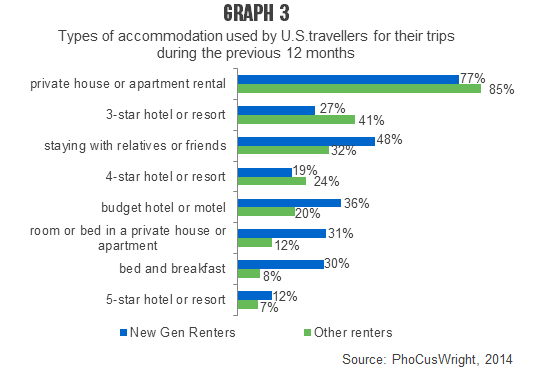
New Gen Renters tend to spend less on accommodation than other renters, since they are more likely to stay in budget hotels, bed and breakfasts or rooms, or else rent a bed in a private home (see Graph 3).

Note that PhoCusWright distinguishes between two types of rental accommodation: the one where the customer rents the entire residence from which the owner is usually absent (see “private house or apartment rental,” below); and the one where the renter only has access to part of the residence, and where the owner is usually present during the rental period (see “room or bed in a private house or apartment,” below). The latter type can be found on websites such as Airbnb, but is completely absent from websites such as HomeAway, that specialize in the first type of rental accommodation.

AL_Airbnb_1_anglais_graph_3

Why choose a rental over hotel accommodation?

The three main deciding factors for all renters are that they can find similar facilities and equipment to those at home, that they have more space, and that the rental can accommodate more people (see Graph 4). However, New Gen Renters particularly like the fact that rentals provide more freedom and privacy than a hotel room, that they offer a more relaxed ambiance, and that they are generally less expensive.

AL_Airbnb_1_anglais_graph_4

How will hotel owners react?

Should hotel owners be alarmed at the prospect of losing part of their clientele to private accommodation? According to PhoCusWright, 82% of non-renters did not even consider the rental option for their trips during the previous 12 months. However, hotel operators would do well to adapt to these New Gen Renters because, although rentals may better meet their needs, they nevertheless use different types of accommodation when travelling.

A second analysis examines the online planning and booking habits of this New Generation, and looks at possible ways of resolving the concerns of the hotel industry.


Image à la une: © BY NC Melies The Bunny

Catégories
Management Trends

The vogue of low-cost travel

Low-cost tourism providers are now attracting a variety of customer segments. This is because their business model has gone upscale, offering a wider selection of improved products and services while keeping prices low. This success is the envy of other companies that are now trying to enter this niche market.

Airlines

Some 15 years ago, the airline industry was turned upside down by the arrival of low-cost carriers and their success continues to grow. According to Euromonitor, these companies have seen their market share and popularity increase every year, putting them into direct competition with regular carriers. In November 2013, they accounted for 20% of all flights and 25% of weekly seats, globally.  

Their development and price strategies have undergone a number of changes. While the « ultra low-cost » model, popularized by Spirit Airlines and Allegiant Air, continues to make inroads in the United States, European low-cost carriers seem to be moving towards the « middle cost » model adopted by easyJet.

With the former business model, a carrier will sell tickets at a very low price and then add various service charges (baggage, meals, ticket printing). These supplemental fees represent, on average, 40% of the total price of a flight with Spirit Airlines. Since this strategy was adopted in 2007, the average price for a flight has dropped from US$94 to US$75. The middle-cost business model, launched by easyJet, has been adopted by Air Berlin, Vueling and, more recently, Ryanair. These airlines have lowered the price of some services (baggage handling, reprinting of boarding pass) and enhanced their products by adding fees for services like seat reservation and speedy boarding. Middle-cost carriers can also compete head-to-head with regular carriers by:

  • flying out of major airports;
  • increasing the number of destinations served;
  • offering flights on strategic routes;
  • adding long-haul flights. Norwegian Air Shuttle (see image below) and XL Airways offer flights between Europe and the United States. Air Asia X, the largest low-cost company in Asia, will offer flights to Europe by the year 2016.

AL_Modele_low_cost_image1

Source: businessinsider.com

The low-cost model also targets business travellers. For example, JetBlue was set to begin offering larger, more comfortable seats in a reserved business section in June (see image below). The airline’s business class prices include cocktails, a gourmet meal and Wi-Fi. In 2012, Vueling launched its « Excellence » class with the goal of having business travellers make up 50% of its clientele by late 2013.

 AL_Modele_low_cost_image2

Source: investor.jetblue.com

With these changes, the business model of middle cost airlines is beginning to resemble that of regular carriers, while the latter, faced with this fierce competition, are trying to enter the low cost market. Air Canada rouge, the Air France subsidiaries Transavia and Hop! and Lufthansa’s Germanwings are all examples of this.

Low-cost hotel options

and there have been two developments similar to those in the airline industry: budget hotels have gone upscale and modern hotel chains have been created.

Within the hotel industry, the economy segment is shaking up its business model and there have been two developments similar to those in the airline industry: budget hotels have gone upscale and modern hotel chains have been created. These changes are responses to the new expectations of travellers, who are looking for good deals without skimping on quality when it comes to facilities, comfort and design.

The Accor hotel group has been renovating the facilities and decor of its economy brands for the past several years. Its Formule 1 and Etap Hotel chains (see image below) have changed their names (to hotelF1 and ibis budget, respectively), while an increased attention to design has made their public spaces and rooms more functional and user-friendly.

AL_Modele_low_cost_image3

Source: ibisbudgethotel.ibis.com

EasyHotel and Motel One are two new low-cost hotel chains that are enjoying growing popularity in Europe. The most recent entry into this market, Eklo Hotels, has adopted an eco approach by using construction materials that are more environmentally friendly and innovative, encouraging employees to be more versatile and having clients pay for any extras.

AL_Modele_low_cost_image4

Source: eklohotels.com

AL_Modele_low_cost_image5Some youth hostels are also joining the upscale trend and now attract a variety of clienteles: adults of all ages, families and even business travellers, that is, anyone looking for a social experience in a setting that offers contemporary design and state-of-the-art technology. Equipped with facilities similar to those found in traditional hotels, such as private bathrooms, a pool, conference rooms and an exercise room, some of these establishments offer even more specialized services like a screening room, playroom, organized social activities, city tours, etc. Europe’s Generator line of hostels (see image to the right – Source: generatorhostels.com) is part of this « new generation » of competitively-priced accommodations (startingat 10€) inspired by so-called lifestyle hotels.

New concept hybrid hotels are flourishing in major cities. For example, Fusion Hotel in Prague is both a three-star hotel and a youth hostel. It provides casual meeting spaces, interactive video games, a bar/lounge for special events, etc. Guests can reserve various categories of rooms priced from 60 to 130€ a night, or just a bed for as little as 14€. According to its general manager, it offers business travellers an alternative solution.

AL_Modele_low_cost_image6

Source: fusionhotels.com

A strategy that is making inroads throughout the industry

Other tourism sectors have also been drawn to this niche market, such as the examples below. 

  • Rail: In April 2013, the French SNCF group launched its new low-cost high-speed train service, Ouigo, to attract new clients. Ticket prices start at 10€.
  • Bus: Serving Canada (particularly Montreal) since 2009, the low-cost bus company megabus.com uses luxury coaches equipped with Wi-Fi. It often offers special deals as low as $1.
  • Car rentals: Major car rental companies are offering clients more economical options through car-sharing subsidiaries like Hertz 24/7.

The revamped low-cost model, enhanced with a touch of originality, is increasingly popular throughout the industry and seems to be a niche that attracts various types of travellers. For businesses, the challenge is to cost-effectively manage this model, even if it means adopting only some of its principles.


Image on page one: © megabus.com

Catégories
Marketing @en

Retargeting: A growing trend in advertising

The US travel industry will spend US$3.35 billion on online advertising this year, a 14% increase over 2012, according to eMarketer. When it comes to optimizing the results of ad campaigns, some methods, like retargeting, generate truly impressive results.

What is ad retargeting?

Ad retargeting, also known as remarketing, is a behavioural segmentation strategy that leverages browsing data. When visitors leave a brand’s Website, a cookie is placed on their browser, which means they will subsequently see banner ads from this same brand when navigating on other sites or search engines (see image below). The business thus boosts its return on investment for advertising by targeting these potential clients, who are more likely to purchase than those who are unfamiliar with the brand.

AL_Reciblage_publicitaire_image1
Source: LaPresse.ca

the placement of the ad is less important than the person targeted.

As Andy Kauffman, Vice President, Global eCommerce Marketing at Marriott, explains, the placement of the ad is less important than the person targeted.

Different types of ads

The three types of banner ads present different content:

  • • The first displays just the brand, with a slogan that is catchy but not personalized. This generic banner reminds consumers of their visit to the site.
  • • The second features the most recent product viewed by the searcher before leaving the site. This type of banner can be used to target visitors who failed to make a transaction or else abandoned their shopping cart before purchasing. Since visitors like these were very advanced in the buying process, it may be easier to convince them to make a purchase. The brand may also offer a discount for the product in question.
  • • Finally, the third type of banner shows products similar to those viewed or purchased. Banners like these are the most relevant and personalized, because their content responds to the interests of the individuals targeted.

Real-time bidding

Real-time bidding (RTB) platforms for the sale and purchase of advertising space make retargeting even more effective. Known as ad exchanges, they operate according to the needs of advertisers and the availability of publishers. According to online marketing firm Mediative, RTB enables buyers to assess the value of an ad impression in real time and determine its current relevance to their campaign. Publishers no longer have to set a price in advance for a predetermined number of impressions, while buyers can purchase advertising when the current bid meets their budget.

Available to a variety of businesses

businesses with relatively modest budgets can give the impression of advertising across the entire Internet

Josiah Mackenzie, Director of Business Development at ReviewPro, notes that the primary advantage of retargeting is that businesses with relatively modest budgets can give the impression of advertising across the entire Internet. While there are specialized firms such as AdRoll, ReTargeter, Mediaforge and Criteo working in the field, businesses can also create their own retargeting campaigns using the Google Display Network to publish ads on affiliated sites or the search engine itself. In addition, this system offers users the option of targeting different customer segments (e.g., customers who have made a purchase in the last 30 to 90 days, customers who have previously taken action on a site, etc.).

In the travel industry, Expedia offers retargeting to its clients (hotels, airlines, etc.) through its marketing service, PassportAds. Banner ads are then displayed on selected sites or on Facebook, and videos can be posted on YouTube as well as major news sites, with the goal of directing consumers to the advertiser’s site.

 AL_Reciblage_publicitaire_image2

Source: advertising.expedia.com

For example, the Las Vegas destination management organization used this tool to boost reservations for its member hotels listed on Expedia. The campaign enabled it to increase its return on investment for advertising expenditures by 120%.

Does retargeting work?

According to John Hach, Vice President, eMarketing Solutions, for TravelClick, retargeting is more effective than traditional advertising. Max Starkov, President and CEO at Hospitality eBusiness Strategies, maintains that Google retargeting campaigns generate more revenues for the hotel industry than the Google Hotel Finder metasearch engine.

Personalized banners are more successful than traditional banner ads. Pascal Gauthier, of Criteo, notes that the average click-through rate of a personalized banner is 0.6%, but that this rate can rise to 2.5% for certain campaigns, in other words, five or six times the rate of a generic retargeting ad.

Hipmunk, a travel metasearch engine, conducted a remarketing campaign with the help of AdRoll. The result was increased conversion rates (when a user visits the site) of 75% in the case of visitors who had previously searched its site, and 50% in the case of those who had seen the banners after having purchased a product via the metasearch engine.

Social networks get involved

Although it is still being tested on Twitter, retargeting has been available on Facebook since 2012. Using real-time bidding, Facebook Exchange (FBX) enables brands to insert their banner ads in the right sidebar of users who have visited their Websites or, since March 2013, in their news feed (see image below). The results have been dramatic: according to a report from AdRoll published in June, retargeting ads displayed in the news feed generate a click-through rate 49 times higher than those displayed in the right sidebar and 21 times higher than retargeting banners displayed outside social networks.

 AL_Reciblage_publicitaire_image3

Source: mdgadvertising.com

Facebook’s mobile application takes things a step further by enabling businesses to retarget users who have already downloaded a brand’s app. A banner ad can be inserted in the news feed with a clickable button (Book Now, Watch Video, etc.) leading to the application (see the example of Hotel Tonight below).

AL_Reciblage_publicitaire_image4

Source: mobilemarketer.com

More and more tourism businesses will likely adopt these ad campaigns, given the excellent return on investment. This communication and loyalty tool is particularly suited for mobile devices, as it can use geolocation to provide even more relevant content. The future looks bright!

Catégories
Ailleurs dans le monde @en etourism and technology

Evaluating the Quality of Digital Hospitality

Destinations the world over must adapt their practices to the changing behaviours of their clients with ever-evolving technological needs. A study done by TCI Research shows that traveller satisfaction with the quality of digital hospitality is at the level of “acceptable,” but just barely. Will destinations be ready to properly meet client expectations in 2013?

This analysis is based on the data gathered by the worldwide TRAVELSAT Competitive Index survey, conducted by the Belgian firm TCI Research, measuring the competitiveness of destinations based on the experiences of nearly 30,000 tourists from more than 30 countries. They were polled in 2011 and 2012 on 80 indexes (see complete list at http://tci-research.com/travelsat-list-indexes/). Of those, only the index concerning digital hospitality will be examined here. Survey respondents were asked to evaluate their impressions of the availability, accessibility, and quality of the content and services offered via various mobile devices.

On-site Internet hospitality

The concept of Internet hospitality at the destination (related reading: Internet de séjour : « Bonjour, que nous suggérez-vous aujourd’hui? ») is increasingly transforming the notion of offering hospitality to a client base that makes massive use of smart phones and e-tablets. Listed among the 13 trends of 2013 in the January Gueuleton touristique, organized by the Transat Chair in Tourism of UQAM’s ESG, in cooperation with Tourisme Montréal, on-site Internet hospitality creates numerous challenges for tourism offices and other organizations involved in providing hospitality to guests and tourists.

How do we evaluate the quality of digital hospitality around the world? Do digital services offered to visitors meet expectations? The TRAVELSAT survey finds that overall, the satisfaction index with the quality of digital hospitality stands at just barely over 100 – indicating that it is acceptable, but does not always exceed expectations (see the five index levels in Table 1).

Qualite_accueil_anglais_tableau1

Note: This rating is indicative only (the progress from one level to the next being gradual) and does not apply to criteria of satisfaction relating to prices, which by their very nature find less favour with clients.

Level of satisfaction according to various criteria

Generation Y travellers (ages 25 to 34) seem slightly more satisfied with digital hospitality than those of other age groups (see Graph 1). When travellers in general spend between 4 and 7 nights at their destination, their needs are clearly met more fully (130) than those who stay between 1 and 3 nights (93) and 8 nights or more (111).

Qualite_accueil_anglais_graphique1

Newlyweds on their honeymoon, shopping enthusiasts, and business travellers (MICE) express the highest level of satisfaction with digital hospitality (see Graph 2). Their experience even exceeds their expectations. At the other end of the spectrum, people whose stay is built around religious tourism often expressed the strongest dissatisfaction of all groups represented.

Qualite_accueil_anglais_graphique2

Survey respondents were especially satisfied with the digital hospitality in New Zealand, Australia, the United States and Canada (see Graph 3). These countries offer an experience that is more competitive than most European destinations. Travellers who visited Latin America mentioned, among other aspects, issues with consistency of quality, which explains the low satisfaction index.

Qualite_accueil_anglais_graphique3

Note: For clarification of destination composition, see Table 2.

Qualite_accueil_anglais_tableau2

Individuals from the BRIC countries – Brazil, Russia, India and China – are those who most appreciated the digital hospitality they experienced during their trips (see Graph 4). We can surmise that technology devices are an effective way to overcome communication issues and that they can facilitate the initiation to a new destination. On the other hand, the expectations of Europeans were not completely met, which translates into less positive feedback.

Qualite_accueil_anglais_graphique4

In terms of satisfaction with digital hospitality relating to the principal activities practiced by visitors, we do not see a wide variation in the indexes (see Graph 5); the majority of travellers find it acceptable. We notice that satisfaction levels rise when it comes to the specific character of the segment under study (golf, theatre, sporting event, etc.); destinations could easily justify focusing their content on activities which motivate travellers to visit.

Qualite_accueil_anglais_graphique5

Influencers (or trend-setters) on the web, who are very active in social media, report a higher level of satisfaction than other client segments (see Graph 6). Better equipped and informed than the average, this group of individuals knows how to make the most of available applications once they’re at their destination.

Qualite_accueil_anglais_graphique6

When we see how enthusiastically the more seasoned travellers (influencers on the web) embrace technology, we can ask ourselves about the correlation between level of knowledge and interest and level of satisfaction with digital hospitality. Being accustomed to services offered on the web, many influencers will even choose certain applications and digital services before arriving at their destination, which allows them to make more use and to better appreciate their devices upon arrival.

Tourism organizations and travellers alike are in the process of adapting to new technologies. The learning curve and the use of online tools are not the same for everyone, which is why we find ourselves in a transition period where a balance must be found between the services offered digitally and those provided personally by the industry’s players.

Sources:

–Transat Chair in Tourism, UQAM ESG and Tourisme Montréal. Gueuleton touristique, « Les 13 tendances de l’industrie touristique pour 2013».

– TCI Research. TRAVELSAT Competitive Index, 2011-2012.


Comment – Olivier Henry-Biabaud

The study simply reminds us that the appeal of technology is one thing, but the relevance of content is another. We still have a good way to go before the two can converge. What good is it for smart phones to have a myriad of apps from all sorts of operators within easy reach if what you really need at a crucial time is not available? Some apps are intriguing; some enable you to scan the exterior façade of a hotel to know if rooms are available. But how many tourists look for accommodations after arriving at their destination? The digital age is profoundly changing the way tourists plan their trips and live the travel experience, but we are yet again reminded that the actual experience is the sum total of hundreds of tangible and intangible points of contact (material, commercial, human and digital) that are all occasions for a destination to score points with visitors.

In the future, the most competitive destinations will likely be those that manage to strike the seamless balance of human and digital hospitality, to enrich the experience of the visit without virtualizing it, and to offer applications that are consistent throughout the visitor’s stay. Infomediation is an enormous challenge for destination management organizations (DMOs), which must strive to guide their visitors through this “jungle” before and during the stay.

Olivier Henry-Biabaud – TCI Research
Olivier_Henry_BiabaudOlivier Henry-Biabaud founded TCI Research in 2010. With a Master’s degree in Marketing Strategy (Paris Dauphine University, Sciences-Po Paris), he has 20 years of experience in international market research with global companies (TNS, Ipsos) in senior operational and management positions based in various locations. A specialist in international travelers’ opinion, he has been in charge of large-scale research programs measuring traveler satisfaction and destination competitiveness for over 50 countries, regions, cities and international tourism organizations. He is a regular speaker in international forums about tourism competitiveness, a member of the UNTWO Panel of Tourism Experts and its Knowledge Network, and a board member of the TTRA – Tourism and Travel Research Association (Europe Chapter).Website: www.tci-research.com
Catégories
Issues Products and activities Trends

Mountain destinations: Trends and best practices in tourism

In the past few years, mountain resorts have been engaged in a mad scramble to become four-season tourist destinations. Gone are the days when mountain resorts relied solely on skiing to maximize the return on their investment. According to a 2011 survey conducted by Ski Area Management (SAM) magazine of 100 North American ski resorts, 44% of them operate year-round.

With an eye to financial and environmental concerns, tourism providers are vying with one another to develop inventive products and services to meet an increasingly diverse demand. This article discusses some of the trends and best practices adopted by mountain resorts as they redefine themselves.

A broad range of recreational activities

Summer activities are more and more popular with mountain resort clients. (Please see: La tentation quatre-saisons des stations de ski). One-quarter of the resorts surveyed by SAM reported that summer operations accounted for at least 20% of their annual revenue. Mountain biking is currently the most popular summer attraction on offer (61%) (see: Le vélo de montagne représente-t-il un potentiel touristique sous-exploité?), after business meetings (64%) and weddings (81%).

In the next two years, the resorts surveyed plan to focus more on family-oriented activities rather than traditional activities like tennis and golf (see Figure 1). A little less than half of the destinations surveyed are planning to add ziplines (42%), and nearly one-quarter plan to build alpine coasters (23%) or a ropes course (22%).


Climbing walls and bungee jumping are becoming more popular, as are skate parks, water parks and mini golf. In fact, the Massif du Sud area in the Chaudière-Appalaches region now calls itself a “four-season adventure sports outfitter.”

New customer segments

Many resorts rent out their facilities for business and festive events. The Banff Centre, located in the heart of Banff National Park, now courts the meetings, incentives, conventions and events (MICE) market. Some resorts, like Crystal Mountain in the northwest United States and Mont Sainte-Anne in Québec, actively target the destination wedding segment during the summer and rent out the facilities located on their summits.

Source: Crystalmountainresort.com

Package deals: An ideal solution

Increasingly, resorts are turning to package deals. Packages help make a destination attractive to new visitors, increase business during the off season and draw regional clientele who are interested in shorter stays. In addition, packages fulfil the varied needs of multi-generational travellers and non-skiers.

Relaxing getaways

Spas have become synonymous with the mountain resort experience. Health and wellness are now part of resort marketing and can even provide the raison d’être for a get-together, such as this year’s Wanderlust yoga festival held at Squaw Valley USA, California.

Source: First Track

Some resorts are improving their culinary offerings, sourcing food from a variety of providers and focussing on regional products. Last winter, the Samoëns ski resort in the French Alps organized its first Winemakers’ Week. Winemakers from various regions in France set up kiosks and presented workshops to introduce tourists to their wines. In Québec, Mont Saint-Sauveur recently began a major renovation of its bar and restaurant to offer patrons a wide variety of healthy foods and ensure that the bistro is the area’s trendiest restaurant.

Online marketing, mobile apps and new technology

Web marketing is now one of the most vital promotional channels available and some resorts are using it to great advantage. Wild Mountain in Minnesota posted a deal on LivingSocial, a group purchasing site, offering a discount package of lift tickets and equipment rental. The goal was to attract a new clientele of novice skiers.

Source: Livingsocial

Snowbird in Utah, one of the first resorts to develop its own app, has implemented a social media strategy by including a community page on its site where visitors can share content.

Source: SnowBird

Brighton Resort in Utah has installed two automatic cameras on one run to photograph skiers and snowboarders, who can then download their performances on the resort’s Facebook page.

Vail Resorts has created EpicMix, an application for either mobile or online use that enables clients of its five ski resorts to share their stats on their social networks. The information provided is extensive and includes rate of descent, skier and snowboarder ranking, weather and real-time location of contacts. Last winter, 100,000 people activated an EpicMix account and 40% downloaded the mobile app.

Source: Epicmix

New technology has also had an enormous impact on resort operations. At the beginning of the 2011-2012 winter season, Mont Saint-Sauveur and Mont Avila will be installing a radio-frequency identification (RFID) system on their lifts to detect skiers’ cards so they don’t have to show them, just like the system already in place at Le Massif in Charlevoix.

A wide variety of lodging options

A great number of privately owned mountain resort rentals are available online. In Québec and British Columbia, such properties represent approximately 60% of the ads listed on HomeAway. These rentals help increase a destination’s potential customer base and many resort managers feel this type of accommodation complements rental condos and hotel rooms.

However, such rentals have not slowed the real estate developments of groups like Intrawest, Boyne Resorts, Aspen Skiing and Vail Resort. Furthermore, many people are buying second homes located at the base of ski mountains. Finally, resorts are also developing new projects. At Le Massif in Charlevoix, the La Ferme hotel complex will open for business in the spring of 2012, and Mont Sainte-Anne is planning to build a new four-season resort in the next few years.

Source: Le Massif de Charlevoix

Sustainable development as a key element of restructuring

The Whistler resort community has developed a long-term plan, entitled Whistler 2020. It defines various priorities and strategies for achieving the sustainable development of the resort and uses indicators to monitor its progress on its Website.

Source: Whistler 2020

The Quebec Golf Course Owners Association (ATGQ) launched a sustainable development initiative this summer with the creation of the ParTROIS program. This measure helps golf clubs take steps towards eco-sustainable certification.

The National Ski Areas Association in the United States recently added a new component to Sustainable Slopes, its environmental charter for ski areas. Called the Climate Challenge, this friendly competition aims to reduce greenhouse gas emissions. With the help of experts, the employees of the eight resorts participating in the voluntary program took action to fight climate change.


Clientele looking for new experiences, threats of global warming, technological advances and the popularity of social media: the industry does not lack for challenges. However, it is these very issues that have led ski resorts to develop innovative ways of maintaining their attractiveness, and the recent projects launched in Québec hold the promise of a bright future for mountain destinations.


Sources:

– Bast, Morgan. “EpicMix gets nearly 100,000 activations in first season”, buzz.snow.com, April 22, 2011.

– Bergeron, Patricia. «Réaménagement à la base de la montagne- Mont Saint Sauveur se peaufine», carnetduski.com, 13 juillet 2011.

– Kahl, Rick. “Condos on the Cheap,” Ski Area Management, Vol. 50, No. 2, March 2011, p. 54.

– Morrison, Alastair M. “International Trends in Mountain Tourism, Marketing and Development,” Belle Tourism Consulting, 2010.

– Rufo, Samantha, Ken Castle, and Katie Bailey. “Best/Worst Marketing 2010-2011,” Ski Area Management, Vol. 50, No. 3, May 2011, p. 41-45.

– Ski Area Management. “Sustainable Slopes Report Highlights Resorts’ Green Efforts” saminfo.com, July 8, 2011.

– Ski Area Management. “Summer in the Mountains,” Vol. 50, No. 3, May 2011, p. 46-47.

– Urban Land Institute. “Ten Resorts Trends”, www.uli.org, consulted July 13, 2011.

– Watson, Tom. “Brighton offers freestylers an ancillary stoke,” National Ski Areas Association, Vol. 19, No. 3, July 2011.

– Wine Tourism in France. “L’oenotourisme, nouveau sport d’hiver”, winetourisminfrance.com, December 29, 2010.

– World Tourism Organization. “UNWTO congress to debate the future of snow and mountain tourism” www2.unwto.org, March 31, 2011.

See also:

Les activités hors saison pour les centres de villégiature: tendances et nouveautés

La tentation quatre-saisons des stations de ski


Catégories
Sustainable tourism

Younger, Less Affluent Travellers Willing to Pay More for Sustainable Tourism

Although there has been a continuous increase in global tourism despite the economic recession (902 million international travelers in 2008 – a 4% increase over 2007), negative effects are also being identified by businesses and governments alike. One of the ways to counter detrimental effects is for tourists and locals to engage in sustainable tourism practices. The demand for sustainable tourism is difficult to assess, however, as most figures are anecdotal and reflect a willingness to participate rather than pay.

Although multiple studies have been conducted by organizations such as Lonely Planet, National Geographic and others, there is little research data about visitors to Canada, let alone Canada’s biggest city – Toronto. A 2007 study conducted by Arente and Ennamorato on Canadian tourists’ awareness and perceptions of sustainable tourism found that only 12% of Canadians are ‘somewhat’ familiar with the concept of sustainable tourism while 31% had never even heard of it. As for participation in sustainable tourism practices, 49% would choose to participate in activities that have sustainable benefits while travelling and 42% would use travel agencies that follow sustainable tourism guidelines. Over 75% of respondents believe that businesses that market and sell tourism as well as mass media should take on the responsibility of distributing information on sustainable tourism.

To augment this data, a recent study of 400 visitors to Toronto was conducted by Dodds, Antonov, Babkina & Gordon (2008). The purpose of the study was to determine the level of demand for and use of sustainable tourism products (e.g., choosing responsible tour operators, carbon offsetting flights and car rentals, purchasing green products and services such as hotels who showcased environmental policies,  and organic and fair trade food/products).

Findings

The study found that young and not necessarily affluent respondents were willing to pay for sustainable products. Of the respondents, 46% were between the ages of 19- 29 and had a relatively low household income (48% with an income of $24-59,000). Results showed that 11% were willing to pay 11-25% more and 59% of respondents were willing to pay 1-10% more.

Although there is often confusion over the term ‘sustainable tourism’ (45% had never heard of sustainable tourism or were not familiar with it as a form of tourism), 72% of respondents said they were likely to use sustainable tourism products in the future.

The study also found that the more respondents were likely to consider buying sustainable tourism products in the future (77%), the more likely they would pay a premium for them.

In terms of motivation or choice, 44% of respondents said they participated in sustainable tourism practices because they did not want to harm the environment. Although this number is not the majority, many people were also concerned that it corresponded with their moral values (38%) and understood the importance of doing so (39%).

Conclusions

Many sceptics maintain that there is not outstanding participation in or widespread demand for more responsible tourism products. This, however, may be due to limited awareness (33% of the travellers who had never purchased sustainable tourism products said that this was because they were not aware of them).

Canadian travellers are also comparable to international travellers. In a 2007 TripAdvisor ecotourism survey of 1,000 travelers worldwide, 38% responded that environmentally-friendly tourism is a consideration when travelling. This finding is similar to the Toronto study. Only 4% of respondents were ‘not at all’ likely to participate in sustainable tourism practices while travelling in the future, while 44% were ‘somewhat’ likely to consider purchasing sustainable tourism products.

References :

Arente, H. & Ennamorato, M. (2007). Sustainable Tourism: Travel Like You Mean It!  Toronto: TNS Canadian Facts. Retrieved Dec 16, 2008, from http://www.tns-cf.com/conferences/ttra/ttra-2007.pdf

Dodds, R., Antonov, Y., Babkina, I., & Gordon, S. (2008). Travellers’ Demand For and Participation in Sustainable Tourism Practices in Canada. Toronto: Ryerson University.

TripAdvisor. (2007). TripAdvisor Travelers Keen on Going Green. Press release. Retrieved Dec 16, 2008, from http://www.tripadvisor.co.uk/PressCenter-i120-c1-Press_Releases.html

Catégories
Customer segments

Spotlight on Generation Y

Although the definition can vary, the term “Generation Y” generally refers to people born between 1978 and 1989, or those aged 18 to 29. Whether you call them Echo Boomers or Generation Y, they are without doubt a major, surprisingly different, customer segment. However, does Quebec’s Generation Y travel? If so, what are its favourite activities when travelling, and in general? What is the best way to appeal to these complex new consumers weaned on technology?

Profile of the Echo Boomer market segment

In 2005, Generation Y represented 20.3% of the Quebec population 18 years and over. They account for a similar proportion of the travel market, constituting 18.8% of the province’s domestic travellers and 19.5% of its international travellers during the past year.
According to the Print Measurement Bureau (PMB), 42% of young Quebeckers in Generation Y have travelled within Canada in the past year, while the rate is 46% among the entire population aged 12 years and over (Table 1). Nearly one-third of them made at least one trip within Quebec and 10% visited Ontario.


Table 2 lists the most popular international destinations among Generation Y travellers in the past three years, noting the percentage of those who made at least one trip to each destination, as compared to the entire Quebec population. Though this demographic group visited the Northeast United States and France in greater numbers than did the overall Quebec population, it was not as fond of Cuba as other customer segments were.

Figure 1 illustrates the percentage of young people aged 18 to 29 who take part in certain activities while travelling in Canada, compared to the number of participants from the overall Quebec population. Members of Generation Y are more likely to practise sports activities, hiking and skiing, and engage in shopping and nightlife than other travellers. However, they are less likely to attend cultural activities like museums, art galleries and events.

Here are some more pertinent facts taken from the PMB with regard to the travel behaviour of Quebec Generation Y travellers in Canada:

  • 85% travel by car, 9% by bus and 10% by plane
  • 78% travel for only a few days, 22% for one week and only 7% for two to three weeks
  • their favourite type of accommodation is with friends and family (40%), followed by hotels (34%), motels (18%), campgrounds (18%), cottages (17%) and, rarely, B&Bs (5%)

When travelling outside the country:

  • 41% travel for a few days, 44% for one week, 27% for two to three weeks and 12% for one to two months
  • 76% travel by plane, 36% by car and 10% by bus

Other than their favourite activities while travelling, what interests this clientele? What are its favourite hobbies and leisure activities? Figure 2 illustrates the percentage of this generation that engaged in various sports and leisure activities over the past year.

Compared to the overall population, young people aged 18 to 29 have a higher participation rate in a greater number of sports and activities (cycling, dance, photography, running, canoeing, amusement parks, etc.). Nightlife is especially popular, with 46% of young people having gone out to bars in the last year.

As illustrated in Figure 3, some Quebec events are quite popular with young people in Generation Y: for example, 15% attended the Montréal International Jazz Festival last year. Other Quebec attractions are popular too, with one out of five Quebeckers aged 18 to 29 having visited La Ronde, a proportion that is twice that of the overall Quebec population.

Looking beyond the numbers

With personalities and behaviours that differ from those of preceding generations, Echo Boomers are a challenge for the companies who would like to attract them. However, they are not unreachable, and the following information may help you understand them better.

  • For this generation, travel offers a sense of accomplishment and pleasure; it is a tool of personal development, a way to discover new lands and an enriching experience, both personally and socially. Traditional sightseeing activities, guided tours and museums are not attractive to them. They prefer adventure tourism, sports tourism, the latest forms of entertainment and outdoor activities.
  • Professionally, the children of Baby Boomers do not want to be like their parents. While the latter are often workaholics, Generation Y aims for a better balance between work, family and one’s personal life. Not particularly loyal employees, these people look for work that they can be passionate about, rather than something stable and well paid. They do not like hierarchical organizations.
  • Though often big consumers, they are also savvy, experienced buyers. As a customer segment, they are demanding and hard to predict. Because they often have limited budgets and many have a high debt ratio, the quality-price ratio is key to them (they often travel with only one credit card). In addition, they are very skilled at searching the Web for the ideal destination and price. The Internet now offers tremendous information transparency and Generation Y is certainly the generation that takes full advantage of this.
  • Technology is part and parcel of their lives and the internet holds few secrets for them; they navigate easily and confidently, whether searching for information or making online reservations.
  • Unlike other customer segments, Echo Boomers are not afraid of innovation. On the contrary, they enjoy surprises, adapt quickly, and like to get off the beaten path to discover new horizons, new destinations and new activities.
  • In terms of marketing, it is vital to remember that they have been immersed in advertising since birth and, as a result, are less sensitive to it or even immune. Therefore, they can be difficult to reach through traditional media and more easily reached through the internet. However, viral marketing, search engine referencing and online public relations are more effective than conventional advertising banners. Furthermore, the advent of social networking sites like MySpace and Facebook means that marketing efforts must “listen” in order to identify, target and reach Generation Y. Members of this generation like to talk about themselves and their lives (their trips, friends, photos, etc.) on personal pages and blogs.
  • Remember that they share a lot. Thanks to social websites, cell phones, online chatting and Skype, they are instantly up to date with whatever their friends are doing, no matter where or when. This is why well-executed viral marketing campaigns can be so effective.
  • The most powerful hook for them is probably a sense of humour, or even sarcasm. Strategies that can make them (and their friends) laugh will win points. Some marketing campaigns have used humour to great effect, even with limited budgets.

In short, they are skilled negotiators, ambitious and nonchalant, and they question everything. They are also wholehearted hedonists, sensitive to the fate of the planet and keen to learn more about the world. Full of ideas, these people are inspiring.

Sources:

– Print Measurement Bureau, 2007.
– Renaud, Jean-François. « Le Web de la génération Y », Adviso, conseil + stratégies, 7 décembre 2005.
– Hira A., Nadira. « You Raised Them, Now Manage Them », Fortune, 28 mai 2007.
– « The Children of the Web », Business Week, 2 juillet 2007.
– Ramsay, Charles-Albert. « Fallait y penser: un nouvel emploi chaque semaine? », Les Affaires, 7 juillet 2007.
– Canning, Simon et Lara Sinclair. « End of the Love-in », The Australian, 20 octobre 2006.

Catégories
Customer segments Trends

Conventions and business meetings: trends to watch

A panel consisting of 26 British and Australian experts comments on the major trends shaping the business and convention tourism industry over the next few years. The rapidly changing economic, technological and sociopolitical contexts exert varying degrees of influence on the industry's leaders. With ever increasing competition and an increasingly diversified product, the convention market remains one to watch.

The convention and business meeting industry is cyclical, and mirrors fluctuations in the economy. After a marked slowdown during the post-September 11 years, the Travel Industry Association expects the growth noted over the past few decades to gradually resume, reaching approximately 3.6% in the United States in 2005.

Be that as it may, players in the convention sector need to be aware of the major trends that will exert a strong influence in the years to come. Two university researchers did a qualitative study to see if there was any consensus concerning important trends among a sample group of over 250 British and Australian experts from tourism associations, convention bureaus, specialized convention planning services, sectorial associations, universities and convention centres. Three categories emerged from the study results: the business environment, technology and the social and political context.

Competition: the No. 1 business issue

There is growing consensus concerning the significance of global competition. This factor can only intensify, given the rapid proliferation of new convention centres, the modernization of services, the competitive prices offered by emerging destinations and higher customer expectations. For instance, meeting and convention space in the United Kingdom is no longer centred solely in large cities. It is also being integrated into country hotels, educational institutions and other kinds of alternate accommodation, such as castles or even historic sites. Even cinema complexes are trying to attract corporate events with high-tech audiovisual facilities and turnkey service.

The panel also identified currency fluctuations as a major issue. In the context of global competition, this can have a significant impact on destinations with a strong currency. In that respect, the strong appreciation the Canadian dollar over the past few months could negatively affect Quebec's desirability for international travellers.

In fact, convention organizations will have to adapt to the changing nature of the events themselves, which will be shorter, with fewer delegates. These kinds of changes will require marketing initiatives that focus on developing long-term relationships with clientele, to ensure a certain stability and encourage repeat business.

In 2003, Meeting Professionals International identified the major technological factors influencing convention planning. These are: shorter reservation times – primarily attributed to more effective communication – and online reservation services, which greatly assist more rapid event organization. These factors inevitably make the long-term scheduling of events more problematic.

Technological advances

Although equipping convention centres with the latest technology makes them more efficient, it can also create problems. Often, the centre lacks the necessary support; when technological difficulties arise during an event, its efficiency is compromised. This, and the fact that convention centre employees need to be trained to use of the new equipment, are some of the reasons for a certain resistance to implementing cutting edge technology.

On the other hand, many customers are demanding the latest technological innovations. Unfortunately, the costs associated with installation and frequent updates are often prohibitive for smaller convention centres. In terms of technology, this will give the larger centres an increasingly significant competitive advantage.

For the past few years, much has been said about the effect of videoconferencing on business travel. Some experts have hailed it as a substitute for the trips themselves, but it seems this view is not completely accurate. These days, the panel of experts by and large agrees that Web solutions will never completely replace the traditional face-to-face meetings. Despite the technological breakthrough, human contact remains essential for effective communication. This view restores business meetings and conventions to their rightful place as the ideal setting – far better than an online videoconference – in which to make business contacts.

Social and political context

The steady growth in international tourism will increase demand for convention tourism. This is due to the simple fact that the more people travel – whether for business or pleasure – the more acceptable the idea of attending a convention in another country becomes.

Work habits have changed over the past few years, with more and more people working from home. The sense of professional isolation this can engender leads to the growing necessity of bringing together geographically dispersed colleagues in the context of business meetings.

Sociodemographic changes could also create new business opportunities. As the working population ages, a large number of former employees remain active in their field by joining various retiree associations and by attending conventions and business meetings. Also, as work-life balance becomes a more pressing issue, an increasing number of delegates will choose to add a pleasure component to their business trip by bringing along the family. Destinations that are seen as « family-friendly » will benefit from this trend.

Finally, a destination's political stability remains a guarantee of visitor safety, in addition to conferring a significant competitive advantage. In that respect, Quebec must continue to capitalize on its completely safe environment, even in the downtown core of major urban areas. As for the future outlook, it remains to be seen what other factors will influence convention planners – choice of destination.

Sources:
– Biarritz, Anne. «Organiser un événement corporatif dans une salle de cinéma», Le Planificateur, mai 2005.
– Meeting Professionals International. «Welcome to Futurewatch 2003», MPI [www.mpiweb.org], 2003.
– Travel Industry Association. «Travel Industry Optimistic For 2005», Hospitality Net [www.hospitalitynet.org], 2 novembre 2004.
– Weber, Karin et Adele Ladkin. «Trends Affecting the Convention Industry in the 21st Century», Journal of Convention & Event Tourism, Vol. 6, No 4, 2004.

Catégories
Ailleurs dans le monde @en

Are senior travellers really so different?

The tourism industry has been watching closely as aging baby-boomers gradually shift into the seniors category. And with good reason because, for all that it requires special treatment, this category has undeniable appeal. However, an informed approach to the senior market must be rooted in an understanding of its behaviours. Research shows this market is not a homogenous one; certain segments are more profitable than others.

Why target the senior market?

Demographics is one of the few fields capable of generating fairly reliable forecasts. Here are a few interesting statistics concerning the senior (50 +) market:

  • In the United States, a baby-boomer becomes a senior every 8.4 seconds;
  • People born in 1950 live 20 years longer than those born in 1900;
  • In 2025, there will be 63 million Americans over 65 years old;
  • Florida currently has the highest concentration of people over 65, and will continue to do so until 2025;
  • In 2025, 30% of the French population (over 16 million people) will be over 60 years old;
  • Given current demographic trends, there will soon be more grandparents than there are young people;
  • On average, seniors spend more than any other population segment on a variety of consumer goods, one of which is travel;
  • In 2001, more than 50% of Americans between the ages of 50 and 64 were using the Internet.

William S. Reece (West Virginia University) studied the senior market by isolating specific sociodemographic variables likely to have a positive or negative impact on senior demand for travel. He based his findings on two sample groups: one consisting of senior American leisure travellers (average age: 69) and another one of non-senior travellers (average age: 40).

Certain variables can have a greater or lesser impact on seniors’ demand for travel. Study findings revealed that propensity to travel varied between groups of individuals that were defined by a specific variable. Thus, 40-year-olds with an annual household income between $75,000 and $100,000 are more likely to travel than seniors in the same income category.

The accompanying figure shows the extent of each factor’s influence. The orange arrow (1.96+) marks the point beyond which the variables become significant. Only two criteria reach that threshold: the distance from residence to destination, and the type of residence (house). Based on these variables, seniors show a markedly greater demand for travel than people in their 40s. One possible explanation for this is that older consumers generally have fewer financial obligations: 80% of Americans over 65 are home-owners, and 80% of that group are no longer paying off a mortgage. As for the other criteria, the differences are not great enough to be deemed significant.

The study’s author rejects the idea that senior travellers behave the same as other travellers, although the differences are not as marked as one might have expected. However, the results do show that older people travel further than the average.

The term « baby-boomers » refers to people in the 40- to 60-year age bracket. Within that group, those over 50 are called « young seniors. » Even though their demand for travel may – by and large – be the same as that of their older counterparts, their reasons for travelling are significantly different. According to Lalia Rach of the Tisch Center for Hospitality, understanding the new reality for seniors is key to grasping their influence on the tourism industry.

The new generation of 50+ seniors was born in the 1950s and lived through the dramatic social changes of the 60s. As a result, people in this consumer segment no longer conform to the stereotype of an elderly stay-at-home. Inaccurate assumptions about seniors abound:

  • They are brand loyal;

  • They are not comfortable with technology;

  • They prefer organized travel (such as senior tours);

  • They prefer activities geared towards older people;

  • They retire at 65;

  • They live a slow-paced lifestyle.

The 50-year-old senior is much more likely to be:

  • highly educated;

  • completely independent;

  • experiencing a sort of personal awakening;

  • living a fast-paced lifestyle;

  • able to enjoy life on their own terms;

  • eager to make choices;excited to learn.

Strategic Approaches

These days, tourists in the over-50 set are more adventurous than ever. According to a survey of UK residents conducted by NOP World, seniors are now choosing far-flung destinations over the traditional beach holiday, with roughly 65% expressing the desire to go on a safari. The survey also showed that fully two-thirds of individuals over 50 find they are still able to enjoy all aspects of life. Tourism products and marketing strategies need to reflect that reality.

Certain industries are ahead of the game in this area, offering innovative equipment that allows older people to keep practicing their chosen sport for longer. Skiers can wear the much more comfortable soft boot (see illustration), and golfers can use the «Big Bertha» club (see illustration), enabling them to hit a long, straight shot with less effort.

Senior_travellers_image1

Advertising campaigns have not adapted to certain aspects of the aging boomers’ sociodemographic profile (for example, 31% of this group are single). Destinations should make a point of showing photos of radiant older people in their advertising material. Seniors have never felt so youthful ? roughly 63% say they feel younger than their actual age, and they want to see that perception acknowledged when they purchase a product. To win over this market segment, be prepared to do the following:offer them a product that is simple, yet original;

  • provide an activity that others are unwilling or unable to offer;
  • don’t try pigeonhole them;
  • encourage them to get involved;
  • offer an experience, not a product;
  • guide but do not manage them;
  • build in frequent breaks and rest stops.

Advertising messages aimed at seniors must be pitched in such a way that they target them without pandering to blatant stereotypes. Seniors do not want to be thought of as ?old,? or consumer automatons. Merchants take note: the following terms are to be avoided when speaking of seniors: golden agers, the elderly, senior citizens, retirees, the grey rinse set, etc.

Companies will have to adapt their approach to the new reality. Golden age discounts can stay, but they should be renamed ?specials for 60+ customers,? in order not to stigmatize those who use them. Finally, managers should be constantly evaluating their products or services for signs that they are no longer relevant to an aging clientele.

Sources:

– Direction du Tourisme de France – Département de la Stratégie, de la Prospective, de l’Évaluation et des Statistiques. «Les pratiques touristiques des seniors en 2003», octobre 2004.
– Littrell, Mary A., Rosalind C. Paige et Kun Song. «Senior travellers: Tourism activities and shopping behaviours», Journal of Vacation Marketing, vol. 10, no 4, 12 mai 2004.
– Outburst Advertising/Marketing News. «Why Target the Senior Market?», octobre 2004.
– Rach, Lalia. «The Aging Society: Realities and Perspectives Impacting the Travel Industry», 18th Annual Governors Conference on Travel & Tourism, 29-30 mars 2005.
– Reece, William S. «Are Senior Leisure Traveler Different?», Journal of Travel Research, vol. 43, août 2004.