Catégories
Accommodation

The New Generation of Lifestyle Hotels

The new generation of hotels is focusing on innovation by developing hotel concepts or updating existing ones. The so-called lifestyle hotel is a good example of this trend; while examples of this type of hotel have existed for several years, they are now preparing to benefit from the winds of change sweeping through the hotel industry. Read on to learn how three hotel groups have interpreted the lifestyle hotel trend.


M Beta: revamped, customized spaces

The Charlotte Marriott City Center was fully renovated in 2016. In fact, the renovation was so complete, they’re calling it the second iteration M Beta as they gather customer feedback on what works and what doesn’t. (Further details in the first part of the analysis, Comment l’hôtel de demain est-il pensé ?). With a budget of $16M, room design was completely reinvented by installing modular furniture and adding a variety of high-tech tools. Customers can access their Netflix or Hulu account from the guest-room TV and use a tablet to order from room service. One whole floor is devoted to StayWell rooms that feature amenities such as: aromatherapy, a shower head with chlorine filter, lighting that emulates natural outdoor light, and hypoallergenic bedding.

Local ingredients are showcased in the restaurant, the bar can act as a co-working space during the week and the café is designed to support interaction (see photo, below). The café provides free workspaces and has a retail space where upmarket foods are sold.

hotel-Marriott-Charlotte-City_Center

Source: Charlotte Business Journal

A new bottle shop sells wines to both guests and locals and the gym features a digital system with over 600 exercise programs displayed on a giant screen. The check-in can be done through the brand’s mobile app, with one of the tablets made available to guests in the reception hall, or with a hotel employee.

reception_de_lhotel_Marriott_Charlotte_City_Center

Source: Marriott

Aparthotels Adagio: where the community itself becomes part of the attraction

According to a recent study of guest expectations conducted by Aparthotels Adagio, these now include a desire to interact with others and to feel a sense of belonging. Based on study results, a brand-new customer experience concept was tested in one of the properties for ten days. Because the goal was to transform the apartment-hotel into a living space with strong community ties, the company asked both guests and locals to try out the new facilities and features. To reinforce that “at-home” feeling, these new features include a shared kitchen, a delicatessen, a supply of objects guests can use to decorate the apartment, wine tastings, cooking and activity classes and foosball matches.

Aparthotel_Adagio_teste-un-nouveau-concept

Source: Aparthotels Adagio

Other properties are trying out other services, such as delivering meals from local and gourmet restaurants, dinners with locals,

Aparthotels Adagio wants to focus as much on the destination as on the hotel

cycling or Segway tours of the surrounding area, and a mobile app with the kind of information that allows visitors to feel more like a resident. Aparthotels Adagio wants to focus as much on the destination as on the hotel. The group will use the results of the customer experience tests to roll out the most popular services across the entire network.

JO&JOE: Focus on mingling

In September 2016, AccorHotels unveiled its innovative new brand, JO&JOE: a cross between youth hostels and apartment hotels. These yet-to-be-built hotels have been dubbed “Open Houses”, where the focus is on creating spaces for living and shared experiences.

The focus is on creating spaces for living and shared experiences

The concept is aimed specifically at millennials, whether they’re a “Townster” (local resident) or “Tripster” (an explorer from out of town).

Common areas promote relaxation and spontaneous interaction. The reception desk is gone; guests enter at the bar; there’s an outdoor “Playground” for events, and the “Happy House” (see picture, below), a private areas for guests only, will be used to relax, work, cook or even do their laundry. The large tables in the shared kitchen promote togetherness and sharing.

JO&JOE_AccorHotels

Source: AccorHotels

The brand also offers a variety of innovative forms of accommodation for guests traveling solo, in couple, in a family or as a group. The “Together” format provides shared, modulable sleeping spaces, while the “Yours” format is a room or apartment for two to five people with a private bathroom and (sometimes) a kitchen area (see picture, below). Last, there are the “OOO” options (for “Out Of the Ordinary”). As the name implies, this means unusual accommodation, including yurts, hammocks and caravans, and varies from one property to the next.

grande-chambre_JO&JOE_AccorHotels

Source: AccorHotels

Naturally, this innovative new concept for millennials has its own booking app! The community-oriented, experiential tool helps users organize events, share recommendations of must-see places, create groups with other guests for where to go and what to do, and chat with JO&JOE staff.

The plan is to build a portfolio of 50 properties, with the first ones due to open in 2018. The brand is part of AccorHotel’s new lifestyle division, also comprising the Mama Shelter and 25hours brands. In designing these new-generation hostels, JO&JOE is positioning itself in a niche market already well populated with new players, and is also entering into direct competition with Airbnb.

Because the new living spaces focus on mingling and experiencing local culture, each hotel can guarantee a unique experience. This trend of focusing on local elements has spread to all sectors of the tourism industry, and is manifestly here to stay.


Image on first page:  Pexels.com

Catégories
Customer segments

Girlfriend getaways

A flourishing market

Although we were unable to find recent statistical data on women’s travel, a 2013 American Express survey reported a record number of trips involving female friends or family, with 56% of female travellers saying they had taken a « women-only » trip.

This booming customer segment led to a 230% increase in the number of US businesses specializing in women-only travel between 2008 and 2014, according to Marybeth Bond, author of the Gutsy Traveler blog and a women’s travel expert.

This booming customer segment led to a 230% increase in the number of US businesses specializing in women-only travel

Although Intrepid Travel, a small-group tour specialist, reports that 63% of the 100,000 reservations made through its Website in 2012 came from women 25 to 39 years old, those aged 60 and over make up a large proportion of female travellers. Now retired, they travel because they have the time and the resources.

According to Kelly Lewis, founder and publisher of Go! Girl Guides, guidebooks for female travellers, women are looking for more active travel experiences or those that involve volunteering. However, health and safety still remain key concerns. Let’s take a look at the tourism industry’s efforts to adapt to this lucrative market.

Girlfriend-friendly hotel packages

Many « girlfriend getaway » hotel packages feature traditional spa and massage sessions like the one at the Auberge Godefroy in Bécancour, the Hotel Spa Watel in Sainte-Agathe-des-Monts, and the Auberge de la Montagne Coupée in the Lanaudière region. The girls’ getaway at the Auberge and Spa West Brome even includes a chick flick and popcorn! Other packages like those at the Courtyard Marriott Niagara Falls and the Andrew Pinckney Inn focus instead on shopping and food.

For something a little less traditional, the Wellness and Workout Weekend in Charlevoix at the Le Germain Hotel in Baie-Saint-Paul invited women to a fall weekend of hiking on the surrounding trails. The full package included a yoga session, hiking, thermal spa experience and a lecture about nutrition.

If a little adventure and entertainment is what you seek, several member resorts of Resorts of Ontario offer activities like poker lessons, courses in cocktail mixing or jewellery making, an extreme course, paintball, hiking and mountain biking.

filles resort ontario

Source: Resorts of Ontario

Is the distribution network targeting the girlfriend getaway market?

Not exactly. However, it does offer products for groups of women with similar interests like outdoor activities or adventure travel. Wild Women Expeditions has been catering to women for over 25 years with a host of outdoor activities like canoeing, kayaking, rafting, biking, hiking and horseback riding on nearly every continent.

World Expeditions, which specializes in small group adventure tourism, has seen a substantial increase in the number of female clients over the past 20 years, with this group rising from 38% of its clients in 1996 to 54% in 2016. Even on the most challenging itineraries, such as mountaineering or long-distance mountain treks, women now represent 30% of the group. Because of this, the tour operator has developed a brand new range of women-only active adventures that will launch in 2017

Destinations promoting girls’ weekends

The Chattanooga Convention and Visitors Bureau began marketing packages designed specifically for women in 2010, a year after the state of Tennessee launched its promotional campaign aimed at female tourists. Its girlfriend getaways include spa treatments, jewellery making, winery tours, meals in local restaurants and, of course, shopping, all with a « behind the scenes » aspect that offers something out of the ordinary.

Seetorontonow, the Tourism Toronto Website, clearly features its girls’ weekends, offering three itineraries involving luxury, spa, food, shopping, museums and entertainment.

femmes bar Toronto

Source: Tourism Toronto

A girlfriends’ fishing trip – why not?

To promote hunting and fishing activities to urban women, the Association des pourvoiries de la Mauricie launched the « Trip de filles » radio campaign that ran from February 29 to March 11, 2016. Female listeners had to answer questions about wildlife to be eligible for a chance to win a package for four offered by the outfitter Le Seigneurie du Triton.

Orvis, a fishing and outdoor equipment retailer in Vermont also runs a school and organizes trips. To celebrate its 50th anniversary this year, Orvis is offering a women-only fly-fishing trip to Belize’s largest island.

trip filles Mauricie

Sources: Pourvoiries Mauricies

Even the sharing economy is getting in on it

A product of the sharing economy, the Website Copines de voyage posts new travel products each week, offering those interested a platform to discuss potential trips with other interested parties before even making a reservation. Once the minimum number of participants has been reached, the trip is confirmed.

In 2015, nearly two million Canadian women 18 years and up travelled in Quebec. Why not take a greater interest in offering them a range of products and services, including girlfriend getaways? Give it a try and see what happens!

Image on first page: Pixabay


Catégories
Ailleurs dans le monde @en Marketing @en

How to create a personalized guest experience

They may be working with standardized products, but major hotel chains are making an effort to personalize the guest experience. To do so, they are leveraging big data generated by traffic on their Websites and social media accounts, as well as their direct communications with customers. Furthermore, this approach is absolutely available to independent hotels as well. Here is an overview of some best practices for hotels, proposed by marketing firm Cendyn.


Pre-arrival: Lay the groundwork

It requires little effort to send personalized reservation confirmation emails. These messages must be short, address customers by name, indicate the booking dates, and include a few words affirming that the customers are expected. This sets the stage for a personalized experience and raises the guests’ level of enthusiasm.

Hoteliers can follow this with another email a few weeks before the scheduled arrival date, to help customers plan their stay. This message could include:

  • links to activities or services (restaurants or a spa, for example) either on-site or in the area, as well as the option to reserve;
  • an opportunity to upgrade the room;
  • detailed special information like an extra bed or any allergies;
  • a short survey to determine the traveller profile, interests and purpose of visit.

For example, here is part of the pre-arrival survey used by the Four Seasons Resort in Scottsdale, Arizona.

Personnaliser_questionnaire_Profil_client_FourSeason

Source: Four Seasons

Several days before arrival, hoteliers can send a third email highlighting:

  • reservation details (room, restaurant, spa, etc.);
  • an overview of any events occurring on-site during the stay;
  • the weather forecast.

Take advantage of these opportunities to showcase your products and thus increase revenues. Remember, most email is read on mobile devices, so make sure your content is easy to read on a small screen.

A virtual concierge

In lieu of administering a pre-arrival survey, the Virgin Hotels chain lets customers share their preferences on the Lucy app. With this virtual concierge, users can indicate their ideal overnight room temperature, the number of extra pillows required and whether they are a foodie, for example. The hotel can thus adjust the thermostat at night and notify the customer if there is a gourmet event like a public market in the area.

Concierge_virtuel_Virgins_hotels

During the stay: Take action!

Once you have gathered information about customer preferences, the tone is set and expectations are high. It is now time to follow through at the operational level. Staff on duty must be informed about customers, before they arrive.

A daily meeting

Every morning, front desk staff can meet to review the files of all the customers arriving that day, or at least the VIPs, in the case of larger establishments. These files should provide the following information:

  • customer name and any special information noted from the pre-arrival survey and prior email exchanges;
  • number and frequency of past visits;
  • products and services consumed during previous stays.

This will ensure that employees are properly prepared to offer a personalized welcome to each and every customer.

Digital communications

After customers have checked in (at the front desk or virtually), the hotel can send a welcome email or text message, depending on their preferred method of communication. This should be short and sweet, reiterating that the staff are at their disposal. During the stay, the hotel can send other targeted messages—but not too many!—that can encourage spending. For example, a microbrew fan could be offered a complimentary drink. The guest will feel special and may order a meal or another drink.

Post-stay: Capitalize on the experience

Hotels must now send post-stay emails to thank customers for their business and invite them to post a comment on an online review site and answer a short customer satisfaction survey. In addition to doing this necessary follow-up, hoteliers must add any information about the establishment reported by customers to their file; this includes posts shared on social media. These data can be used to personalize a future stay, as well as strengthen customer-hotel relationships.

For example, having noted that a yoga enthusiast had published a photo of herself on Instagram during her stay at a Kimpton Hotel Group property, the company sent her a new yoga mat at home.

To cultivate the relationship, hoteliers can send customers birthday wishes, invitations to join their loyalty program or information about upcoming events that correspond to their profile. Don’t over-use promotional messages, but do send exclusive discounts and unique products before they are widely advertised.

Personalize to enhance one’s reputation

Personalized services lead to customer satisfaction and foster loyalty. Satisfied customers will tell their friends and families, as well as spread the word on social media and online review sites. It is in the best interest of hoteliers to develop strategies for gathering and effectively using data about their customers to develop a mutually beneficial relationship.

Image on first page: Pixabay


Catégories
Marketing @en

Marketing and the Human Factor

The human factor in the sharing economy

Lately, tourism marketing has been saturated with the human factor, as companies capitalize on tourists’ apparent fondness for stories that make them dream, stories with a human element that they can identify with. That element is played up in the latest messages from the sharing economy’s biggest players: think of Airbnb’s Mankind campaign, urging travellers to see the world through the eyes of an innocent child. Or, what about Uber’s “What’s Your Destination?” ad, reminding us that “we’re all going somewhere”, or BlaBlaCar’s Members stories, yet another instance of so-called “humanized” communication?


Source: YouTube


 The human factor in destination marketing

Many tourist destinations are now presenting real-life moments and allowing viewers to meet actual residents. London is an excellent example of this trend, along with its series of video clips entitled The London Story, in which Londoners talk about what makes their city unique.


Source: VisitLondon

Another example – this one more daring – is the short video I hate Thailand, which tells the story of a young traveller whose bag is stolen, but whose happy ending shines a light on the Thai people’s generous and open spirit. Closer to home, the #MTLmoments campaign, launched by Tourism Montréal in May 2013, invites Montrealers and tourists alike to capture spontaneous, everyday moments and share them on social media.

retour_humain_Mtl_momentsSource: Tourism Montreal

California showcases the state’s unique character through a series of short (2- or 3-minute) videos on its farmers and the soil they work. The clips show testimonials by specialists in different fields, demonstrating their in-depth knowledge of and profound love for their work.


Source: YouTube

The main message of South African Tourism’s new #MeetSouthAfrica campaign is that you don’t just VISIT South Africa, you MEET it by meeting its people. Through videos, a blog and Instagram photos, visitors see the country through the eyes of South Africans; the spectacular scenery stays in the background, taking second place to the conversations.


Source: YouTube

VisitHolland has produced about ten short (less than 60 seconds) videos inviting tourists to experience the city as a local, by showing its inhabitants in a variety of situations: falling in love, waking up in the morning, enjoying local specialties or sharing their traditions. It also reveals the many faces of its people in two videos, Faces (see below) and Kids.


Source: YouTube

 In an attempt to debunk the myth that Finns are cold and reserved, VisistFinland uses a section of its website to describe the intrinsic qualities of its people, against a backdrop of stunning visuals. The northern part of the country, known as Lapland, invites users to meet locals who share their interests and get their insights about the region they call home, and then follow their advice for a successful travel experience.

Lapland

Source: OnlyInLapland

 The human factor in hotel marketing

As a means of enticing travellers and stirring their emotions, several large hotel chains are now focussing on the human factor and the experience rather than the hotel environment or the room itself. In this spirit, Marriott has created the Marriott Traveler website, a sort of unofficial tourist guide to destinations like New Orleans, Chicago, Orlando, with headings like culture, family, fashion, food & drink, Zen and so on, populated by texts, photos and videos by residents or other travellers. There’s the Tour of New Orleans with Chef Tory McPhail, for instance, or how to find the best pizza in Chicago

Some luxury hotel groups are also adopting an approach that centres on the human factor and the experience. Rather than focussing on its 10 hotels, the Maisons et Hôtels Sibuet website suggests 13 different kinds of experiences over four seasons for their guests to enjoy


Source: Sibuet Experience

 The human factor in product marketing

After making a series of “How To” videos showing visitors how to dress for the company’s various activities, how to drive a snowmobile or dog sled, etc., Lapland Safaris (a destination management company) is now revealing the company’s human face. In its recent tourism experience videos, Faces of Lapland Safaris introduces twelve employees who work in different areas of the company and ending with the words “With a human touch”: a great way to create some positive feelings and a sense of brand loyalty.

 
Source: https://www.youtube.com/watch?v=89RcJPZN0Kw

 The human factor in the Distribution Network

An example of this is the home page of Thomas Cook’s YouTube channel, which has 30 videos, the most recent of which (that make up a good half) focus much more on the human factor than on the destination itself.

Thomas_Cook

Source: YouTube


There are sure to be many more examples to come. If you are one of the many who are starting to put a human touch on your marketing messages, make us happy and share them with us!


Source of the header image: YouTube


Catégories
etourism and technology

Use instant messaging to provide top-notch customer experience

What is it?

An improved version of cell phone text messaging, instant messaging services – such as WhatsApp, Facebook Messenger, WeChat and Snapchat – are mobile applications that enable real-time communication. In addition to live chat with their contacts, users can send emoticons and stickers, share files and location, start a group chat and make video calls.

Whatsapp

Source: iTunes

Among the main apps currently available, the only one so far with a tourism application is Slack, a tool designed to enable corporate team members to communicate with one another. Recently, through a partnership with online travel communities NomadList and Travel Noire, the tool was used to form two travel chat communities, #nomads and #TNdistrict (also the chat hashtags), whose members help each by sharing information about destinations.

Slack_nomads

Source: #nomads

How Big is the Market?

The most popular, WhatsApp, was acquired by Facebook two years ago, as of February 2016, it has one billion monthly active users.

Four of the five most widely used social networks in the world are instant messaging apps. The most popular, WhatsApp, was acquired by Facebook two years ago, as of February 2016, it has one billion monthly active users. It is followed by Chinese app QQ Mobile (860 million users) and Facebook Messenger (800 million users). Search giant Google announced last December that it plans to launch a similar application. Apparently, it will include an automated virtual assistant, or chatbot, that will quickly respond to certain user questions.

According to industry intelligence platform Skift, the current era (dubbed the Post-App Economy) is a result of the rapid growth of instant messaging. Skift predicts that brands and businesses will take over applications that offer the most opportunities for real-time interaction with consumers. The information in the following table is by no means final and may well change in the near future.

graph messaging

eMarketer claims that 75% of cell phone users worldwide used a mobile messaging app at least once a month during 2015 . The firm also estimates that 13.4 billion Canadians used these apps in 2015, up 40% over last year. Facebook Messenger was the most commonly used app in Canada and the U.S., used by 22.6% and 17.3% of Internet users respectively in July 2015.

The Tourism Industry Jumps on the Bandwagon

Some tourism-related businesses have invested in this new communication platform and are finding new uses for it. WeChat is widely used by China’s tourism industry, and Air France also has an account to answer customers’ travel questions. China Southern Airline uses the app to offer an online check-in service, Shangri-La Hotels offer a price comparison search function on it, and readers can access the comments made by Marriott hotel chain customers on its WeChat account.

Others have used it as a model to create innovative personal assistant tools that resemble a concierge service:

  • Online travel agency Kayak offers a text messaging service called KAYAK Snap, only available in the United States, that helps users create the perfect trip;
  • Users of the Hyper Travel app can chat with an experienced travel agent to plan and reserve trips and receive assistance once they arrive.
  • Last year, HotelTonight launched Aces, an in-app chat feature that connects customers with a team of advisors for access to local tips and recommendations, plus help with hotel bookings through text messaging and online chat. A certain number of automated responses are sent in answer to FAQs.

  • Joie de Vivre and Thompson Hotels have integrated CheckMate into their app. All conversations, whether via text, email or on the hotel’s app, are centralized by hotel for every stage of the customer’s trip. From their cell phone, customers can request a room upgrade, find out when their room is ready, order room service, make restaurant reservations or ask a valet to bring their car.

Checkmate_hotel

Source: Skift

Improved Customer Relations

All interactions between the customer and the company’s various stakeholders

For tourism-related businesses, these mobile apps provide a way to improve their customer service by adopting an omni-channel approach. In Checkmate’s case, all interactions between the customer and the company’s various stakeholders appear in a single, shared Inbox, allowing staff members to more easily follow up on customer requests. This promotes a consistent and seamless experience, in which the brand speaks with a single, unified voice.

In the past five years, the growth in instant messaging apps has outstripped that of social media platforms. Indeed, Skift has called them one of the Megatrends Defining Travel in 2016, saying that tourism companies need to jump onboard. Customers are sure to make ever-greater use of messaging services because these apps meet all their needs. Not only can they book their trip on them, they can chat with the tourism company and their family and friends while they are away.

What about you? Do you think that instant messaging is the future of online communication?


Source of the header image: © pexels

Catégories
Marketing @en Sustainable tourism

Green marketing in hotels shows increased guest satisfaction

 The Business Case for greening

The idea of implementing sustainability methods into a business has become increasingly a common practice amongst businesses and ‘greening’ has become a major brand differentiators that many businesses are acting upon in order to stand out amongst their competitors (Areseculeratne & Yazdanifard, 2014).


This is also true among the hotel sector globally. ‘Greening’ is understood to mean increasing overall environmental performance by reducing waste, water and energy. Additionally, the consumer is interested in green hotels. A survey of more than 700 U.S travelers conducted by TripAdvisor (2012), suggested that 71 percent of the respondents planned to make eco-friendly choices in the next 12 months while, 65 percent did so in the 12 month period preceding the survey. Additionally a study done by Mensah and Mensah (2013), found that the majority of consumers surveyed was more likely to book with a hotel that has a responsible environmental attitude. They also found that the majority of tourists have a positive attitude towards environmental management by hotels.

What is unknown however is if the marketing of such environmental practices actually benefits the hotels.

But does green marketing help the bottom line?

In a study conducted by Franco et al, (2014) at Ryerson University, researchers found that 76 % of boutique hotels said that green marketing had a positive impact on their business in general. Additionally 88% of accommodations felt that green practices were ‘Important or Very Important” for their success. Accommodations, however, do not track how much they specifically spend on marketing their ‘green’ achievements (49% could not give an exact figure).

In order to analyze if there were any impacts or more specifically, any benefits from green marketing, the accommodations were asked to rate how green marketing has impacted their business in general. There was a statistical significance when comparing the allocation of revenue to marketing and guest satisfaction (p value =0.014). Additionally, accommodations saw a positive impact when they allocated revenue towards green marketing (p value = 0.05). There was also no significant specific benefit to increased average daily rate (ADR), profit or length of stay as there was no correlation between these factors.

When examining actual practices, the most common environmental practices included water and energy efficient methods where 87 percent of the respondents have applied water efficient showerheads in each guest bathroom, 90 percent had a linen reuse program and 66 percent of respondents have efficient heating/air conditioning systems. More advanced green practices were not as well implemented as only 50% of hotels track their actual water use and only 7% of respondents used solar panels.

Interestingly, hotels did not necessarily obtain certifications to promote their environmental practices. Sixty percent of accommodations claimed they had obtained some sort of green certification that included such labels as LEED, ISO, Green Key, Green Globe or Green Seal.

The main barriers or impediments to implementing green practices were financial (45%) or motivating employees to follow practices (25%). 

Save money and boost reputation

The recent study by Franco et al (2014) shows that it is evident that there is a positive impact when accommodations allocate a percentage of revenue towards green marketing. It supports the notion that if society has a vested interest in environmental issues, it can lead many businesses, including hotels to change their practices (Hu, 2012). Will green marketing alone push industry to improve their ‘greeness’? Perhaps not although this recent research is positive. What is not disputed however is that accommodations can save large amounts of money in costs as well as boost their reputation in the marketplace by monitoring how they are impacting the environment.

Catégories
Accommodation etourism and technology

Online Behaviour of Airbnb Travellers

The private accommodation rental market has not escaped the tidal wave of online information that brings us to today’s diversified offer on a number of specialized sites. The PhoCusWright study states that, in the United States, the penetration rate of these online reservations has gone from 12% in 2008 to 24% in 2012. The arrival of start-ups in the collaborative economy, such as Airbnb, and the improvement of already well-established sites in this market, such as HomeAway, have helped accelerate this trend.

This trend gave rise to a new generation of renters, or “New Gen Renters,” whose travel behaviour differs from that of travellers who use other types of accommodation. This distinction was made following an analysis of these travellers, that was based on a PhoCusWright study of their online planning and booking habits. The results of that study are described below.

AL_Airbnb_2_encadre_anglais

New Gen Renters very active online

When planning their leisure trips, New Gen Renters are more likely to search the Web on a mobile device (32%) or a tablet (29%) than other renters (see Graph No. 1). They also more frequently use other sources of information, such as recommendations from relatives and friends, online advertising and promotional emails. The behaviour of other renters more closely resembles that of other travellers who do not rent private accommodation.

AL_Airbnb_2_graph_1_anglais

New Gen Renters browse more sites to compare and choose the various components of their trip

All three categories of traveller primarily access the same sources for their online trip planning (see Graph No. 2). Online travel agencies such as Expedia or Priceline came first, followed by search engines and comment sites such as TripAdvisor. However, New Gen Renters browse more sites to compare and choose the various components of their trip. Almost 40% of these new renters use social media, compared to 11% of other renters and 12% of non-renters. This gap also holds true for travel guide sites and online magazines, news websites and private accommodation rental websites – although the latter category is also accessed by a significant proportion (20%) of other renters.

AL_Airbnb_2_graph_2_anglais

What online content are they looking for?

New Gen Renters have a strong appetite for online travel content (se       e Graph No. 3). They access comments and opinions, professional and amateur photos and videos, and supplier posts to plan at least half of their stays. They are far more likely than other renters and non-renters to view this information on social media.

AL_Airbnb_2_graph_3_anglais

Inspiration and personalization

The inspirational aspect of the site is very important for this new generation. Indeed, 41% of them look for new trip ideas online, whereas this objective is only shared by 28% of other renters and 29% of non-renters. This group is also looking for a more personalized web browsing experience than the other traveller groups, with 27% preferring a site that saves their personal information in order to recognize them on subsequent visits, compared with 12% of other renters and 9% of non-renters.

New Gen Renters are spontaneous

The “other renters” category books its stays further in advance than other segments: 57% do so at least one month before departure, whereas only 41% of New Gen Renters and half of non-renters adopt similar behaviour (see Graph No. 4). In fact, there are proportionally more last-minute New Gen travellers, as 43% of them book less than three weeks before their trip is due to start, compared to 33% of other renters and 31% of non-renters.

AL_Airbnb_2_graph_4_anglais

Keen collaborative consumers

According to PhoCusWright, New Gen Renters tend to use collaborative sites such as Airbnb to book their accommodation. This segment is also attracted by a similar approach to getting around: 21% of these avid users of new technology used a car-sharing app during their stay, compared to a fairly low percentage (6%) of other renters, and only 2% of non-renters. They are also more likely (25% compared to 11% and 6%, respectively) to have used app-based rideshare services such as Uber and Sidecar.

Should the traditional hotel market be concerned?

According to PhoCusWright’s probability calculations based on the frequency of travellers’ leisure trips, it seems that each time a traveller rents private accommodation, the chances he or she will book a hotel room within the same year drop by 24%. Similarly, if a traveller stays in two rentals over the course of the year, the chances he or she will stay in a hotel drop by 50%. In other words, the more often travellers stay in private accommodation, the less likely they are to book a hotel room. While this statement may alarm hotel owners, they should remember that, in 2013, only 14% of U.S. travellers rented a private house or apartment, and only 3% booked a room or a bed in a private home. In fact, it was the least popular type of accommodation.

Fundamental shift or passing trend?

Will the advocates of collaborative consumption – largely members of Generation Y – continue to travel this way as they grow older? It is difficult to predict the future, but one thing is certain: their use of the Internet and an array of technological tools is permanently rooted in their travel behaviour. Accommodation providers therefore have no choice but to react – and adapt to! – this enduring trend!


Image à la une: © istockphoto

Catégories
Accommodation etourism and technology

Who are these travellers booking on Airbnb?

Renting short-term lodging has become an increasingly common accommodation choice for travellers, made popular by the advent of websites such as Airbnb. A survey conducted in the U.S. by PhoCusWright profiles these users and defines their behaviour as it compares to that of other traveller groups.

Methodology

The web survey was conducted in February and March 2014 among 1,880 American respondents who had made at least one leisure trip during the previous 12 months. To be eligible for the survey, they had to have reserved commercial accommodation and planned the trip themselves. The company identified two categories of traveller: those who rented private accommodation (room, house or apartment), i.e., the renters (17%), and those who booked other types of accommodation for their stay (non-renters; 83%).

Young travellers with a good income

A number of factors separate the renters from the non-renters: over half (51%) of U.S. travellers who rented private accommodation during the previous year were under 35, compared to 38% of travellers who booked another type of accommodation (see Graph 1).

AL_Airbnb_1_anglais_graph_1

There was also a definite difference in earnings between the two traveller groups: 33% of non-renters had an annual household income of less than US$50,000, compared to 24% of renters. Also, the proportion of the latter group with incomes between $50,000 and $125,000 is higher than it is among non-renters, indicating that, generally speaking, renters are more prosperous than other traveller group.

Renters travel for longer and are more active

Almost two out of three renters (63%) travelled for one or two weeks during the previous year, while only 43% of non-renters were away for the same period of time. Furthermore, the first group made more trips abroad (42%, compared to 31%).

Aside from flights, renters are proportionally more likely than the other group to book several components of their trip (car rental, package, cruise, train, visit). This fact makes them more active travellers, who tend to do more (see Graph 2).

AL_Airbnb_1_anglais_graph_2The “New Generation of Renters” – a distinct category
Among the travellers who rented a private room, house or apartment during the past year, PhoCusWright has defined a new category of traveller that it calls “New Gen Renters.” Between 18 and 34, these travellers represent 31% of all renters and see themselves as avid users of new technology.

This group spends more on vacations and travels more frequently. In fact, a typical household in this category allocates an average of US$4,338 per year to travel, compared to US$3,743 for the other renters and US$3,153 for non-renters. Furthermore, 27% of these travellers have made at least six trips during the previous year, compared to 15% of the other renters and 9% of non-renters.

New Gen travel behaviour

Several aspects of New Gen travel behaviour distinguish this group from other travellers, such as:

  • They want to explore the destination as much as possible: meet new people and share their experiences with them;
  • They are spontaneous, travelling as soon as they have the means to do so;
  • When staying in commercial accommodation, they seek out stylish, smaller hotels;
  • They like to travel alone or with friends.

Preferred types of accommodation

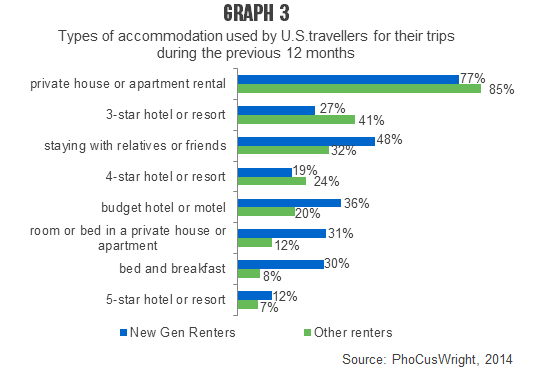
New Gen Renters tend to spend less on accommodation than other renters, since they are more likely to stay in budget hotels, bed and breakfasts or rooms, or else rent a bed in a private home (see Graph 3).

Note that PhoCusWright distinguishes between two types of rental accommodation: the one where the customer rents the entire residence from which the owner is usually absent (see “private house or apartment rental,” below); and the one where the renter only has access to part of the residence, and where the owner is usually present during the rental period (see “room or bed in a private house or apartment,” below). The latter type can be found on websites such as Airbnb, but is completely absent from websites such as HomeAway, that specialize in the first type of rental accommodation.

AL_Airbnb_1_anglais_graph_3

Why choose a rental over hotel accommodation?

The three main deciding factors for all renters are that they can find similar facilities and equipment to those at home, that they have more space, and that the rental can accommodate more people (see Graph 4). However, New Gen Renters particularly like the fact that rentals provide more freedom and privacy than a hotel room, that they offer a more relaxed ambiance, and that they are generally less expensive.

AL_Airbnb_1_anglais_graph_4

How will hotel owners react?

Should hotel owners be alarmed at the prospect of losing part of their clientele to private accommodation? According to PhoCusWright, 82% of non-renters did not even consider the rental option for their trips during the previous 12 months. However, hotel operators would do well to adapt to these New Gen Renters because, although rentals may better meet their needs, they nevertheless use different types of accommodation when travelling.

A second analysis examines the online planning and booking habits of this New Generation, and looks at possible ways of resolving the concerns of the hotel industry.


Image à la une: © BY NC Melies The Bunny

Catégories
Management Trends

Co-creation in the participatory era


At the dawn of this renaissance, the competitive environment of tourism is being redefined by new models of consumption and production. Collective intelligence is now considered an abundant precious resource that must be exploited if one is to remain competitive. Organizations that use co-creation (similar to crowdsourcing) are ahead of the curve because they are identifying consumer expectations and getting innovative ideas from their community.

The dynamic duo behind meaningful experiences

Today’s connected tourists are ideally positioned to actively influence service providers, at every stage of their visit. In this new context, businesses must listen closely to their customers if they want to satisfy them, a task made easier by the emergence of social media. Impressing travellers requires adopting an approach that artfully combines the following two elements:

  • Technology to enhance the organization’s processes and products while facilitating interactions among the various stakeholders
  • Co-creation to empower consumers to design their own tourist experiences by contributing ideas about a product or service, discussing with others, personalizing the products they are offered, etc. 

Examples from the hotel industry

Crowdsourcing is gradually entering the hospitality sector and radically changing design and marketing practices. Given the phenomenal rise of Airbnb and fierce competition from online intermediaries, hotels are now building on this trend to enhance their brand reputations, attract Millennials and discover user-generated content that can help them better communicate with their clientele.

Club Med

For its future Val Thorens ski resort in France, Club Med adopted a crowdsourcing approach and encouraged public feedback on the concept. Using a participatory application designed for Facebook, Club Med fans voted each week on the elements they wanted to see in the resort, such as the name, logo, design and even the activities offered.

MLV_Cocreation_Image1

Source: e-marketing.fr

17John

Democratizing real estate investment, architecture and urban design is the mission of the Prodigy Network. 17John, its New York City extended-stay hotel project aimed at business travellers, will incorporate innovative ideas generated by a crowdsourced campaign involving architects, designers and other creative professionals (see video). The organization used the competition to help it redefine the building’s spaces so as to create more collaborative, communal and connected ways of working and meeting.

Marriott Hotels

Marriott Hotels’ Travel Brilliantly initiative is in its second year. This dedicated Website invites guests to share innovative hotel ideas in the following six categories: technology, culinary, work and play, wellness, design and style, and other. Though the concept was initially aimed only at US consumers, this year’s edition also includes those in the UK. According to a Marriott executive: « There is no creation anymore except co-creation. To build any idea in a vacuum is more of a risk than building it with the insight of your guests and your associates. »  


Initiatives targeting local populations

Residents can be a source of many innovative ideas and play a key role in developing and implementing new strategies and campaigns.  Co-creation makes it possible to develop tourist experiences that are more beneficial to host communities while also satisfying visitors’ desire for authenticity.

Museums and co-creation

Given that the average museum-goer now wants to « do » rather than simply « view, » many museums have adopted a more participatory approach. These establishments are rethinking their role as the sole authority for determining which stories should be told and are instead working with the community to co-create stories. 

For example, in October 2013, the Chicago History Museum asked the public to determine the theme of a future exhibit. The city’s residents were then invited to vote for their favourite on Facebook.

MLV_Cocreation_Image2

Source: hstryqt.tumblr.com

Tourism becomes a force for change

Travel2change , a non-profit organization, wants to foster social innovation by inviting local populations to propose unique activities that visitors could find rewarding.  The best suggestions are then passed on to travellers interested in responsible travel. The digital platform provides a meeting space for tourists and locals who want to get together to support a cause.

MLV_Cocreation_Image3

Source: travel2change.org

« Open source » festivals 

The interdisciplinary SPARKcon festival in Raleigh, North Carolina, is billed as a « creative potluck » that showcases the local artistic community. In addition to enjoying an opportunity to present their artistic efforts, participants can help plan, program and organize the event.

Along similar lines, the Helsinki Festival in Finland invites the public to be part of the event’s creative process, thus highlighting local talent.

Artists redraw national parks

To mark its centenary, the National Parks Conservation Association, in cooperation with the Creative Action Network, launched the See America crowdsourcing campaign. Artists and designers were invited to create a collection of posters celebrating these heritage sites. The initiative uses collective creativity to showcase this precious resource and encourage the public to visit the parks.

MLV_Cocreation_Image4

Source: seeamericaproject.com

Increased competition due to the burgeoning number of alternative products is forcing businesses to rethink how they do things and reinvent how they relate to consumers. Having understood the new rules of the game, tourism-based organizations that do more to encourage the participation and commitment of their customers and stakeholders will increase their chances of success. What can you co-create?


Article written as part of a partnership with Tourisme Montréal on cultural tourism


Catégories
Management Trends

The vogue of low-cost travel

Low-cost tourism providers are now attracting a variety of customer segments. This is because their business model has gone upscale, offering a wider selection of improved products and services while keeping prices low. This success is the envy of other companies that are now trying to enter this niche market.

Airlines

Some 15 years ago, the airline industry was turned upside down by the arrival of low-cost carriers and their success continues to grow. According to Euromonitor, these companies have seen their market share and popularity increase every year, putting them into direct competition with regular carriers. In November 2013, they accounted for 20% of all flights and 25% of weekly seats, globally.  

Their development and price strategies have undergone a number of changes. While the « ultra low-cost » model, popularized by Spirit Airlines and Allegiant Air, continues to make inroads in the United States, European low-cost carriers seem to be moving towards the « middle cost » model adopted by easyJet.

With the former business model, a carrier will sell tickets at a very low price and then add various service charges (baggage, meals, ticket printing). These supplemental fees represent, on average, 40% of the total price of a flight with Spirit Airlines. Since this strategy was adopted in 2007, the average price for a flight has dropped from US$94 to US$75. The middle-cost business model, launched by easyJet, has been adopted by Air Berlin, Vueling and, more recently, Ryanair. These airlines have lowered the price of some services (baggage handling, reprinting of boarding pass) and enhanced their products by adding fees for services like seat reservation and speedy boarding. Middle-cost carriers can also compete head-to-head with regular carriers by:

  • flying out of major airports;
  • increasing the number of destinations served;
  • offering flights on strategic routes;
  • adding long-haul flights. Norwegian Air Shuttle (see image below) and XL Airways offer flights between Europe and the United States. Air Asia X, the largest low-cost company in Asia, will offer flights to Europe by the year 2016.

AL_Modele_low_cost_image1

Source: businessinsider.com

The low-cost model also targets business travellers. For example, JetBlue was set to begin offering larger, more comfortable seats in a reserved business section in June (see image below). The airline’s business class prices include cocktails, a gourmet meal and Wi-Fi. In 2012, Vueling launched its « Excellence » class with the goal of having business travellers make up 50% of its clientele by late 2013.

 AL_Modele_low_cost_image2

Source: investor.jetblue.com

With these changes, the business model of middle cost airlines is beginning to resemble that of regular carriers, while the latter, faced with this fierce competition, are trying to enter the low cost market. Air Canada rouge, the Air France subsidiaries Transavia and Hop! and Lufthansa’s Germanwings are all examples of this.

Low-cost hotel options

and there have been two developments similar to those in the airline industry: budget hotels have gone upscale and modern hotel chains have been created.

Within the hotel industry, the economy segment is shaking up its business model and there have been two developments similar to those in the airline industry: budget hotels have gone upscale and modern hotel chains have been created. These changes are responses to the new expectations of travellers, who are looking for good deals without skimping on quality when it comes to facilities, comfort and design.

The Accor hotel group has been renovating the facilities and decor of its economy brands for the past several years. Its Formule 1 and Etap Hotel chains (see image below) have changed their names (to hotelF1 and ibis budget, respectively), while an increased attention to design has made their public spaces and rooms more functional and user-friendly.

AL_Modele_low_cost_image3

Source: ibisbudgethotel.ibis.com

EasyHotel and Motel One are two new low-cost hotel chains that are enjoying growing popularity in Europe. The most recent entry into this market, Eklo Hotels, has adopted an eco approach by using construction materials that are more environmentally friendly and innovative, encouraging employees to be more versatile and having clients pay for any extras.

AL_Modele_low_cost_image4

Source: eklohotels.com

AL_Modele_low_cost_image5Some youth hostels are also joining the upscale trend and now attract a variety of clienteles: adults of all ages, families and even business travellers, that is, anyone looking for a social experience in a setting that offers contemporary design and state-of-the-art technology. Equipped with facilities similar to those found in traditional hotels, such as private bathrooms, a pool, conference rooms and an exercise room, some of these establishments offer even more specialized services like a screening room, playroom, organized social activities, city tours, etc. Europe’s Generator line of hostels (see image to the right – Source: generatorhostels.com) is part of this « new generation » of competitively-priced accommodations (startingat 10€) inspired by so-called lifestyle hotels.

New concept hybrid hotels are flourishing in major cities. For example, Fusion Hotel in Prague is both a three-star hotel and a youth hostel. It provides casual meeting spaces, interactive video games, a bar/lounge for special events, etc. Guests can reserve various categories of rooms priced from 60 to 130€ a night, or just a bed for as little as 14€. According to its general manager, it offers business travellers an alternative solution.

AL_Modele_low_cost_image6

Source: fusionhotels.com

A strategy that is making inroads throughout the industry

Other tourism sectors have also been drawn to this niche market, such as the examples below. 

  • Rail: In April 2013, the French SNCF group launched its new low-cost high-speed train service, Ouigo, to attract new clients. Ticket prices start at 10€.
  • Bus: Serving Canada (particularly Montreal) since 2009, the low-cost bus company megabus.com uses luxury coaches equipped with Wi-Fi. It often offers special deals as low as $1.
  • Car rentals: Major car rental companies are offering clients more economical options through car-sharing subsidiaries like Hertz 24/7.

The revamped low-cost model, enhanced with a touch of originality, is increasingly popular throughout the industry and seems to be a niche that attracts various types of travellers. For businesses, the challenge is to cost-effectively manage this model, even if it means adopting only some of its principles.


Image on page one: © megabus.com