Catégories
Accommodation etourism and technology

Online Behaviour of Airbnb Travellers

The private accommodation rental market has not escaped the tidal wave of online information that brings us to today’s diversified offer on a number of specialized sites. The PhoCusWright study states that, in the United States, the penetration rate of these online reservations has gone from 12% in 2008 to 24% in 2012. The arrival of start-ups in the collaborative economy, such as Airbnb, and the improvement of already well-established sites in this market, such as HomeAway, have helped accelerate this trend.

This trend gave rise to a new generation of renters, or “New Gen Renters,” whose travel behaviour differs from that of travellers who use other types of accommodation. This distinction was made following an analysis of these travellers, that was based on a PhoCusWright study of their online planning and booking habits. The results of that study are described below.

AL_Airbnb_2_encadre_anglais

New Gen Renters very active online

When planning their leisure trips, New Gen Renters are more likely to search the Web on a mobile device (32%) or a tablet (29%) than other renters (see Graph No. 1). They also more frequently use other sources of information, such as recommendations from relatives and friends, online advertising and promotional emails. The behaviour of other renters more closely resembles that of other travellers who do not rent private accommodation.

AL_Airbnb_2_graph_1_anglais

New Gen Renters browse more sites to compare and choose the various components of their trip

All three categories of traveller primarily access the same sources for their online trip planning (see Graph No. 2). Online travel agencies such as Expedia or Priceline came first, followed by search engines and comment sites such as TripAdvisor. However, New Gen Renters browse more sites to compare and choose the various components of their trip. Almost 40% of these new renters use social media, compared to 11% of other renters and 12% of non-renters. This gap also holds true for travel guide sites and online magazines, news websites and private accommodation rental websites – although the latter category is also accessed by a significant proportion (20%) of other renters.

AL_Airbnb_2_graph_2_anglais

What online content are they looking for?

New Gen Renters have a strong appetite for online travel content (se       e Graph No. 3). They access comments and opinions, professional and amateur photos and videos, and supplier posts to plan at least half of their stays. They are far more likely than other renters and non-renters to view this information on social media.

AL_Airbnb_2_graph_3_anglais

Inspiration and personalization

The inspirational aspect of the site is very important for this new generation. Indeed, 41% of them look for new trip ideas online, whereas this objective is only shared by 28% of other renters and 29% of non-renters. This group is also looking for a more personalized web browsing experience than the other traveller groups, with 27% preferring a site that saves their personal information in order to recognize them on subsequent visits, compared with 12% of other renters and 9% of non-renters.

New Gen Renters are spontaneous

The “other renters” category books its stays further in advance than other segments: 57% do so at least one month before departure, whereas only 41% of New Gen Renters and half of non-renters adopt similar behaviour (see Graph No. 4). In fact, there are proportionally more last-minute New Gen travellers, as 43% of them book less than three weeks before their trip is due to start, compared to 33% of other renters and 31% of non-renters.

AL_Airbnb_2_graph_4_anglais

Keen collaborative consumers

According to PhoCusWright, New Gen Renters tend to use collaborative sites such as Airbnb to book their accommodation. This segment is also attracted by a similar approach to getting around: 21% of these avid users of new technology used a car-sharing app during their stay, compared to a fairly low percentage (6%) of other renters, and only 2% of non-renters. They are also more likely (25% compared to 11% and 6%, respectively) to have used app-based rideshare services such as Uber and Sidecar.

Should the traditional hotel market be concerned?

According to PhoCusWright’s probability calculations based on the frequency of travellers’ leisure trips, it seems that each time a traveller rents private accommodation, the chances he or she will book a hotel room within the same year drop by 24%. Similarly, if a traveller stays in two rentals over the course of the year, the chances he or she will stay in a hotel drop by 50%. In other words, the more often travellers stay in private accommodation, the less likely they are to book a hotel room. While this statement may alarm hotel owners, they should remember that, in 2013, only 14% of U.S. travellers rented a private house or apartment, and only 3% booked a room or a bed in a private home. In fact, it was the least popular type of accommodation.

Fundamental shift or passing trend?

Will the advocates of collaborative consumption – largely members of Generation Y – continue to travel this way as they grow older? It is difficult to predict the future, but one thing is certain: their use of the Internet and an array of technological tools is permanently rooted in their travel behaviour. Accommodation providers therefore have no choice but to react – and adapt to! – this enduring trend!


Image à la une: © istockphoto

Catégories
Accommodation etourism and technology

Who are these travellers booking on Airbnb?

Renting short-term lodging has become an increasingly common accommodation choice for travellers, made popular by the advent of websites such as Airbnb. A survey conducted in the U.S. by PhoCusWright profiles these users and defines their behaviour as it compares to that of other traveller groups.

Methodology

The web survey was conducted in February and March 2014 among 1,880 American respondents who had made at least one leisure trip during the previous 12 months. To be eligible for the survey, they had to have reserved commercial accommodation and planned the trip themselves. The company identified two categories of traveller: those who rented private accommodation (room, house or apartment), i.e., the renters (17%), and those who booked other types of accommodation for their stay (non-renters; 83%).

Young travellers with a good income

A number of factors separate the renters from the non-renters: over half (51%) of U.S. travellers who rented private accommodation during the previous year were under 35, compared to 38% of travellers who booked another type of accommodation (see Graph 1).

AL_Airbnb_1_anglais_graph_1

There was also a definite difference in earnings between the two traveller groups: 33% of non-renters had an annual household income of less than US$50,000, compared to 24% of renters. Also, the proportion of the latter group with incomes between $50,000 and $125,000 is higher than it is among non-renters, indicating that, generally speaking, renters are more prosperous than other traveller group.

Renters travel for longer and are more active

Almost two out of three renters (63%) travelled for one or two weeks during the previous year, while only 43% of non-renters were away for the same period of time. Furthermore, the first group made more trips abroad (42%, compared to 31%).

Aside from flights, renters are proportionally more likely than the other group to book several components of their trip (car rental, package, cruise, train, visit). This fact makes them more active travellers, who tend to do more (see Graph 2).

AL_Airbnb_1_anglais_graph_2The “New Generation of Renters” – a distinct category
Among the travellers who rented a private room, house or apartment during the past year, PhoCusWright has defined a new category of traveller that it calls “New Gen Renters.” Between 18 and 34, these travellers represent 31% of all renters and see themselves as avid users of new technology.

This group spends more on vacations and travels more frequently. In fact, a typical household in this category allocates an average of US$4,338 per year to travel, compared to US$3,743 for the other renters and US$3,153 for non-renters. Furthermore, 27% of these travellers have made at least six trips during the previous year, compared to 15% of the other renters and 9% of non-renters.

New Gen travel behaviour

Several aspects of New Gen travel behaviour distinguish this group from other travellers, such as:

  • They want to explore the destination as much as possible: meet new people and share their experiences with them;
  • They are spontaneous, travelling as soon as they have the means to do so;
  • When staying in commercial accommodation, they seek out stylish, smaller hotels;
  • They like to travel alone or with friends.

Preferred types of accommodation

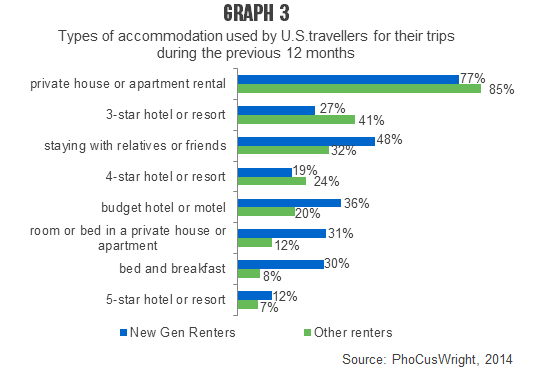
New Gen Renters tend to spend less on accommodation than other renters, since they are more likely to stay in budget hotels, bed and breakfasts or rooms, or else rent a bed in a private home (see Graph 3).

Note that PhoCusWright distinguishes between two types of rental accommodation: the one where the customer rents the entire residence from which the owner is usually absent (see “private house or apartment rental,” below); and the one where the renter only has access to part of the residence, and where the owner is usually present during the rental period (see “room or bed in a private house or apartment,” below). The latter type can be found on websites such as Airbnb, but is completely absent from websites such as HomeAway, that specialize in the first type of rental accommodation.

AL_Airbnb_1_anglais_graph_3

Why choose a rental over hotel accommodation?

The three main deciding factors for all renters are that they can find similar facilities and equipment to those at home, that they have more space, and that the rental can accommodate more people (see Graph 4). However, New Gen Renters particularly like the fact that rentals provide more freedom and privacy than a hotel room, that they offer a more relaxed ambiance, and that they are generally less expensive.

AL_Airbnb_1_anglais_graph_4

How will hotel owners react?

Should hotel owners be alarmed at the prospect of losing part of their clientele to private accommodation? According to PhoCusWright, 82% of non-renters did not even consider the rental option for their trips during the previous 12 months. However, hotel operators would do well to adapt to these New Gen Renters because, although rentals may better meet their needs, they nevertheless use different types of accommodation when travelling.

A second analysis examines the online planning and booking habits of this New Generation, and looks at possible ways of resolving the concerns of the hotel industry.


Image à la une: © BY NC Melies The Bunny

Catégories
Customer segments Products and activities

Generation Y, the new face of business travel

Why take an interest in the business travel of Generation Y?

First of all, because of the potential: Millennials currently make up about one-third of all passengers on business flights in the United States and their share should rise to 50% by the year 2020, while that of Baby Boomers will drop to 11%.

Secondly, they spend more on travel than members of other generations, according to a survey by Boston Consulting Group. When travelling for business, they indulge in extras: they frequently make last-minute reservations, opt for refundable tickets, change their seat for one with more legroom, make changes to their itinerary, and splurge on high-end meals or onboard Wi-Fi, all of which leads to higher-than-average business travel expenditures.

Booking and planning travel

Spontaneity and connectivity are the hallmarks of Gen Y business travellers, so mobile devices are crucial: nearly one third (32%) of Millennials use smartphones to book travel while 20% use tablets, compared to just 12% of business travellers over 45. They are also much more likely than their elders to use mobile devices to enhance their travel experience: nearly three-quarters of them have travel apps on their smartphones.

for Gen Y, meetings have seven possible purposes: celebrate, decide, educate, ideate, network, produce and promote

To satisfy this demanding clientele, the Marriott chain has introduced an innovative concept that reinvents how meetings are planned. Meetings Imagined is a very visual, social site that offers expert advice, information on the latest trends in the world of event planning and hundreds of inspiring photos to stimulate creativity. Users of the site can work with the hotels to design customized experiences or browse the ideas proposed by participating hotels. They can also post their favourite images on social media sites like Facebook and Pinterest. The concept was the result of research showing that, for Gen Y, meetings have seven possible purposes: celebrate, decide, educate, ideate, network, produce and promote. So instead of concentrating solely on dates, rates and floor plans, the Meetings Imagined approach focusses on the specific purpose of the meeting to create and design a more personal experience.

CN_Affaires_Millenials_image1

The importance of social networks

The majority (80%) of young business travellers attach considerable importance to online reviews when planning travel. They are also much more likely to post a negative online review of a hotel, restaurant or mode of transport (airline, public transit, taxi or rental car): 26% of those 34 and under said they had done so in the last year, compared to 14% of their older peers. Hotels were the most popular subjects of negative reviews from US business travellers, just ahead of restaurants.

The popularity of « bleisure » travel

The line between business and leisure is become increasingly blurred, particularly among young people. According to a survey conducted by the Hilton Garden Inn chain, 84% of Gen Y business travellers are willing to extend a business trip to take in a few days of leisure, a much higher number than their older peers. Furthermore, 65% said that exploring a new city was the best part of a business trip.

Are Gen Y travellers loyal?

although inclined to join loyalty programs, they do not actually show a lot of brand loyalty

Young business travellers are more likely to join loyalty programs: half of them take such programs into account when booking flights (48%) and hotels (51%), compared to a third of travellers ages 46-65 (31% and 30%, respectively). That being said, although inclined to join loyalty programs, they do not actually show a lot of brand loyalty. In fact, they are less brand loyal than their elders and more apt to switch from one airline or hotel chain to another if they believe the loyalty program is better for them. In fact, Gen Y business travellers do not seek the same program benefits as their colleagues. For example, they are more likely to use airline miles and points on free or discounted travel rather than on upgrades.

Youth hostels, an interesting alternative to traditional hotels

Youth hostels are becoming more popular among hip young business travellers – especially those on a tight budget – who don’t want to spend an entire evening alone in their room. Generator Hostels is one such chain: on certain days of the week, particularly during the off-season, nearly 20% of its guests are young business travellers.  Another example is the Fusion in Prague, which is both a hotel and youth hostel. It offers individual standard rooms and dormitory-style accommodations, as well as non-traditional meeting spaces like its 360° Lounge Bar and Playroom, which features over-sized seating attached to the wall that can also be folded up and out of the way. In addition, its social media presence enables business travellers to meet other guests with similar interests, even before their arrival.

CN_Affaires_Millenials_image2

Young business travellers are still in the process of trying out different brands to determine what appeals to them most and best corresponds to their life style and travel habits. It is the ideal time for hotels, restaurants and other tourism stakeholders to listen to them and try to meet their expectations for they are the travellers of today… and tomorrow!

Catégories
etourism and technology Marketing @en

Instagram: A mobile partner for the tourism industry

With 40 million photos uploaded per day and 8500 « likes » and 1000 comments per second, the Instagram mobile application has become an essential tool for Marketing 2.0.

Named « Application of the Year » by Apple in 2011, Instagram has popularized the art of mobile phone photography, or iPhoneography, by enabling users to personalize and share their photos with others. Purchased by Facebook for US$1 billion in April 2012, a year later Instagram boasts a community of more than 100 million monthly active users.

Hugely popular among young adults, Instagram offers businesses an ideal opportunity to enhance their visibility and public relations, especially if their target public includes members of Generation Y. Many brands, including companies working in the tourism industry, have joined the network and made it part of their marketing strategy.

Instagram 101

For those of you unfamiliar with Instagram, here’s how it works:

  • After taking a picture using Instagram or selecting a saved photo from your phone, you can modify the final image with one of the application’s 18 automatic filters before sharing it with your network.

MLV_Instagram_image_1

  • Similar to Twitter, members subscribe to the accounts they want to follow and use #hashtags to label or describe their photos. Just like on Facebook, viewers can express appreciation for an image by « liking » it; they can also post comments.

MLV_Instagram_image_2

  • Moreover, the application can be used to share photos on other social platforms.

MLV_Instagram_image_3

  • Although Instagram does have a Web version, other Websites have adapted the mobile platform for larger screens, making it easier to navigate and manage your account: Webstagram, Statigram and Pintacular.

MLV_Instagram_image_4

Source: Pintacular

How can tourism businesses and organizations benefit from Instagram?

With Instagram, businesses have access to user-generated mobile-optimized content. A convergence of two major trends, the rise in visual marketing content and SoLoMo (see also: Vous avez dit SoLoMo?), this medium is generating interest in the tourism industry, which sees it as a new way for communicating with clients. Making Instagram part of your marketing strategy can provide the following benefits:

  • Develop your brand image. Instagram can introduce users to a variety of interesting photos associated with the brand or destination.
  • Strengthen customer relations. Analyzing Instagram photo searches can help businesses better understand their target clientele. They can use the application to interact with their target market and participate in conversations about certain images, thus reaching a different digital community to complement those in other social media.
  • Create visual content. An organization can repost the best user photos of its establishment or destination on its own account. When you do this, the firm Adviso suggests adding a message to the photo mentioning the name of the user who took the picture, to give photo credit. You can also include Instagram photo albums on your Facebook page, thereby increasing the amount of visual content shared with your fans.
  • Increase your mobile presence among travellers. Instagram can be useful at every stage of the travel cycle, not just during a stay. Its content can provide inspiration, encouragement and guidance during the planning stage, and keep a potential visitor connected with the destination or organization after the initial contact. It is an opportunity to increase one’s presence among connected customers.

How can individuals use Instagram in the context of tourism?

MLV_Instagram_image_6_ENG

What tourism businesses or destinations use Instagram?

The Canadian Tourism Commission has added Instagram to its social media strategy with the ExploreCanada account, which has nearly 15,000 followers. It invites members of the tourism industry to post images using the hashtag #ExploreCanada.

MLV_Instagram_image_7

Source: ExploreCanada

The destination management organizations of Nova Scotia, British Columbia and Alberta have also created hashtags to showcase their destinations.

MLV_Instagram_image_8

Source: #visitnovascotia, #tourismbc, #travelalberta on Instagram

Tourisme Montréal encourages the use of hashtag #MTL and incorporates user-generated Instagram photos in a page on its blog, Vivez Montreal/The Montreal Buzz. Some images are also reposted on its Facebook page or put together to form a special blog post. For summer 2013, the site has developed a strategy using the hashtag #mtlmoments on Instagram and Twitter.

MLV_Instagram_image_9

Source: The Montreal Buzz

The number of major hotel chains using Instagram more than quadrupled in one year, from 19% in 2011 to 82% in 2012, according to Digital IQ Index: Hotels 2013. Some brands, like the Shangri-La and Four Seasons, have come up with hashtags (#lovingthemoment and #FSFotog, respectively) to encourage guests to share photos of their hotel stays.

MLV_Instagram_image_10

Source: @althotel, @intercontinental and @fairmonthotels on Instagram

Furthermore, the ALT Hotel banner launched its second mobile photo contest, #ALTexpo, to create a mural of digital photos for the lobby of its new hotel at Halifax Stanfield International Airport. The video below presents a behind-the-scenes look at the first edition of the contest, organized for the ALT Hotel at Toronto Pearson International Airport:

<iframe width= »560″ height= »315″ src= »http://www.youtube.com/embed/Od3CEQRrXpU » frameborder= »0″ allowfullscreen></iframe>

www.youtube.com/watch?v=Od3CEQRrXpU

The application has also been enthusiastically adopted by the airlines, particularly Air Canada and WestJet.

MLV_Instagram_image_11

Source: @WestJet, @Air France and @AirCanada on Instagram

With an adoption rate of 18% in the United States, Instagram is still an emerging platform, currently used primarily by young people. Some 28% of Americans ages 18 to 29 used Instagram in 2012, compared to 14% of 30 to 49 year-olds and 3% of 50 to 64 year-olds. However, it has significant growth potential and relevance for tourism, which is reflected in its current popularity among numerous industry organizations.

Catégories
Sustainable tourism

Younger, Less Affluent Travellers Willing to Pay More for Sustainable Tourism

Although there has been a continuous increase in global tourism despite the economic recession (902 million international travelers in 2008 – a 4% increase over 2007), negative effects are also being identified by businesses and governments alike. One of the ways to counter detrimental effects is for tourists and locals to engage in sustainable tourism practices. The demand for sustainable tourism is difficult to assess, however, as most figures are anecdotal and reflect a willingness to participate rather than pay.

Although multiple studies have been conducted by organizations such as Lonely Planet, National Geographic and others, there is little research data about visitors to Canada, let alone Canada’s biggest city – Toronto. A 2007 study conducted by Arente and Ennamorato on Canadian tourists’ awareness and perceptions of sustainable tourism found that only 12% of Canadians are ‘somewhat’ familiar with the concept of sustainable tourism while 31% had never even heard of it. As for participation in sustainable tourism practices, 49% would choose to participate in activities that have sustainable benefits while travelling and 42% would use travel agencies that follow sustainable tourism guidelines. Over 75% of respondents believe that businesses that market and sell tourism as well as mass media should take on the responsibility of distributing information on sustainable tourism.

To augment this data, a recent study of 400 visitors to Toronto was conducted by Dodds, Antonov, Babkina & Gordon (2008). The purpose of the study was to determine the level of demand for and use of sustainable tourism products (e.g., choosing responsible tour operators, carbon offsetting flights and car rentals, purchasing green products and services such as hotels who showcased environmental policies,  and organic and fair trade food/products).

Findings

The study found that young and not necessarily affluent respondents were willing to pay for sustainable products. Of the respondents, 46% were between the ages of 19- 29 and had a relatively low household income (48% with an income of $24-59,000). Results showed that 11% were willing to pay 11-25% more and 59% of respondents were willing to pay 1-10% more.

Although there is often confusion over the term ‘sustainable tourism’ (45% had never heard of sustainable tourism or were not familiar with it as a form of tourism), 72% of respondents said they were likely to use sustainable tourism products in the future.

The study also found that the more respondents were likely to consider buying sustainable tourism products in the future (77%), the more likely they would pay a premium for them.

In terms of motivation or choice, 44% of respondents said they participated in sustainable tourism practices because they did not want to harm the environment. Although this number is not the majority, many people were also concerned that it corresponded with their moral values (38%) and understood the importance of doing so (39%).

Conclusions

Many sceptics maintain that there is not outstanding participation in or widespread demand for more responsible tourism products. This, however, may be due to limited awareness (33% of the travellers who had never purchased sustainable tourism products said that this was because they were not aware of them).

Canadian travellers are also comparable to international travellers. In a 2007 TripAdvisor ecotourism survey of 1,000 travelers worldwide, 38% responded that environmentally-friendly tourism is a consideration when travelling. This finding is similar to the Toronto study. Only 4% of respondents were ‘not at all’ likely to participate in sustainable tourism practices while travelling in the future, while 44% were ‘somewhat’ likely to consider purchasing sustainable tourism products.

References :

Arente, H. & Ennamorato, M. (2007). Sustainable Tourism: Travel Like You Mean It!  Toronto: TNS Canadian Facts. Retrieved Dec 16, 2008, from http://www.tns-cf.com/conferences/ttra/ttra-2007.pdf

Dodds, R., Antonov, Y., Babkina, I., & Gordon, S. (2008). Travellers’ Demand For and Participation in Sustainable Tourism Practices in Canada. Toronto: Ryerson University.

TripAdvisor. (2007). TripAdvisor Travelers Keen on Going Green. Press release. Retrieved Dec 16, 2008, from http://www.tripadvisor.co.uk/PressCenter-i120-c1-Press_Releases.html

Catégories
Customer segments

Spotlight on Generation Y

Although the definition can vary, the term “Generation Y” generally refers to people born between 1978 and 1989, or those aged 18 to 29. Whether you call them Echo Boomers or Generation Y, they are without doubt a major, surprisingly different, customer segment. However, does Quebec’s Generation Y travel? If so, what are its favourite activities when travelling, and in general? What is the best way to appeal to these complex new consumers weaned on technology?

Profile of the Echo Boomer market segment

In 2005, Generation Y represented 20.3% of the Quebec population 18 years and over. They account for a similar proportion of the travel market, constituting 18.8% of the province’s domestic travellers and 19.5% of its international travellers during the past year.
According to the Print Measurement Bureau (PMB), 42% of young Quebeckers in Generation Y have travelled within Canada in the past year, while the rate is 46% among the entire population aged 12 years and over (Table 1). Nearly one-third of them made at least one trip within Quebec and 10% visited Ontario.


Table 2 lists the most popular international destinations among Generation Y travellers in the past three years, noting the percentage of those who made at least one trip to each destination, as compared to the entire Quebec population. Though this demographic group visited the Northeast United States and France in greater numbers than did the overall Quebec population, it was not as fond of Cuba as other customer segments were.

Figure 1 illustrates the percentage of young people aged 18 to 29 who take part in certain activities while travelling in Canada, compared to the number of participants from the overall Quebec population. Members of Generation Y are more likely to practise sports activities, hiking and skiing, and engage in shopping and nightlife than other travellers. However, they are less likely to attend cultural activities like museums, art galleries and events.

Here are some more pertinent facts taken from the PMB with regard to the travel behaviour of Quebec Generation Y travellers in Canada:

  • 85% travel by car, 9% by bus and 10% by plane
  • 78% travel for only a few days, 22% for one week and only 7% for two to three weeks
  • their favourite type of accommodation is with friends and family (40%), followed by hotels (34%), motels (18%), campgrounds (18%), cottages (17%) and, rarely, B&Bs (5%)

When travelling outside the country:

  • 41% travel for a few days, 44% for one week, 27% for two to three weeks and 12% for one to two months
  • 76% travel by plane, 36% by car and 10% by bus

Other than their favourite activities while travelling, what interests this clientele? What are its favourite hobbies and leisure activities? Figure 2 illustrates the percentage of this generation that engaged in various sports and leisure activities over the past year.

Compared to the overall population, young people aged 18 to 29 have a higher participation rate in a greater number of sports and activities (cycling, dance, photography, running, canoeing, amusement parks, etc.). Nightlife is especially popular, with 46% of young people having gone out to bars in the last year.

As illustrated in Figure 3, some Quebec events are quite popular with young people in Generation Y: for example, 15% attended the Montréal International Jazz Festival last year. Other Quebec attractions are popular too, with one out of five Quebeckers aged 18 to 29 having visited La Ronde, a proportion that is twice that of the overall Quebec population.

Looking beyond the numbers

With personalities and behaviours that differ from those of preceding generations, Echo Boomers are a challenge for the companies who would like to attract them. However, they are not unreachable, and the following information may help you understand them better.

  • For this generation, travel offers a sense of accomplishment and pleasure; it is a tool of personal development, a way to discover new lands and an enriching experience, both personally and socially. Traditional sightseeing activities, guided tours and museums are not attractive to them. They prefer adventure tourism, sports tourism, the latest forms of entertainment and outdoor activities.
  • Professionally, the children of Baby Boomers do not want to be like their parents. While the latter are often workaholics, Generation Y aims for a better balance between work, family and one’s personal life. Not particularly loyal employees, these people look for work that they can be passionate about, rather than something stable and well paid. They do not like hierarchical organizations.
  • Though often big consumers, they are also savvy, experienced buyers. As a customer segment, they are demanding and hard to predict. Because they often have limited budgets and many have a high debt ratio, the quality-price ratio is key to them (they often travel with only one credit card). In addition, they are very skilled at searching the Web for the ideal destination and price. The Internet now offers tremendous information transparency and Generation Y is certainly the generation that takes full advantage of this.
  • Technology is part and parcel of their lives and the internet holds few secrets for them; they navigate easily and confidently, whether searching for information or making online reservations.
  • Unlike other customer segments, Echo Boomers are not afraid of innovation. On the contrary, they enjoy surprises, adapt quickly, and like to get off the beaten path to discover new horizons, new destinations and new activities.
  • In terms of marketing, it is vital to remember that they have been immersed in advertising since birth and, as a result, are less sensitive to it or even immune. Therefore, they can be difficult to reach through traditional media and more easily reached through the internet. However, viral marketing, search engine referencing and online public relations are more effective than conventional advertising banners. Furthermore, the advent of social networking sites like MySpace and Facebook means that marketing efforts must “listen” in order to identify, target and reach Generation Y. Members of this generation like to talk about themselves and their lives (their trips, friends, photos, etc.) on personal pages and blogs.
  • Remember that they share a lot. Thanks to social websites, cell phones, online chatting and Skype, they are instantly up to date with whatever their friends are doing, no matter where or when. This is why well-executed viral marketing campaigns can be so effective.
  • The most powerful hook for them is probably a sense of humour, or even sarcasm. Strategies that can make them (and their friends) laugh will win points. Some marketing campaigns have used humour to great effect, even with limited budgets.

In short, they are skilled negotiators, ambitious and nonchalant, and they question everything. They are also wholehearted hedonists, sensitive to the fate of the planet and keen to learn more about the world. Full of ideas, these people are inspiring.

Sources:

– Print Measurement Bureau, 2007.
– Renaud, Jean-François. « Le Web de la génération Y », Adviso, conseil + stratégies, 7 décembre 2005.
– Hira A., Nadira. « You Raised Them, Now Manage Them », Fortune, 28 mai 2007.
– « The Children of the Web », Business Week, 2 juillet 2007.
– Ramsay, Charles-Albert. « Fallait y penser: un nouvel emploi chaque semaine? », Les Affaires, 7 juillet 2007.
– Canning, Simon et Lara Sinclair. « End of the Love-in », The Australian, 20 octobre 2006.