Catégories
Accommodation

The New Generation of Lifestyle Hotels

The new generation of hotels is focusing on innovation by developing hotel concepts or updating existing ones. The so-called lifestyle hotel is a good example of this trend; while examples of this type of hotel have existed for several years, they are now preparing to benefit from the winds of change sweeping through the hotel industry. Read on to learn how three hotel groups have interpreted the lifestyle hotel trend.


M Beta: revamped, customized spaces

The Charlotte Marriott City Center was fully renovated in 2016. In fact, the renovation was so complete, they’re calling it the second iteration M Beta as they gather customer feedback on what works and what doesn’t. (Further details in the first part of the analysis, Comment l’hôtel de demain est-il pensé ?). With a budget of $16M, room design was completely reinvented by installing modular furniture and adding a variety of high-tech tools. Customers can access their Netflix or Hulu account from the guest-room TV and use a tablet to order from room service. One whole floor is devoted to StayWell rooms that feature amenities such as: aromatherapy, a shower head with chlorine filter, lighting that emulates natural outdoor light, and hypoallergenic bedding.

Local ingredients are showcased in the restaurant, the bar can act as a co-working space during the week and the café is designed to support interaction (see photo, below). The café provides free workspaces and has a retail space where upmarket foods are sold.

hotel-Marriott-Charlotte-City_Center

Source: Charlotte Business Journal

A new bottle shop sells wines to both guests and locals and the gym features a digital system with over 600 exercise programs displayed on a giant screen. The check-in can be done through the brand’s mobile app, with one of the tablets made available to guests in the reception hall, or with a hotel employee.

reception_de_lhotel_Marriott_Charlotte_City_Center

Source: Marriott

Aparthotels Adagio: where the community itself becomes part of the attraction

According to a recent study of guest expectations conducted by Aparthotels Adagio, these now include a desire to interact with others and to feel a sense of belonging. Based on study results, a brand-new customer experience concept was tested in one of the properties for ten days. Because the goal was to transform the apartment-hotel into a living space with strong community ties, the company asked both guests and locals to try out the new facilities and features. To reinforce that “at-home” feeling, these new features include a shared kitchen, a delicatessen, a supply of objects guests can use to decorate the apartment, wine tastings, cooking and activity classes and foosball matches.

Aparthotel_Adagio_teste-un-nouveau-concept

Source: Aparthotels Adagio

Other properties are trying out other services, such as delivering meals from local and gourmet restaurants, dinners with locals,

Aparthotels Adagio wants to focus as much on the destination as on the hotel

cycling or Segway tours of the surrounding area, and a mobile app with the kind of information that allows visitors to feel more like a resident. Aparthotels Adagio wants to focus as much on the destination as on the hotel. The group will use the results of the customer experience tests to roll out the most popular services across the entire network.

JO&JOE: Focus on mingling

In September 2016, AccorHotels unveiled its innovative new brand, JO&JOE: a cross between youth hostels and apartment hotels. These yet-to-be-built hotels have been dubbed “Open Houses”, where the focus is on creating spaces for living and shared experiences.

The focus is on creating spaces for living and shared experiences

The concept is aimed specifically at millennials, whether they’re a “Townster” (local resident) or “Tripster” (an explorer from out of town).

Common areas promote relaxation and spontaneous interaction. The reception desk is gone; guests enter at the bar; there’s an outdoor “Playground” for events, and the “Happy House” (see picture, below), a private areas for guests only, will be used to relax, work, cook or even do their laundry. The large tables in the shared kitchen promote togetherness and sharing.

JO&JOE_AccorHotels

Source: AccorHotels

The brand also offers a variety of innovative forms of accommodation for guests traveling solo, in couple, in a family or as a group. The “Together” format provides shared, modulable sleeping spaces, while the “Yours” format is a room or apartment for two to five people with a private bathroom and (sometimes) a kitchen area (see picture, below). Last, there are the “OOO” options (for “Out Of the Ordinary”). As the name implies, this means unusual accommodation, including yurts, hammocks and caravans, and varies from one property to the next.

grande-chambre_JO&JOE_AccorHotels

Source: AccorHotels

Naturally, this innovative new concept for millennials has its own booking app! The community-oriented, experiential tool helps users organize events, share recommendations of must-see places, create groups with other guests for where to go and what to do, and chat with JO&JOE staff.

The plan is to build a portfolio of 50 properties, with the first ones due to open in 2018. The brand is part of AccorHotel’s new lifestyle division, also comprising the Mama Shelter and 25hours brands. In designing these new-generation hostels, JO&JOE is positioning itself in a niche market already well populated with new players, and is also entering into direct competition with Airbnb.

Because the new living spaces focus on mingling and experiencing local culture, each hotel can guarantee a unique experience. This trend of focusing on local elements has spread to all sectors of the tourism industry, and is manifestly here to stay.


Image on first page:  Pexels.com

Catégories
Accommodation etourism and technology

Online Behaviour of Airbnb Travellers

The private accommodation rental market has not escaped the tidal wave of online information that brings us to today’s diversified offer on a number of specialized sites. The PhoCusWright study states that, in the United States, the penetration rate of these online reservations has gone from 12% in 2008 to 24% in 2012. The arrival of start-ups in the collaborative economy, such as Airbnb, and the improvement of already well-established sites in this market, such as HomeAway, have helped accelerate this trend.

This trend gave rise to a new generation of renters, or “New Gen Renters,” whose travel behaviour differs from that of travellers who use other types of accommodation. This distinction was made following an analysis of these travellers, that was based on a PhoCusWright study of their online planning and booking habits. The results of that study are described below.

AL_Airbnb_2_encadre_anglais

New Gen Renters very active online

When planning their leisure trips, New Gen Renters are more likely to search the Web on a mobile device (32%) or a tablet (29%) than other renters (see Graph No. 1). They also more frequently use other sources of information, such as recommendations from relatives and friends, online advertising and promotional emails. The behaviour of other renters more closely resembles that of other travellers who do not rent private accommodation.

AL_Airbnb_2_graph_1_anglais

New Gen Renters browse more sites to compare and choose the various components of their trip

All three categories of traveller primarily access the same sources for their online trip planning (see Graph No. 2). Online travel agencies such as Expedia or Priceline came first, followed by search engines and comment sites such as TripAdvisor. However, New Gen Renters browse more sites to compare and choose the various components of their trip. Almost 40% of these new renters use social media, compared to 11% of other renters and 12% of non-renters. This gap also holds true for travel guide sites and online magazines, news websites and private accommodation rental websites – although the latter category is also accessed by a significant proportion (20%) of other renters.

AL_Airbnb_2_graph_2_anglais

What online content are they looking for?

New Gen Renters have a strong appetite for online travel content (se       e Graph No. 3). They access comments and opinions, professional and amateur photos and videos, and supplier posts to plan at least half of their stays. They are far more likely than other renters and non-renters to view this information on social media.

AL_Airbnb_2_graph_3_anglais

Inspiration and personalization

The inspirational aspect of the site is very important for this new generation. Indeed, 41% of them look for new trip ideas online, whereas this objective is only shared by 28% of other renters and 29% of non-renters. This group is also looking for a more personalized web browsing experience than the other traveller groups, with 27% preferring a site that saves their personal information in order to recognize them on subsequent visits, compared with 12% of other renters and 9% of non-renters.

New Gen Renters are spontaneous

The “other renters” category books its stays further in advance than other segments: 57% do so at least one month before departure, whereas only 41% of New Gen Renters and half of non-renters adopt similar behaviour (see Graph No. 4). In fact, there are proportionally more last-minute New Gen travellers, as 43% of them book less than three weeks before their trip is due to start, compared to 33% of other renters and 31% of non-renters.

AL_Airbnb_2_graph_4_anglais

Keen collaborative consumers

According to PhoCusWright, New Gen Renters tend to use collaborative sites such as Airbnb to book their accommodation. This segment is also attracted by a similar approach to getting around: 21% of these avid users of new technology used a car-sharing app during their stay, compared to a fairly low percentage (6%) of other renters, and only 2% of non-renters. They are also more likely (25% compared to 11% and 6%, respectively) to have used app-based rideshare services such as Uber and Sidecar.

Should the traditional hotel market be concerned?

According to PhoCusWright’s probability calculations based on the frequency of travellers’ leisure trips, it seems that each time a traveller rents private accommodation, the chances he or she will book a hotel room within the same year drop by 24%. Similarly, if a traveller stays in two rentals over the course of the year, the chances he or she will stay in a hotel drop by 50%. In other words, the more often travellers stay in private accommodation, the less likely they are to book a hotel room. While this statement may alarm hotel owners, they should remember that, in 2013, only 14% of U.S. travellers rented a private house or apartment, and only 3% booked a room or a bed in a private home. In fact, it was the least popular type of accommodation.

Fundamental shift or passing trend?

Will the advocates of collaborative consumption – largely members of Generation Y – continue to travel this way as they grow older? It is difficult to predict the future, but one thing is certain: their use of the Internet and an array of technological tools is permanently rooted in their travel behaviour. Accommodation providers therefore have no choice but to react – and adapt to! – this enduring trend!


Image à la une: © istockphoto

Catégories
Accommodation etourism and technology

Who are these travellers booking on Airbnb?

Renting short-term lodging has become an increasingly common accommodation choice for travellers, made popular by the advent of websites such as Airbnb. A survey conducted in the U.S. by PhoCusWright profiles these users and defines their behaviour as it compares to that of other traveller groups.

Methodology

The web survey was conducted in February and March 2014 among 1,880 American respondents who had made at least one leisure trip during the previous 12 months. To be eligible for the survey, they had to have reserved commercial accommodation and planned the trip themselves. The company identified two categories of traveller: those who rented private accommodation (room, house or apartment), i.e., the renters (17%), and those who booked other types of accommodation for their stay (non-renters; 83%).

Young travellers with a good income

A number of factors separate the renters from the non-renters: over half (51%) of U.S. travellers who rented private accommodation during the previous year were under 35, compared to 38% of travellers who booked another type of accommodation (see Graph 1).

AL_Airbnb_1_anglais_graph_1

There was also a definite difference in earnings between the two traveller groups: 33% of non-renters had an annual household income of less than US$50,000, compared to 24% of renters. Also, the proportion of the latter group with incomes between $50,000 and $125,000 is higher than it is among non-renters, indicating that, generally speaking, renters are more prosperous than other traveller group.

Renters travel for longer and are more active

Almost two out of three renters (63%) travelled for one or two weeks during the previous year, while only 43% of non-renters were away for the same period of time. Furthermore, the first group made more trips abroad (42%, compared to 31%).

Aside from flights, renters are proportionally more likely than the other group to book several components of their trip (car rental, package, cruise, train, visit). This fact makes them more active travellers, who tend to do more (see Graph 2).

AL_Airbnb_1_anglais_graph_2The “New Generation of Renters” – a distinct category
Among the travellers who rented a private room, house or apartment during the past year, PhoCusWright has defined a new category of traveller that it calls “New Gen Renters.” Between 18 and 34, these travellers represent 31% of all renters and see themselves as avid users of new technology.

This group spends more on vacations and travels more frequently. In fact, a typical household in this category allocates an average of US$4,338 per year to travel, compared to US$3,743 for the other renters and US$3,153 for non-renters. Furthermore, 27% of these travellers have made at least six trips during the previous year, compared to 15% of the other renters and 9% of non-renters.

New Gen travel behaviour

Several aspects of New Gen travel behaviour distinguish this group from other travellers, such as:

  • They want to explore the destination as much as possible: meet new people and share their experiences with them;
  • They are spontaneous, travelling as soon as they have the means to do so;
  • When staying in commercial accommodation, they seek out stylish, smaller hotels;
  • They like to travel alone or with friends.

Preferred types of accommodation

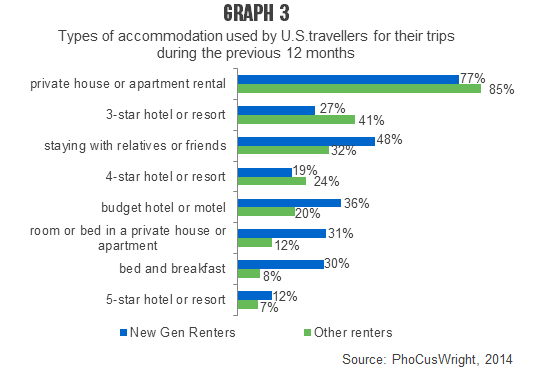
New Gen Renters tend to spend less on accommodation than other renters, since they are more likely to stay in budget hotels, bed and breakfasts or rooms, or else rent a bed in a private home (see Graph 3).

Note that PhoCusWright distinguishes between two types of rental accommodation: the one where the customer rents the entire residence from which the owner is usually absent (see “private house or apartment rental,” below); and the one where the renter only has access to part of the residence, and where the owner is usually present during the rental period (see “room or bed in a private house or apartment,” below). The latter type can be found on websites such as Airbnb, but is completely absent from websites such as HomeAway, that specialize in the first type of rental accommodation.

AL_Airbnb_1_anglais_graph_3

Why choose a rental over hotel accommodation?

The three main deciding factors for all renters are that they can find similar facilities and equipment to those at home, that they have more space, and that the rental can accommodate more people (see Graph 4). However, New Gen Renters particularly like the fact that rentals provide more freedom and privacy than a hotel room, that they offer a more relaxed ambiance, and that they are generally less expensive.

AL_Airbnb_1_anglais_graph_4

How will hotel owners react?

Should hotel owners be alarmed at the prospect of losing part of their clientele to private accommodation? According to PhoCusWright, 82% of non-renters did not even consider the rental option for their trips during the previous 12 months. However, hotel operators would do well to adapt to these New Gen Renters because, although rentals may better meet their needs, they nevertheless use different types of accommodation when travelling.

A second analysis examines the online planning and booking habits of this New Generation, and looks at possible ways of resolving the concerns of the hotel industry.


Image à la une: © BY NC Melies The Bunny

Catégories
Accommodation

Green hotels confuse consumers

Marketing or public relations?

According to Cronin, Smith, Gleim, Ramirez and Martinez (2011), businesses are expected to commit to green marketing strategies because of the increasing public pressure and declare that subscribing to the triple bottom line can increase consumer demand.

With the increasing demand for sustainable tourism comes the increase in green marketing. Consumers wanting to make the ‘right’ choice are bombarded with green options but must be wary and have the ability to decipher between green tourism and green wash. Within the tourism industry, green, sustainable or eco has gained considerable attention in the past few years and the number of green programs in hotels have increased. These programs claim to offer operational efficiencies, cost savings, employee values connection, marketing, and improved public relations. The question, however is – is it working with regard to marketing and public relations?

There have been numerous studies done to ascertain sustainable tourism behavior (see sustainabletourism.net for numerous studies). For example, a study done in 2012 by TripAdvisor stated that 71% of those surveyed would make environmentally friendly choices in the next twelve months. In 2012, TUI, the worlds largest travel provider found that 54% of those surveyed were highly familiar with sustainability and 40% very interested in it. In 2011, 93% of Conde Nast Traveler readers thought travel companies should be responsible for protecting the environment and 58% said their choice of travel is influenced by the support it gives to the local community.

Confusing information

To determine green hotel practices, an in-depth Web search was conducted between September and December 2013. Over 100 pages of Google were analyzed on five different occasions using terms such as ‘Green hotels’, ‘Ecohotels’ ‘Sustainable hotels’.

A number of discrepancies result from the findings. Results show that some hotels that come up on Google searches for ‘eco’ or ‘green’ do not offer very much in terms of ‘green’ practices. One hotel in British Columbia for example, markets itself as an ecoresort but they are not even off the grid and their biggest environmental practice is recycling and composting.

There is also no clear ‘green hotel’ site globally accepted ranking system. Currently in the tourism industry there are a number of certification programs yet none have critical mass. Alternatively, some programs that are gaining ground do not show up in search engine results as they are named something other than ‘green’ or ‘eco’. With so many different terms in the industry such as ‘sustainable’, ‘responsible’, ‘eco’, ‘green’, etc – the industry, the consumer may be getting confused.

Websites from searches fall primarily into four main categories:

  1. Individual hotels promoting their own green programs. These are mainly large hotel groups (e.g. Kimpton, Marriott etc.)
  2. Websites that certify hotels on a specific set of criteria and award a ranking. Within this category there is a distinction between:
    1. Organizations that provide specific, quantifiable, and detailed criteria  – Green Key, Green Globe, LEED, ISO 1400, Green Seal, Energy Star GSTC and;
    2. Organizations for which the criteria are vague and hard to quantify – Eco Luxury hotels, Eco hotels of the World etc.
    3. Websites that list environmentally friendly hotels based on other providers criteria (e.g. Expedia, TripAdvisor)
    4. Websites that list information and tools on how to become more environmentally friendly (e.g. usually magazine articles providing advice to hotels on how to reduce their footprint)

The majority of Web search results listed environmentally friendly hotels based on other provider’s criteria. For example, Eco lodge, Element, and Green Tourism are all Websites that list hotels that had been awarded LEED certification, or used energy star appliances. In this case the Website was not independently certifying the hotels rather providing a list of green hotels based on established certification systems. These criteria were almost entirely environmental and did not necessarily touch on community or other social issues that many consumers wish to see. Other search results included Websites that list information and tools on how to become a more environmentally friendly hotel (or g ‘greener’ traveler). In this case actual hotels were not listed rather training materials and service providers for implementing sustainable solutions.

Conclusions

From this research, two things are clear. First, many claims of ‘green’ may just be ‘greenwash’. Green wash, or green washing is a term used when referring to business operations that utilize marketing tactics to create the perception of being green through deceptive or exaggerated environmental claims [1]. The primary objective of this marketing ploy is to convince consumers that the businesses or hotels in this case, are implementing sustainable initiatives when in reality they may be doing very little. Today, much of consumers awareness is still around towel washing and hotels have not yet increased awareness about other issues such as waste, electricity, heating/cooling or social and community elements.

The second thing that is clear is that ‘green’ is gaining traction. Although information may be confusing – there is more of it. It is potentially good news that TripAdvisor now has a ‘green’ rating (http://green.tripadvisor.com/) as it has become powerful enough to force hotels to improve quality or whatever element reviewers complain about. With over 40 million monthly viewers, it can be a strong influencer for consumers to make more sustainable choices. Unfortunately it only rates hotels based on environmental choices rather than social or community criteria. As many travelers want to know what the hotel is doing for the local community, this is unfortunate.

Although the benefits of capturing the revenue and business of the green-oriented traveler is an attractive prospect  – many consumers may struggle to make informed green choices based on the information currently available. Hotels shouldn’t just rely on attracting the green consumer though as green programs also improve operational efficiencies, save costs and attract, retain, and inspire employees – worth implementing even if marketing is not necessarily working.

If the tourism industry truly wishes to influence the consumer to make ‘green’ choices, then some key elements need to be addressed:

  1. Websites should be transparent for consumers to determine what is green
  2. There is a need for one main website compiling all hotels globally so that a search is easy
  3. Criteria must be consistent so that the consumer knows what is being evaluated

[1] The term was first used by environmentalist Jay Westerveld when objecting to hoteliers’ practice of placing notices in hotels rooms, which asked their guest to reuse towels to ‘save the environment’. In practicality this initiative was more likely motivated by a cost concern that would be reduced by washing fewer towels (Motavalli, 2011).

In collaboration with Julie Ellefsen

Julie graduated from the University of Western Ontario with an honors specialization in Geography before going on to complete her post graduate diploma at Niagara College’s Environmental Resource Management and Assessment Program. She has worked as an environmental consultant completing on site waste, energy and water audits for retail and commercial office spaces and assisting properties with certification process for LEED and BOMA Best. Julie also spent a year abroad in Melbourne Australia working for a solar energy company in sales and business development. Julie’s passion for travel and the environmental issues has naturally sparked interest in sustainability and how it is incorporated into the tourism industry. She has deepened her knowledge of the industry and sustainable tourism through personal travels throughout over 20 countries. She currently is working in as a Marketing Analyst.

Catégories
Accommodation

Ancillary revenues in the hotel industry

Mobile technology can help hoteliers increase their sales of ancillary products and services.

Though ancillary products and services (add-ons) were first introduced by the airlines, they are also sold by hotels, though less often. As long as hotels have the tools to promote such sales, there are numerous opportunities for increasing customer spending: fees for Internet, parking, breakfast, etc. Mobile technology is one such tool that can help boost additional revenues and enhance the customer’s hotel experience.

A practice used throughout the tourism industry

According to PhoCusWright, in 2011 U.S. hotels sold approximately US$1.85 billion in ancillary products and services, which accounted for 1.7% of the country’s total hotel revenues. Compared to the airline industry, a pioneer in the use of additional charges, the hotel sector is not very active. In fact, according to Amadeus, U.S. carriers generated $12.5 billion in ancillary revenues in 2011, representing an average 12% of a company’s operating results. The Forrester and Amadeus firms estimate that by the year 2015, ancillary sales will account for more than 18% of a tourism business’ total revenues.

What are these ancillary products and services?

In the hotel sector, rooms are the core product. All related products and services like food and drink, upgrades, and Internet, cancellation or early departure fees (see Table 1) generate ancillary revenues (see also: La «montée en gamme» ou comment générer des revenus supplémentaires tout en augmentant la satisfaction de la clientèle). They are supplied by the hotel itself or outside service providers (see also: La vente croisée: une source de revenu encore peu exploitée par l’industrie touristique), and are suggested by hotel employees, call centres or delivered automatically via technology.

AL_RevenusComplementaires_tab1_ENG

Mobile technology and its benefits for hotels

While hotel options can be purchased before (e.g., upgrade) or after the client’s stay (customized promotion for the next stay), the time to maximize ancillary revenues is when the client is actually present in the hotel.


According to PhoCusWright, mobile technology appears to be one means of accomplishing this by increasing the visibility of ancillary products and services at each point of contact with guests. Hotels with their own app or mobile website version can make customized, location-based offerings available on smart phones and tablets. Hotels have already realized the importance of this market, for many of them have added a tool for reserving spa treatments or ordering in-room services to their mobile site or app.

The many uses of mobile devices in hotels

When hotel in-room tablets are available, they boost sales of in-room services and on-demand films and games. QR codes can be placed in various locations throughout the establishment to facilitate communication AL_RevenusComplementaires_image1with guests, encourage customer feedback and promote specials at the restaurant or souvenir shop. Mobile payments using NFC technology (see also: La tendance cash-less gagne l’industrie touristique) also help hoteliers sell more ancillary products. Finally, hotels who belong to location-based social networking sites like Foursquare can use them to share promotions that entice clients to spend more (get the second breakfast free, two drinks for the price of one, etc.).

Micros’ MyStayManager application organizes a guest’s entire hotel stay: reservation, additional products and services as needed, check-in, in-room services, wake-up call, spa reservation, view of final bill and check-out. Hotels can send targeted promotions to each guest by email or text message, inviting them to take advantage of the services and products available in the establishment.

How can hotels increase ancillary revenues?

It is not easy to make ancillary sales.  Here are the challenges facing both managers and third parties:

  • Determine points of contact and the customer profile

PhoCusWright has identified the points of contact for each stage of the travel cycle (see Table 2), and there are numerous opportunities for hotels to increase ancillary sales. The firm recommends that hotels make greater use of « up-selling » when rooms are reserved, just like airlines do. According to Valyn Perini, CEO of OpenTravel Alliance, they can then make more offers between the booking date and arrival date.

AL_RevenusComplementaires_tab2_ENG

  • Have the right technology

The global distribution systems (GDS) of traditional travel agencies, online agencies and meta-search engines do not provide customers with access to all ancillary hotel products and services. This means that hotel managers have a competitive edge, if they can offer these products on their hotel website and they have high-performance management systems (see also: Technologies en hôtellerie: regard sur les systèmes de gestion).

  • Manage inventory and availability

Hotels must assess their potential future sales and anticipate how much inventory is needed. Some products are limited in number (e.g., spa treatments), while others can be sold without restriction (e.g., breakfast). It is also essential that product and service availability be updated in all reservation systems.

  • Other obstacles

Hoteliers hesitate to make ancillary products and services accessible via third-party distribution channels, because of the commission charged. Moreover, business travel agencies like Carlson Wagonlit Travel and American Express are not likely to suggest these options, because their clients are used to getting services comped in hotels and thus do not feel like they should pay.

Is there a magic formula?

To increase its ancillary revenues, an establishment must meet certain conditions: communicate effectively with its clients, know their preferences and needs, multiply opportunities for interaction, and adopt mobile technology and payment. If hoteliers suggest personalized products and services adapted to the traveller’s current stage (before, during or after the stay), these products will be perceived as value-added services and not sales.


Sources:

– Amadeus. « Airline ancillary revenue soars to $32.5 billion worldwide in 2011, » amadeus.com, 19 October 2011.

– Dandapani, Vijay. « Pricing Ancillary Goods and Services, » 4hoteliers.com, 6 March 2013.

– Google and Nielsen. « Mobile Search Moments – Understanding How Mobile Drives Conversions,« , google.com, March 2013.

– Juman, David and Ralph Merten. « Tee Times & Touchscreens: Hotels Leverage Mobile to Drive Ancillary Sales » insider.phocuswright.com, 13 February 2013.

– Merten, Ralph. « Hotel Ancillary Revenue in Europe, » PhoCusWright, January 2013.

– Samuels, Gerry. « Can mobile change the way travellers feel about ancillary products? » tnooz.com, 2 June 2011.

– Turner, Shawn A. «Hotel ancillary revenue model questioned, » hotelnewsnow.com, 9 March 2011.


Catégories
Accommodation Issues

Hotels must innovate to successfully compete

At the Association des hôteliers du Québec annual convention on February 6, Alain April explained that hotel owners must be creative and update their properties to maintain and improve their competitiveness. With the exception of luxury hotels, Québec hotels seem to be lagging when it comes to ingenuity and modernization. This sector, composed primarily of mid-range hotels, must find ways to innovate. The examples below may provide some inspiration.

Top priority: Satisfy your target markets

• Women

Hotels are pampering female travellers, offering them a range of personalized services and facilities like emergency kits with all the necessities, make-up, ultramodern hairdryers, rooms with large closets, and yoga mats and DVDs. Vancouver’s Georgian Court Hotel has even set aside 18 rooms specifically for women, at no extra cost.

• Children

Hotels are treating children like little adults. The Steigenberger Hotel Gstaad-Saanen , in Switzerland, has installed a climbing wall and a kid’s spa. Le Meurice, in Paris, provides child-sized robes and slippers and serves children tea and sweets.

• Businesspeople

Flexibility is the key to attracting business travellers. As part of their loyalty program, Starwood Hotels and Resorts guarantees that customers who stay more than 75 nights per year can get a room at any time, day or night, at no extra cost.

Major changes in interior design

Hotels are transforming their decor to attract younger travellers, who like relaxed settings that encourage socializing and networking . Some hotel chains have been designed with this in mind, notably the Radisson Blu (see image, lower left) and the Hyatt House. Traditional lobbies are being replaced by common areas where guests can have a drink, enjoy a light meal or buy souvenirs. Reception desks are disappearing and self-service check-in terminals are becoming more widespread. Some establishments are making the hotel lobby a place for creativity. Le Méridien Hub (see image, lower right) reinterprets the hotel lobby as a « a gathering place for creative minds » with artwork, a lounge and a library (see also: Dessine-moi un nouveau hall!).

Sources: Chicagonista and Le Méridien Hub

So-called lifestyle hotels (see also: Hôtel lifestyle: autopsie d’un concept) are designed to meet the needs of young hip, urban travellers. The rooms in the Hôtel du Triangle d’Or in Paris are inspired by the theme of music and its lobby features a multimedia area equipped with headphones.

Source: Hôtel du triangle d’or

New must-have technologies

According to a hotels.com survey of Canadian travellers, the iPad is the second-most popular modern amenity requested by this clientele , following the high-end coffee maker. Although tablets and touch screens are increasingly common at concierge and reception desks, they are now appearing in restaurants and rooms as well. At Parisian hotel Mama Shelter, the restaurant tables feature inset touch screens and there is an iMac photo space so patrons can take pictures of themselves and display them on screens throughout the restaurant.

Source: Mama Shelter

Accor has joined forces with Microsoft to integrate video games into its new modular room concept. Created in the Novotel Vaugirard Montparnasse in Paris, room « 3120 » was tested during a three-month pilot project.

Source: MSN.fr

Sustainable choices

More and more hotels have adopted sustainable development as a guiding principle. Delta Hotels and Resorts have launched « Delta Greens, » an initiative where every employee works to achieve the company’s stated goals: reduce energy consumption, carbon emissions and water consumption by 30% in the next five years. In France, the Comfort Hotel Lille Tourcoing in 2011 created a hotel room that is 80% recyclable, the first of its kind in Europe. In Accor’s Mercure hotels, all pillows and duvets are made of recycled plastic bottles. When no longer needed by the hotel, these items are then recycled and transformed into building and auto insulation.

Business events get a makeover

Basement-level meeting rooms are no longer popular, with users seeking rooms on the upper floors, preferably those with a panoramic view of the outside. New meeting spaces are bathed in natural light, like those at the JW Marriott L.A. LIVE, or offer a warm, inviting atmosphere, like the rooms at Meet at the apartment, in New York City.

Source: JW Marriott L.A. LIVE

Source: Meet at the apartment

Eating well and staying in shape

According to an Omni Hotels & Resorts survey, 56% of business clients would like hotel restaurant menus to offer more low-fat meal options. Over 70% of respondents would like to see healthy snacks in their minibar. In response, some hotels are replacing elaborate hard-to-digest business lunches with cold lunches. In addition, Fairmont has introduced a low-cal children’s menu, while Omni Hotels offer a gluten-free breakfast buffet. Connecticut’s Delamar hotels in Greenwich Harbor and Southport now stock their minibars with local products.

Source: USA Today

The Omni group survey also shows that business travellers would like more opportunities to work out. Therefore, the group’s Los Angeles and San Diego hotels now offer Get Fit Kits and Get Fit Rooms with treadmills. To make the fitness centre more fun, Le Parker Meridien in New York City has installed a Wii gaming console.

Well-rested guests are satisfied guests!

All the technology in the world is no good to a client who can’t get a good night’s sleep. Some hotels have taken this to heart and are working to improve the quality of their guests’ sleep. The Crowne Plaza hotel chain is testing snore-absorption rooms equipped with sound proof walls and headboards, specially designed anti-snoring pillows and wedges and a white noise machine to reduce the sound of snoring.

The Dorchester Collection has enlisted the services of a Paris sleep clinic to develop a sleep aid tool. Resembling a bedside lamp, this device diffuses light wavelengths and sound frequencies that help guests fall asleep. Finally, Scandic is the first hotel chain in the world to introduce beds that guests can adjust to their height, weight, body shape and sleeping position, using a remote.

There are any number of ways to amaze customers and foster loyalty. To remain competitive, Québec’s hotels must embrace innovation in order to reinvent themselves. Take inspiration from the creative ideas of the major chains and then call on design and technology professionals to help you carry out your new projects!


Sources:

– April, Alain. « Rôle de l’hôtellerie au sein de l’échiquier touristique québécois, » talk delivered at the Association des hôteliers du Québec annual convention, Manoir St-Castin, February 6, 2012.

– É. de B. « Chez Mercure, rien ne se perd tout se transforme« , L’Hotellerie Restauration, July 26, 2011.

– Lenoir, Aude. « Nouvelles tendances en hôtellerie« , presentation given at the Association des hôteliers du Québec annual convention, Manoir St-Castin, February 6, 2012.

– Hospitality Net. « Scandic introduces personally customized beds as the first hotel chain in the world« , hospitalitynet.org, February 16, 2012.

– Nayer, Mélanie. « Dorchester Collection Introduces Innovative Luxuries to Hotels« , 4hoteliers.com, February 15, 2012.

– Poulin, Ginette. « La CITQ fait le bilan de dix années de classification de l’industrie touristique« , hrimag.com, February 1, 2012.

– PR Newswire. « New Wellness Report Released by Omni Hotels & Resorts Reveals On-The-Road Habits of Business Travelers » prnewswire.com, September 20, 2011.

– Springwise. « Hotel “minibar” offers up food for the mind » springwise.com, February 23, 2011.

– Tendance Hôtellerie. « Crowne Plaza crée la nuit d’hôtel sans ronflements » tendancehotellerie.fr, June 28, 2011.

– Tendance Hôtellerie. « Etude TravelClick® aux États-Unis: 1/4 des chambres sont réservées sur les sites web des hôtels« , tendancehotellerie.fr, January 16, 2012.

– Tour Magazine. « Lille: ouverture de la première chambre d’hôtel recyclable« , tourmagazine.fr, September 6, 2011.

– Travelpulse. « Le Meridien Hotels Unveils New Lobby Concept in Barcelona« , travelpulse.com, June 23, 2011.

– Trejos, Nancy. « Hotels cater to special diets; gluten-free food now on menus« , travel.usatoday.com, February 5, 2012.

– Trejos, Nancy. « Goodbye potato chips; Hotel mini-bars turn exotic and even healthy« , usatoday.com, February 8, 2012.

– Vong, Katherine. « Flexible Hotel Check-Ins« , trendhunter.com, February 7, 2012.

Catégories
Accommodation Around the world

Albergo diffuso: An alternative form of hospitality

Buildings located in historic areas are given a second life as they welcome visitors eager to learn about and experience local culture. This is the albergo diffuso, an Italian concept that combines the very old with the contemporary.

Concept

An albergo diffuso is a type of accommodation that offers the services of a traditional hotel along with a space that is like a rented private home. One of the special features of this Italian concept is its horizontal structure, which spreads the hotel services over several buildings. For example, the guest rooms and apartments may be located on different streets in the same neighbourhood, while the reception area is located in location X, the restaurant in location Y and other services in location Z, all within a 200-metre radius.

International publications have sometimes described the concept as a hotel-village.

Source: Villa Retrosi

Another distinctive feature of the albergo diffuso is the age of the buildings that compose it. In fact, one of the goals of the concept is to repurpose abandoned buildings, houses and even monuments. The idea is not to build anything new, but to reuse.


Source: Castello di Montignano Relais & Spa

The guidelines of the albergo diffuso model respect the values of sustainable development in many respects:

  • Promote local culture: one reason visitors select this type of accommodation is to enjoy an authentic local experience.
  • Stimulate the local economy: the creation of an albergo diffuso encourages one or more homeowners to participate in an organization that is usually a cooperative and supports the development of small businesses working in traditional sectors like handicrafts and food preparation.
  • Protect the environment: preserving existing buildings and giving them a second life helps safeguard the area’s history and limits the environmental damage that could be caused by new construction.

This type of hospitality is also reminiscent of the old European tradition of hosting tourists in homes.

An increasingly structured concept

To be able to call itself an albergo diffuso, an accommodation must meet several conditions, summarized as follows:

  • The idea must be launched by local stakeholders
  • Hotel services (reception, restaurant, etc.) must be provided
  • There must be a sole management entity: a single entrepreneur or any other efficient form of association, with a cooperative being the most commonly used form
  • There must be a minimum of seven rooms, located within 200 metres of each other and made available for a period of at least nine years
  • The town or village where the albergo diffuso is located must offer a minimum of services such as a pharmacy, grocery store, etc.
  • The albergo diffuso must take root in a lively, welcoming community that is open to sharing experiences with visitors


In the past few years, an association, the Associazione Nazionale Alberghi Diffusi (ADI), has been founded to help its members market themselves. At the same time, the Scuola Internazionale di Specializzazione in Albergo Diffuso, a school specializing in albergo diffuso, offers seminars, training and tools to assist property owners, management companies and local communities who are implementing this concept in their area.

Examples

The tiny medieval village of Smerillo is a centre of poetry that hosts the festival Le Parole della Montagna (“the words of the mountain”). Since 1998, the local authorities have been inviting certain homeowners to renovate their properties so they could be part of an albergo diffuso. Despite its population of 400, Smerillo can accommodate 60 visitors.

Source: Smerillo Albergo Diffuso

Le grotte della civita is an unusual example of the albergo diffuso concept; the 18 rooms are located in hillside caves! The goal of this albergo diffuso was to conserve Matera, a historic Apennine village in central southern Italy, and preserve its local heritage.

Source: Le grotte della civita

An exportable concept

The albergo diffuso model may be copied in other countries by adapting it to the host region. Moreover, the Business Innovation Centre of the Lazio Region, BIC Lazio, and the ADI offer technical assistance to the various countries that would like to implement this approach.

Will the albergo diffuso concept make its way to Quebec? It would be one way to revitalize certain villages affected by the rural exodus, repurpose some of the buildings from our religious heritage or even develop a network of accommodations in Quebec’s Far North.

—————————————


Comment – Giacomo Del Chiappa

Albergo diffuso represents a particular type of hospitality which help to achieve a sustainable tourism development (economic, environmental and sociocultural) of area that usually are abandoned. Indeed, albergo diffuso is usually considers as a way to recover the competitiveness of rural area which are interested by progressive flows of people leaving the rural area (emigrating) attracted from the more sparkling urban area. By this way, albergo diffuso is consider as a way to achieve a sustainable tourism development, creating job opportunities for local people, recovering the builindings, allowing to preserve and exploit the local authenticity and identity thus having the possibility to satisfy the needs of those travelers, the so called responsible tourists, (even more numerous) that travel looking for the possibility to be in touch with local authenticity, identity and culture in its various espressions (food, wine, cooking style, handcraft, etc) . Several examples could be done. One of this is Santo Stefano Sessanio located in the “Gran Sasso” national park in Abruzzo region. There everything is done to preserve local authenticity: research was done to understand how the old house were built, rooms has wool mattresses made as in the past and embroidered sheets accordingly the local traditions. Acccording with Kihgreln, the architect who developed this albergo diffuso, today the real estate in the village has been tripled.


Giacomo Del Chiappa – Assistant Professor in Marketing, Faculty of Economics, University of Sassari
Giacomo Del Chiappa received a Ph.D in “Marketing and Business Administration” at the Faculty of Economics of the University of Milan-Bicocca. He was Visiting Scholar at the University of Melbourne (Australia). He is Assistant Professor in Marketing at the University of Sassari, Faculty of Economics. He teaches in the areas of “Tourism Management and Marketing” and “Destination Management” for the Degree in Tourism Marketing and Management, based in Olbia (Sardinia). He is a member of the editorial board of the journal “Tourism Analysis” and referee for international journals. His research topics are related to destination governance and branding, convention site selection criteria and meeting industry and, finally, consumer behavior in tourism. In this latter field his studies are concentrated on responsible tourism, on web 2.0 in the hospitality sector and, finally, on community-based tourism. Fields of expertise:

  • Destination governance and branding
  • Convention site selection criteria and meeting industry
  • Consumer behavior

Organization Web site


Sources:

• Giordano Dichter, Giancarlo Dall’Ara. “Albergo diffuso – Developing tourism through innovation and tradition.”

• Marinela Dropulic, Aleksandra Krajnovic, Pavlo Ruzic. “Albergo diffuso hotels – A solution to sustainable development of tourism,” March 2008.

• M. Droli, S.I.S.A.D®. (International School Specializing in the Albergo Diffuso). “The albergo diffuso in Italy – The strengths of Friuli Venezia Giulia and innovative proposals,” March 22, 2007.

• Michèle Prévost, “L’hôtel diffus – Un concept d’hébergement rural qui se développe en Italie.” Espaces 295, September 2011.


Websites:

Associazione Nazionale Alberghi Diffusi

Bic Lazio

Scuola Internazionale di Specializzazione in Albergo Diffuso

Catégories
Accommodation etourism and technology Marketing @en

The Troubling Trend of Increasing ‘Web Marketing Ineptitude’ in Hospitality… by Max Starkov

The Québec Tourism Intelligence Network is pleased to present some highly relevant thoughts about online marketing of hotels, written by special collaborator M. Starkov, consultant in Hospitality eBusiness Strategies.

Throughout our nearly 15 years of hotel Internet marketing experience, we have been consistently concerned about the increasing level of disparity between savvy Internet/Mobile marketers in hospitality and travel, and the Internet/Mobile Marketing-inept players in the industry.With the advent of social media in recent years, Web 2.0 technologies and the mobile Web, this disparity has accelerated dramatically.

On one side there are the extremely Web-savvy:

  • Online travel agencies like Expedia, Travelocity, etc.
  • Most major hotel brands’ e-commerce departments
  • Airlines
  • Some e-commerce departments at smaller and mid-size hotel and resort chains
  • Some very bright individuals at the marketing departments of full service hotels, resorts and casinos

On the other side there is everybody else, which unfortunately means the majority of hospitality executives and sales and marketing professionals.
HeBS defines “Web Marketing Ineptitude” as the lack of hands-on experience in Internet marketing and all of its formats: website re-designs, SEO optimizations, search marketing, email marketing, strategic linking, banner advertising and online sponsorships, social media and Web 2.0 and more recently, mobile marketing. In addition, this ineptitude also indicates a lack of understanding of best practices and latest trends in the direct online channel.

In the 1990s, it was “normal” that only a few hospitality and travel marketers were proficient in the online channel.  Less than 3% of travel reservations in the U.S. were booked online back in 1999. In the 2000s (in 2001, online travel bookings reached 5.4% of all travel reservations in the U.S.), hospitality marketers and the major hotel brands began to pay closer attention to the Internet channel. In the years that followed, Internet travel adoption increased dramatically and in 2009 alone over 55% of all travel reservations in the U.S. will be online (45% of all hotel reservations) to the tune of a staggering $116.1 billion (eMarketer).

Yet, to our dismay, over the past 15 years the level of Internet marketing expertise in the hospitality industry has not kept up with this remarkable growth. On the contrary, we are witnessing whole new generations of hospitality executives and marketing professionals who are unfamiliar with Internet marketing in general as well as best practices and trends in the direct online channel.

This problem has been exacerbated by a) the social media and Web 2.0 phenomena, and b) mobile marketing. Both of these new marketing and distribution channels introduced an entirely new level of complexity and skill set requirements, as well as new best practices and trends.

  • Social Media have changed how customers plan and purchase travel, how customers access information, and how customers perceive the credibility of information. How can hoteliers create/monitor/take advantage of the social media “chatter” around the hotel, target receptive audiences, and ultimately stimulate hotel website visits, interactions and bookings? What type of Web 2.0 and interactive features and functionality do you need on the hotel website?
  • Mobile Web is expected to surpass the traditional Web within the next five years. The promise of “immediate, anywhere and anytime” Internet access, instant information and transaction capabilities, location-based services and personalization are some of the key factors for the “explosion” of the mobile Web. Hotel guests–past, current and potential–are increasingly becoming mobile-ready and hoteliers have to respond adequately to this growing demand for mobile services. This is the reason why hoteliers and travel marketers need to have robust mobile Web initiatives in place, including mobile brand websites, mobile apps, m-CRM and mobile marketing.

Why Is There a Growing Web Marketing Ineptitude in the Industry?

There are many reasons for this “Web Marketing Ineptitude” among the ranks, but here are some of the most important:

Franchised Properties:

  • Many major brands control all Internet marketing initiatives at the corporate level, including property-level initiatives, thus depriving staff at the property from any meaningful experience in Internet marketing.
  • We have seen a trend among small/mid-size chains to establish small but vital e‑commerce departments. In many cases, these companies outsource whatever online marketing they do to outside vendors. Here again, when outsourcing, they make a crucial mistake by not demanding professional development to be part of the Internet marketing vendor’s responsibilities. This results in Internet marketing expertise not being disseminated to the properties in the process.

Independent Hotels and Resorts:

  • The biggest concentration of Internet marketing knowledge is at this level.
  • Many big full-service hotels and resorts have some form of in-house Internet expertise. However, due to staff turnover and constantly decreasing budgets, these properties tend to have a very spotty Internet expertise retention rate.
  • Smaller hotels and resorts are most vulnerable due to limited budgets and difficulties with hiring and retaining employees with expert knowledge.

Destination Marketing Organizations (DMOs) and Convention and Visitor Bureaus (CVBs):

  • These organizations boast some of the brightest Internet marketing stars and some of the most inept marketers.
  • In many cases among DMOs and CVBs, ignoring Internet marketing best practices is not even a matter of budget size, but a result of inertia and commitment to traditional advertising formats.
  • The government or quasi -government nature of CVBs and tourism offices does not help with the hiring and retention of Internet expertise.

So What Is the Verdict?

HeBS believes there are different levels of Web Marketing Ineptitude in the industry regarding three important marketing media: Traditional Web, Social Media/Web 2.0 and Mobile Web. Here are our estimates of the ineptitude rates in each of these media:

Internet Marketing/Traditional Web

  • Nearly 15 years of existence of the traditional Web
  • Internet Marketing Ineptitude rate in hospitality:  65%

Web 2.0/Social Media Marketing

  • Nearly 5 years of existence of social media
  • Web 2.0/Social Media Marketing Ineptitude rate in hospitality:  90%

Mobile Marketing/Mobile Web

  • Nearly 10 years of existence of Mobile Web but in reality, the Mobile Web in the U.S. exploded with the introduction of the first iPhone in June 2007.
  • Mobile Marketing Ineptitude rate in hospitality:  97%

Conclusion

Hoteliers should strive to gain a crystal-clear understanding of what the best practices and latest trends are in hospitality Internet marketing: what works, what doesn’t, and why. Hoteliers should recognize that they do not have all the answers in-house and that there are thought leaders and other proven industry experts who can help them and their property stay competitive in these economic times, preserve and increase market share, and generate the highest website revenues and ROIs.

Hoteliers should take a hard look at how Best Industry Practices are being utilized by their corporate offices or major brands, as well as by the hotel’s Internet marketing vendors. Almost 15 years after the first online hotel booking, best practices have been established in practically every aspect of hotel Internet marketing. Hoteliers should not allow their Internet marketing vendors to “learn the business on the hotel’s dime.”

The prospect of professional development should become the main criterion when choosing an Internet marketing vendor.  Hoteliers should hire experts who are able and willing to teach the hotel and staff best practices and keep the hotel appraised of the latest direct online channel trends.

Hoteliers should work only with Internet marketing experts who can help them acquire new core competencies and adopt best industry practices in the direct online channel. 

They should provide crucial professional development as well as guide the hotel’s direct Internet marketing strategies, online brand building strategies, e-CRM, website re-design and SEO optimization, search and email marketing, social media and mobile marketing initiatives.

Catégories
Accommodation Sustainable tourism

Greening American hotels: some practical measures implemented so far by the lodging sector

The number of certified green hotels continues to grow, but the eco-efficiency measures implemented vary widely among establishments. For many hotels, a sustainability strategy includes working towards carbon neutrality, community involvement, supporting conservation initiatives and participating in a range of certification programs. However, not all hotels are green, and often even basic measures have not been taken to improve performance, as outlined in the recent findings of the 2008 American Hotel and Lodging Association (AH&LA) and Smith Travel Research Report (1) (referred to as the AH&LA Report in this analysis). This study presents data based on a total of 10,350 responses, or 23% of the entire sector in the United States.

Measure 1: Linen/towel reuse programs

Linen reuse programs have emerged as one of the oldest and most popular forms of energy conservation measures since they directly result in cost savings on labour, water, energy and detergent use. This measure is an easy way to improve resource efficiency, and research suggests that 75% of guests who have the opportunity to participate in such programs, do (2). Furthermore, guests are more likely to reuse their towels when they know other guests are doing it, as the research shows that signs focussing on environmental benefits are less effective than signs that point out the level of participation of other guests. According to the AH&LA Report, 67% of establishments had a linen/towel reuse program in 2008, compared to 52% in 2004 (1). Analysis by price segment shows that 63% of economy hotels have adopted the program, while 76% of luxury hotels have. Larger hotels are more likely to implement this program than smaller establishments.

Measure 2: Liquid soap dispensers

Greenlodgingnews.com estimates that approximately ten billion shower amenity packaging pieces are thrown away annually by the world’s hotels (3). The installation of liquid soap dispensers is an eco-efficiency measure that saves 70% on waste production and reduces operational costs because cleaning staff do not have to replace amenities daily. According to the AH&LA Report, the use of liquid soap dispensers increased from 6% in 2004 to 22% in 2008 across surveyed hotels. Analysis by price segment shows that 15% of budget hotels, compared to 20% of luxury establishments, have installed liquid soap dispensers in their establishments, while the size of a hotel seems to have no effect on the rate of installation.

Measure 3: In-room energy management sensors

The UNEP estimates that the accommodation sector contributes 21% of all tourism-generated CO2 emissions globally (4). In addition, maintaining the heating, TV and lights in empty rooms can cost up to 20% of a hotel’s electricity budget. Many hotels have installed in-room energy monitoring systems in recent years in an effort to be eco-efficient. The manufacturers of some sensors report that the savings in energy costs due to monitors provide a return on investment within just one year. These monitoring systems function automatically and are time-savers for management staff, who do not have to manually adjust the controls in each room (5). Of course, energy use per-room can also be reduced if guests simply pay attention to switching things off themselves and if hotel managers book one floor at a time (6). This measure can help reduce energy consumption, especially during low occupancy periods. The AH&LA Report shows that, across the United States, 25% of establishments had in-room energy management sensors in 2008, compared to 15% in 2004 (1). By price segment, 38% of budget hotels had installed this tool, compared to 32% in the luxury segment. In terms of hotel size, larger hotels appear to have installed sensors in greater numbers than smaller hotels have.

Measure 4: Recycling programs

The implementation of recycling programs can be difficult since it depends on the availability of additional infrastructure and considerable logistics to deal with the waste collected (4). This is particularly true in remote and isolated areas. However, hotels are implementing recycling programs slowly, and trends suggest a general rise. According to the AH&LA Report, in 2008, 40% of establishments in the United States had recycling programs, compared to 32% in 2004 (1). A comparison according to price segment shows that only 21% of budget hotels recycle, compared to 56% of luxury establishments. It seems that mid-sized hotels with 20 to 129 rooms are less likely to recycle when compared to smaller hotels and those with more than 130 rooms.

Measure 5: Energy-efficient lighting

A lot of hotels have replaced their incandescent light fixtures, especially hallway lighting, with T5 and T8 fluorescent lamps. In many cases, government organizations provide incentives via subsidies and rebates to encourage this practice. According to the AH&LA Report (1), in 2008, 68% of all American hotels had energy-efficient lighting installed, and there were very few differences in implementation according to either price segment or room range.

Measure 6: Water saving programs

The UNEP estimates that tourists typically use four times more water when travelling, compared to staying at home (4). Some fixtures such as efficient bathroom faucets and dual-flush toilets can help hotels reduce their water use between 20% and 40%. The number of products on the market to improve water efficiency is on the rise and the U.S. Environmental Protection Agency has a voluntary partnership program called WaterSense, which labels designated products and services that conserve water. The AH&LA Report shows that water saving programs had been implemented by 46% of surveyed establishments across the United States in 2008. According to price range, 64% of budget hotels had done so, compared to 50% of luxury hotels. Analysis according to the size of the hotel shows no clear pattern in implementation; however, it seems that larger hotels are more active in saving water resources.

Conclusions

Like any business, a hotel needs to respect its triple bottom line in order to stay competitive. While green programs offer significant cost savings, the guest response to these programs (impact on loyalty, price sensitivity) can also provide a significant market opportunity (7). According to the Market Metrix Hospitality Index Survey (8), overall, guests who rank a hotel’s green program highly are willing to pay at least 7% more for their room compared to other guests. These same guests also stay longer, are happier with their stay and are more likely to consider the loyalty program as “very important” in selecting a hotel. Hotels with highly ranked green programs also experience half as many guest-reported problems (according to the same survey).

Forbes listed the following as America’s greenest hotels for 2008 (9):

  • Marriott New York City
  • Wyland Waikiki, Hawaii
  • Bison Quest Sanctuary and Spa, Montana
  • Seaport Hotel Boston
  • Hotel Triton (Kimpton), San Francisco
  • Lookout Point Inn, Arkansas
  • Banyan Resort, Key West Florida

Sources

(1) Smith Travel Research (2008) Lodging Survey. Lodging, Facilities, Trends 2008. Report prepared for the American Hotel and Lodging Association. Washington, DC, 245 p.

(2) Goldstein, N.J., Cialdini, R.B. and Griskevicius, V. (2008) “Room with a Viewpoint: Using Social Norms to Motivate Environmental Conservation in Hotels.” Journal of Consumer Research, Vol. 35, October.

(3) Greenlodging News (2008) “’Green’ Definitions Can Confuse Conscientious Amenity Purchasers.” www.greenlogingnews.com Last accessed 20 September 2008.

(4) United Nations Environment Programme, Sustainable Consumption & Production Branch (2008) Environmental Impacts of Tourism. www.unep.fr/scp/tourism/sustain/impacts/environmental/ Last accessed 20 September 2008.

(5) Butler, J. (2008) “The Compelling ’Hard Case’ for ’Green’ Hotel Development.” Cornell Hospitality Quarterly 49 (3) 234-244.

(6) Maycock, P. (2008) “Four easy ways to cut carbon and costs.” Hotel News Now. 28 August 2008. www.hotelnewsnow.com Last accessed 28 August 2008.

(7) Houdré, H. (2008) “Sustainable Hospitality: Sustainable Development in the Hotel Industry.” Industry Perspectives: A White Paper Series from Cornell University, School of Hotel Administration, The Center for Hospitality Research, No. 2.

(8) Barsky, J. (2008) Do customers really care about “green”? Market Metrix http://www.marketmetrix.com/ Last accessed 20 September 2008.

(9) Forbes Traveler (2008) “America’s Greenest Hotels 2008.” http://www.forbestraveler.com/resorts-hotels/green-hotels-us-2008-slide.html?partner=msnbc_greenhotels Last accessed 20 September 2008.

Catégories
Accommodation

Tourism-related freshwater issues in Québec

Water has become one of the scarcest resources as its consumption has increased sixfold in the last century. At the present time, over 40% of the world’s population lives in water poverty (1-4). In Québec, water quality and resource ownership are of greater concern than water availability since many lakes have suffered from algal outbreaks associated with eutrophication (5). Eutrophication is a transformative process affecting water quality, which results in a water body reaching a nutrient-enriched state (5, 6). Natural processes related to the ageing of lakes can cause eutrophication because the decomposition of organisms in the water consumes available oxygen. This contributes to nutrient enrichment, but eutrophication can also be caused by pollution from human activity (7).

In any situation, eutrophication is influenced by the natural characteristics of a lake, as well as by the land uses around its watershed (8, 9). One result of eutrophication can be the excessive growth of phytoplankton and algae, as well as changes in species abundance and composition, biomass production and dissolved oxygen content. Once a lake becomes eutrophic, it can trigger the rapid growth of certain harmful algae types such as blue-green algae or cyanobacteria (10, 11). These algae are the most commonly known harmful algae in freshwater bodies. In Europe and North America, agricultural sources are generally the primary contributors to eutrophication, followed by sewage and industrial run-off (10, 12). Tourism and recreation can also contribute to eutrophication because the sector uses water and produces waste that often contains harmful chemicals (13).

Tourism and water

The average global tourist uses anywhere from 100 to 2000 litres per day (7), a figure that is several times higher than that of the average residential user. This is directly linked to the operation of tourism facilities, as well as use by visitors for regular activities such showers, swimming in pools, and so on. Water use is high for some activities in particular, such as when ski resorts produce artificial snow.

Tourism-related water consumption is also associated with chemical use, like synthetic fertilizers to maintain green spaces as well as detergents and soaps, all of which can be a significant source of pollution. Furthermore, besides their damaging physical impacts, water-based motorized activities also introduce various hydrocarbon compounds from fuels and anti-fouling paints (14). In Québec, for example, 307 golf courses contribute approximately 40 000 kilograms of active ingredients to ecosystems through fungicides, herbicides and insecticides (15). Sewage outflow from diffuse small-scale tourism and recreation facilities, especially around outfitter camps and resorts, can be a particularly significant source of bacteria and algae in freshwater systems in remote areas (16), although their contribution has not been quantified in Québec. Septic tanks around secondary homes lose up to 25% of their waste, which can seep into the soil and groundwater and, depending on the location, eventually enter a lake (5).

According to sustainable development objectives, the tourism sector needs to use water resources more efficiently and avoid the use of harmful substances that affect its quality (17). In turn, water resource availability and quality also affects tourism but few studies have provided any details quantifying how and where. In Florida, a study showed that algal blooms in coastal waters resulted in net reductions of 29% and 35% for the restaurant and lodging sectors respectively (18). The total net economic effect of diminished lake water quality in Québec has not yet been calculated.

Some solutions

Restoring a water environment is expensive and complex but several mitigation options exist. There are several examples of successful restoration projects in Québec involving collaborative work between the tourism industry, government and non-government organizations (19). Some of these projects have included riparian vegetation planting and the development of recreation activities and infrastructures around lakes. Other management actions, such as planting aquatic species to increase natural filtering mechanisms, may also be pertinent in some lakes because they enable the water to absorb additional nutrient loads (2).

One of the most effective ways is to prevent pollution, and this can be achieved by raising awareness via education. Various organizations recommend more efficient use of water and the elimination of toxic substances. Awareness programs in Québec such as the Charte des lacs (20) remain important tools. Regulation can also be effective. For example, the use of pesticides, herbicides and insecticides is regulated, although various land uses are affected differently. Since 2006, it is against the law to use pesticides on public lawns and green spaces, including semi-public areas and places managed by municipalities (6). Consequently, specific users in the tourism sector such as golf courses are now required to submit plans by 2009 for reducing their use of pesticides by an average 12.9%, fungicides by 9.4%, herbicides by 8.2% and insecticides by 7.4%. There do not appear to be any restrictions imposed on other sectors in tourism.

Time for action

The competition for freshwater resources will likely intensify in the future and climate change will also affect lakes in Canada (21). Some tourism businesses have reduced water use and/or switched from using toxic substances in their operations and replaced polluting products with biodegradable alternatives. However, the extent of change across the whole sector has not been determined. Currently in Québec, it is unclear how either tourism or recreational activities contribute to water quality problems compared to other land uses. It is also not clear how much lakes contribute to the economics of tourism in different regions. It is thus important to understand the relationship between water resources and tourism so that problem mitigation may involve all relevant industry stakeholders.

Sources:

1.    Klessing, L.L. (2001), “Lakes and Society: the Contribution of Lakes to Sustainable Societies,” Lakes and Reservoirs: Research and Management, vol. 6, p. 95-101.
2.    Jöbgen, A.M., A. Palm, and M. Melkonian (2004), “Phosphorus Removal from Eutrophic Lakes Using Periphyton on Submerged Artificial Substratal,” Hydrobiologia, vol. 528, p. 123-142.
3.    Babou, I. and P. Callot (2007), Les dilemmes du tourisme, Vuibert, Paris.
4.    World Resources Institute (2008), Water Resources and Freshwater Ecosystems [http://earthtrends.wri.org/features/index.php?theme=2]. Last accessed May 2, 2008.
5.    Hade, A. (2002), Nos lacs : les connaître pour mieux les protéger, Fides, Québec.
6.    Ministère du Développement durable, de l’Environnement et des Parcs (MDDEP) (2008a), Actions ministérielles en matière de pesticides [www.mddepp.gouv.qc.ca/pesticides/actions.htm]. Last accessed April 28, 2008.
7.    Gössling, S. (2006), “Tourism and Water,” in S. Gössling and C.M. Hall (eds.), Tourism and Global Environmental Change: Ecological, Social, Economic, and Political Interrelationships, Routledge, London, p. 180-194.
8.    Salmaso, N. (2000), “Factors Affecting the Seasonality and Distribution of Cyanobacteria and Chlorophytes: A Case Study from Large Lakes South of the Alps, with Special Reference to Lake Garda,” Hydrobiologia, vol. 438, p. 43-63.
9.    Davis, C. (2007), The Multiple Dimensions of Water Scarcity. EarthTrends. World Resources Institute.
10.    Cronberg, G. (1999), “Qualitative and Quantitative Investigations of Phytoplankton in Lake Ringsjön, Scania, Sweden,” Hydrobiologia, vol. 404, p. 27-40.
11.    Larkin, S.L. and C.M. Adams (2007), “Harmful Algal Blooms and Coastal Business: Economic Consequences in Florida,” Society and Natural Resources, vol. 20, p. 849-859.
12.    McGarrigle, M.L. and W.S.T. Champ (1999), “Keeping Pristine Lakes Clean: Loughs Conn and Mask, Western Ireland,” Hydrobiologia, vol. 395-396, p. 455-469.
13.    Bramwell, B. and G. Pomfret (2007), “Planning for Lake and Lake Shore Tourism: Complexity, Coordination and Adaptation,” International Journal of Tourism and Hospitality Research, vol. 18, no. 1, p. 43-66.
14.    Mosisch, T.D. and A.H. Arthington (2004), “Impacts of Recreational Power-boating on Freshwater Ecosystems,” in R. Buckley (ed.), Environmental Impacts of Ecotourism, Wallingford, CABI Publishing, p. 125-154.
15.    Lavardière, C, S. Dion, and S. Gauthier (2007), Bilan des plans des réductions des pesticides sur les terrains de golf au Québec, Rapport réalisé pour le ministère du Développement durable, de l’Environnement et des Parcs, Gouvernement du Québec.
16.    Lukavsky, J., A. Moravcova, L. Nedbalova, and O. Rauch (2006), “Phytobenthos and Water Quality in Mountain Streams in the Bohemian Forest Under the Influence of Recreational Activity,” Biologia, vol. 61 (Suppl. 20), p. S533-S542.
17.    United Nations Environment Programme, Division of Technology, Industry, and Economics, Sustainable Consumption & Production Branch : Resource Efficiency [http://www.unep.fr/scp/tourism/topics/resource/use.htm]. Last accessed May 2, 2008.
18.    Hoagland, P., D.M. Anderson, Y. Kaoru, and A.W. White (2002), “The Economic Effects of Harmful Algal Blooms in the United States: Estimates, Assessment Issues and Information Needs,” Estuaries, vol. 25, no. 4, p. 819-837.
19.    Tourisme Québec (2000), Guide de mise en valeur des plans d’eau du Québec à des fins récréotouristiques et de conservation du patrimoine, Groupe DBSF for Tourisme Québec.
20.    Ministère du Développement durable, de l’Environnement et des Parcs (MDDEP) (2008b), Charte des lacs [www.menv.gouv.qc.ca/eau/algues-bv/engagement/engagement.asp]. Last accessed May 2, 2008.
21.    Jones, B.E., D. Scott, and S. Gössling (2006), “Lakes and Streams,” in S. Gössling and C.M. Hall (eds.), Tourism and Global Environmental Change: Ecological, Social, Economic, and Political Interrelationships, Routledge, London, p. 67-94.