Catégories
etourism and technology

A 21st-century Toolkit: Fourteen Ways to Boost Your Online Presence

SEO, or Search Engine Optimization

Google has found a way to help small businesses create low-budget, local advertising messages. Adwords Express is a simplified, automated version of Adwords that does not require business owners to have a website. The ads can only be seen by users who search near the business, or who use the name of the city in their search. They are displayed next to the results of Google searches on the Web and on mobile devices, on Google Maps and on the websites of relevant partners. The screen cap (below) shows how a Montreal Bed & Breakfast can compete with Booking, Trivago and Airbnb in terms of visibility.

referencement-chambres-dho%cc%82tes-et-bnb-sur-google

Source: Google

Google Maps is an important Adwords Express feature: only ads from businesses in the travellers’ current geographic area will show when they search for a given product or service.

referencement-chambres-dho%cc%82tes-et-bnb-sur-google-maps

Source: Google

All the business owner has to do is write three lines about their business – including, a title and a description – and set a budget; the rest is done automatically. And, the budget is flexible: it can be increased for greater visibility, or reduced in low season.

However, this effective and profitable strategy should only be used in conjunction with Search Engine Optimization or SEO (article in French only). And, because it can be a challenge to master the complexities of SEO, there are tools to help you create an organic SEO strategy. For instance, WordPress (French only) content management users can install the WordPress SEO by Yoast plugin to optimize their site in search results pages and on social media. The plugin also helps users configure their SEO title settings, meta descriptions and keywords for each page of their site. It also offers advice on how to write better content.

14-outils-art-referencement-naturel  Source: Veilletourisme.ca

Starting this year, Google’s website analytics service, Google Analytics, has a new feature, the Search Console, enabling users to monitor and maintain their site’s presence in Google Search results through reports, tools and educational resources.

Content creation

Buzzsumo is a content intelligence tool that tells users what content is being shared the most across all social networks on a given topic, thereby enabling businesses (among other benefits) to target their blog posts. The following screen cap shows the most shared content on family activities in Québec.

buzzsumo-indique-les-contenus-les-plus-partages-sur-les-reseaux-sociaux

Source: Buzzsumo

In a move to make promotional videos available to small businesses, YouTube recently launched the YouTube Director app, a tool that advises users on content choice and suggests different templates, music and editing tools. With the app, users can easily create video ads from a mobile phone and then upload them to YouTube’s platform.

14-outils-youtube-director

 Source: Adweek

There are also many editing tools out there that make it easy to create compelling visuals, whether for websites, social media posts or paper versions. The Tourism Intelligence Network uses Canva, which has the added benefit of proposing predefined formats for Facebook ad banners, Twitter profile photos, Pinterest posts, and more.

canva-logiciel-de-creation-de-visuels

Source: Canva

Online infographic tools such as Easel.ly and Piktochart offer free, fully customizable templates.

Social Media Management

Managing and updating social media can be a time-consuming process. Fortunately, there are a wide range of tools to auto-schedule posts, monitor your online reputation and generate statistics that measure your actions’ effectiveness. In 2015, G2 Crowd analyzed feedback from hundreds of users on the main social media management tools. The top four – Hootsuite, AgoraPulse, Sendible and Sproutsocial – were assessed based on eight criteria, with AgoraPulse earning the highest approval rating due to its range of compelling features and its ability to meet user needs.

gestion-des-reseaux-sociaux-avec-agorapulse

Source: AgoraPulse je vais chercher une image moins floue

Subscription costs start at approximately $70 per month. While there are sites that cost less, they also offer less. Buffer, for instance, offers a $10-per-month version, but it only covers a maximum of six social media accounts and 100 posts per month.

Online Reputation Management

It’s not always easy to follow what’s being said about your business on the web. The sheer number of company mentions, volume of interactions and speedy response times that can be required all point to the need for a reputation management tool. Talkwalker and Mention both have a free version that lets you create alerts based on keywords, delivered straight to your inbox. The paid versions offer more comprehensive social media monitoring and analysis. They can also identify influencers, measure their effectiveness and provide competitive data intelligence.

Website Performance

Canada’s Business Development Bank offers a free website assessment tool. Simply enter the URL and you will instantly receive a personalized report of several dozen pages that includes a rating from one to ten on different aspects of the site: accessibility, user experience, marketing and technology. It even includes advice on how to solve the problems and make the necessary changes that can be passed on to the webmaster.

Along the same lines, Google has developed a tool to help companies test the strength and speed of their websites across desktop and mobile platforms, with Test My Site with Google.

This wide range of tools enables VSEs and SMEs to compete with the huge corporations’ mega advertising budgets. Do you use them? If so, we’d love your feedback.

Source de l’image à la une: © Pexels

Catégories
etourism and technology

Use instant messaging to provide top-notch customer experience

What is it?

An improved version of cell phone text messaging, instant messaging services – such as WhatsApp, Facebook Messenger, WeChat and Snapchat – are mobile applications that enable real-time communication. In addition to live chat with their contacts, users can send emoticons and stickers, share files and location, start a group chat and make video calls.

Whatsapp

Source: iTunes

Among the main apps currently available, the only one so far with a tourism application is Slack, a tool designed to enable corporate team members to communicate with one another. Recently, through a partnership with online travel communities NomadList and Travel Noire, the tool was used to form two travel chat communities, #nomads and #TNdistrict (also the chat hashtags), whose members help each by sharing information about destinations.

Slack_nomads

Source: #nomads

How Big is the Market?

The most popular, WhatsApp, was acquired by Facebook two years ago, as of February 2016, it has one billion monthly active users.

Four of the five most widely used social networks in the world are instant messaging apps. The most popular, WhatsApp, was acquired by Facebook two years ago, as of February 2016, it has one billion monthly active users. It is followed by Chinese app QQ Mobile (860 million users) and Facebook Messenger (800 million users). Search giant Google announced last December that it plans to launch a similar application. Apparently, it will include an automated virtual assistant, or chatbot, that will quickly respond to certain user questions.

According to industry intelligence platform Skift, the current era (dubbed the Post-App Economy) is a result of the rapid growth of instant messaging. Skift predicts that brands and businesses will take over applications that offer the most opportunities for real-time interaction with consumers. The information in the following table is by no means final and may well change in the near future.

graph messaging

eMarketer claims that 75% of cell phone users worldwide used a mobile messaging app at least once a month during 2015 . The firm also estimates that 13.4 billion Canadians used these apps in 2015, up 40% over last year. Facebook Messenger was the most commonly used app in Canada and the U.S., used by 22.6% and 17.3% of Internet users respectively in July 2015.

The Tourism Industry Jumps on the Bandwagon

Some tourism-related businesses have invested in this new communication platform and are finding new uses for it. WeChat is widely used by China’s tourism industry, and Air France also has an account to answer customers’ travel questions. China Southern Airline uses the app to offer an online check-in service, Shangri-La Hotels offer a price comparison search function on it, and readers can access the comments made by Marriott hotel chain customers on its WeChat account.

Others have used it as a model to create innovative personal assistant tools that resemble a concierge service:

  • Online travel agency Kayak offers a text messaging service called KAYAK Snap, only available in the United States, that helps users create the perfect trip;
  • Users of the Hyper Travel app can chat with an experienced travel agent to plan and reserve trips and receive assistance once they arrive.
  • Last year, HotelTonight launched Aces, an in-app chat feature that connects customers with a team of advisors for access to local tips and recommendations, plus help with hotel bookings through text messaging and online chat. A certain number of automated responses are sent in answer to FAQs.

  • Joie de Vivre and Thompson Hotels have integrated CheckMate into their app. All conversations, whether via text, email or on the hotel’s app, are centralized by hotel for every stage of the customer’s trip. From their cell phone, customers can request a room upgrade, find out when their room is ready, order room service, make restaurant reservations or ask a valet to bring their car.

Checkmate_hotel

Source: Skift

Improved Customer Relations

All interactions between the customer and the company’s various stakeholders

For tourism-related businesses, these mobile apps provide a way to improve their customer service by adopting an omni-channel approach. In Checkmate’s case, all interactions between the customer and the company’s various stakeholders appear in a single, shared Inbox, allowing staff members to more easily follow up on customer requests. This promotes a consistent and seamless experience, in which the brand speaks with a single, unified voice.

In the past five years, the growth in instant messaging apps has outstripped that of social media platforms. Indeed, Skift has called them one of the Megatrends Defining Travel in 2016, saying that tourism companies need to jump onboard. Customers are sure to make ever-greater use of messaging services because these apps meet all their needs. Not only can they book their trip on them, they can chat with the tourism company and their family and friends while they are away.

What about you? Do you think that instant messaging is the future of online communication?


Source of the header image: © pexels

Catégories
Accommodation etourism and technology

Online Behaviour of Airbnb Travellers

The private accommodation rental market has not escaped the tidal wave of online information that brings us to today’s diversified offer on a number of specialized sites. The PhoCusWright study states that, in the United States, the penetration rate of these online reservations has gone from 12% in 2008 to 24% in 2012. The arrival of start-ups in the collaborative economy, such as Airbnb, and the improvement of already well-established sites in this market, such as HomeAway, have helped accelerate this trend.

This trend gave rise to a new generation of renters, or “New Gen Renters,” whose travel behaviour differs from that of travellers who use other types of accommodation. This distinction was made following an analysis of these travellers, that was based on a PhoCusWright study of their online planning and booking habits. The results of that study are described below.

AL_Airbnb_2_encadre_anglais

New Gen Renters very active online

When planning their leisure trips, New Gen Renters are more likely to search the Web on a mobile device (32%) or a tablet (29%) than other renters (see Graph No. 1). They also more frequently use other sources of information, such as recommendations from relatives and friends, online advertising and promotional emails. The behaviour of other renters more closely resembles that of other travellers who do not rent private accommodation.

AL_Airbnb_2_graph_1_anglais

New Gen Renters browse more sites to compare and choose the various components of their trip

All three categories of traveller primarily access the same sources for their online trip planning (see Graph No. 2). Online travel agencies such as Expedia or Priceline came first, followed by search engines and comment sites such as TripAdvisor. However, New Gen Renters browse more sites to compare and choose the various components of their trip. Almost 40% of these new renters use social media, compared to 11% of other renters and 12% of non-renters. This gap also holds true for travel guide sites and online magazines, news websites and private accommodation rental websites – although the latter category is also accessed by a significant proportion (20%) of other renters.

AL_Airbnb_2_graph_2_anglais

What online content are they looking for?

New Gen Renters have a strong appetite for online travel content (se       e Graph No. 3). They access comments and opinions, professional and amateur photos and videos, and supplier posts to plan at least half of their stays. They are far more likely than other renters and non-renters to view this information on social media.

AL_Airbnb_2_graph_3_anglais

Inspiration and personalization

The inspirational aspect of the site is very important for this new generation. Indeed, 41% of them look for new trip ideas online, whereas this objective is only shared by 28% of other renters and 29% of non-renters. This group is also looking for a more personalized web browsing experience than the other traveller groups, with 27% preferring a site that saves their personal information in order to recognize them on subsequent visits, compared with 12% of other renters and 9% of non-renters.

New Gen Renters are spontaneous

The “other renters” category books its stays further in advance than other segments: 57% do so at least one month before departure, whereas only 41% of New Gen Renters and half of non-renters adopt similar behaviour (see Graph No. 4). In fact, there are proportionally more last-minute New Gen travellers, as 43% of them book less than three weeks before their trip is due to start, compared to 33% of other renters and 31% of non-renters.

AL_Airbnb_2_graph_4_anglais

Keen collaborative consumers

According to PhoCusWright, New Gen Renters tend to use collaborative sites such as Airbnb to book their accommodation. This segment is also attracted by a similar approach to getting around: 21% of these avid users of new technology used a car-sharing app during their stay, compared to a fairly low percentage (6%) of other renters, and only 2% of non-renters. They are also more likely (25% compared to 11% and 6%, respectively) to have used app-based rideshare services such as Uber and Sidecar.

Should the traditional hotel market be concerned?

According to PhoCusWright’s probability calculations based on the frequency of travellers’ leisure trips, it seems that each time a traveller rents private accommodation, the chances he or she will book a hotel room within the same year drop by 24%. Similarly, if a traveller stays in two rentals over the course of the year, the chances he or she will stay in a hotel drop by 50%. In other words, the more often travellers stay in private accommodation, the less likely they are to book a hotel room. While this statement may alarm hotel owners, they should remember that, in 2013, only 14% of U.S. travellers rented a private house or apartment, and only 3% booked a room or a bed in a private home. In fact, it was the least popular type of accommodation.

Fundamental shift or passing trend?

Will the advocates of collaborative consumption – largely members of Generation Y – continue to travel this way as they grow older? It is difficult to predict the future, but one thing is certain: their use of the Internet and an array of technological tools is permanently rooted in their travel behaviour. Accommodation providers therefore have no choice but to react – and adapt to! – this enduring trend!


Image à la une: © istockphoto

Catégories
Accommodation etourism and technology

Who are these travellers booking on Airbnb?

Renting short-term lodging has become an increasingly common accommodation choice for travellers, made popular by the advent of websites such as Airbnb. A survey conducted in the U.S. by PhoCusWright profiles these users and defines their behaviour as it compares to that of other traveller groups.

Methodology

The web survey was conducted in February and March 2014 among 1,880 American respondents who had made at least one leisure trip during the previous 12 months. To be eligible for the survey, they had to have reserved commercial accommodation and planned the trip themselves. The company identified two categories of traveller: those who rented private accommodation (room, house or apartment), i.e., the renters (17%), and those who booked other types of accommodation for their stay (non-renters; 83%).

Young travellers with a good income

A number of factors separate the renters from the non-renters: over half (51%) of U.S. travellers who rented private accommodation during the previous year were under 35, compared to 38% of travellers who booked another type of accommodation (see Graph 1).

AL_Airbnb_1_anglais_graph_1

There was also a definite difference in earnings between the two traveller groups: 33% of non-renters had an annual household income of less than US$50,000, compared to 24% of renters. Also, the proportion of the latter group with incomes between $50,000 and $125,000 is higher than it is among non-renters, indicating that, generally speaking, renters are more prosperous than other traveller group.

Renters travel for longer and are more active

Almost two out of three renters (63%) travelled for one or two weeks during the previous year, while only 43% of non-renters were away for the same period of time. Furthermore, the first group made more trips abroad (42%, compared to 31%).

Aside from flights, renters are proportionally more likely than the other group to book several components of their trip (car rental, package, cruise, train, visit). This fact makes them more active travellers, who tend to do more (see Graph 2).

AL_Airbnb_1_anglais_graph_2The “New Generation of Renters” – a distinct category
Among the travellers who rented a private room, house or apartment during the past year, PhoCusWright has defined a new category of traveller that it calls “New Gen Renters.” Between 18 and 34, these travellers represent 31% of all renters and see themselves as avid users of new technology.

This group spends more on vacations and travels more frequently. In fact, a typical household in this category allocates an average of US$4,338 per year to travel, compared to US$3,743 for the other renters and US$3,153 for non-renters. Furthermore, 27% of these travellers have made at least six trips during the previous year, compared to 15% of the other renters and 9% of non-renters.

New Gen travel behaviour

Several aspects of New Gen travel behaviour distinguish this group from other travellers, such as:

  • They want to explore the destination as much as possible: meet new people and share their experiences with them;
  • They are spontaneous, travelling as soon as they have the means to do so;
  • When staying in commercial accommodation, they seek out stylish, smaller hotels;
  • They like to travel alone or with friends.

Preferred types of accommodation

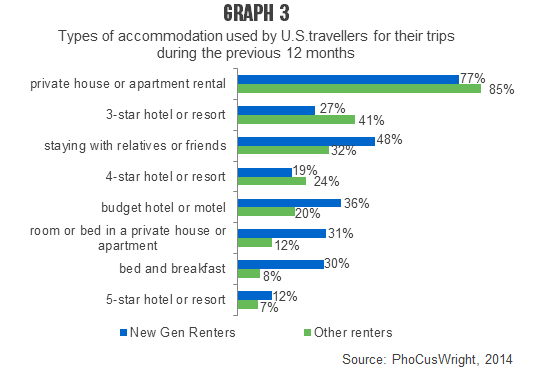
New Gen Renters tend to spend less on accommodation than other renters, since they are more likely to stay in budget hotels, bed and breakfasts or rooms, or else rent a bed in a private home (see Graph 3).

Note that PhoCusWright distinguishes between two types of rental accommodation: the one where the customer rents the entire residence from which the owner is usually absent (see “private house or apartment rental,” below); and the one where the renter only has access to part of the residence, and where the owner is usually present during the rental period (see “room or bed in a private house or apartment,” below). The latter type can be found on websites such as Airbnb, but is completely absent from websites such as HomeAway, that specialize in the first type of rental accommodation.

AL_Airbnb_1_anglais_graph_3

Why choose a rental over hotel accommodation?

The three main deciding factors for all renters are that they can find similar facilities and equipment to those at home, that they have more space, and that the rental can accommodate more people (see Graph 4). However, New Gen Renters particularly like the fact that rentals provide more freedom and privacy than a hotel room, that they offer a more relaxed ambiance, and that they are generally less expensive.

AL_Airbnb_1_anglais_graph_4

How will hotel owners react?

Should hotel owners be alarmed at the prospect of losing part of their clientele to private accommodation? According to PhoCusWright, 82% of non-renters did not even consider the rental option for their trips during the previous 12 months. However, hotel operators would do well to adapt to these New Gen Renters because, although rentals may better meet their needs, they nevertheless use different types of accommodation when travelling.

A second analysis examines the online planning and booking habits of this New Generation, and looks at possible ways of resolving the concerns of the hotel industry.


Image à la une: © BY NC Melies The Bunny

Catégories
etourism and technology Marketing @en

Instagram: A mobile partner for the tourism industry

With 40 million photos uploaded per day and 8500 « likes » and 1000 comments per second, the Instagram mobile application has become an essential tool for Marketing 2.0.

Named « Application of the Year » by Apple in 2011, Instagram has popularized the art of mobile phone photography, or iPhoneography, by enabling users to personalize and share their photos with others. Purchased by Facebook for US$1 billion in April 2012, a year later Instagram boasts a community of more than 100 million monthly active users.

Hugely popular among young adults, Instagram offers businesses an ideal opportunity to enhance their visibility and public relations, especially if their target public includes members of Generation Y. Many brands, including companies working in the tourism industry, have joined the network and made it part of their marketing strategy.

Instagram 101

For those of you unfamiliar with Instagram, here’s how it works:

  • After taking a picture using Instagram or selecting a saved photo from your phone, you can modify the final image with one of the application’s 18 automatic filters before sharing it with your network.

MLV_Instagram_image_1

  • Similar to Twitter, members subscribe to the accounts they want to follow and use #hashtags to label or describe their photos. Just like on Facebook, viewers can express appreciation for an image by « liking » it; they can also post comments.

MLV_Instagram_image_2

  • Moreover, the application can be used to share photos on other social platforms.

MLV_Instagram_image_3

  • Although Instagram does have a Web version, other Websites have adapted the mobile platform for larger screens, making it easier to navigate and manage your account: Webstagram, Statigram and Pintacular.

MLV_Instagram_image_4

Source: Pintacular

How can tourism businesses and organizations benefit from Instagram?

With Instagram, businesses have access to user-generated mobile-optimized content. A convergence of two major trends, the rise in visual marketing content and SoLoMo (see also: Vous avez dit SoLoMo?), this medium is generating interest in the tourism industry, which sees it as a new way for communicating with clients. Making Instagram part of your marketing strategy can provide the following benefits:

  • Develop your brand image. Instagram can introduce users to a variety of interesting photos associated with the brand or destination.
  • Strengthen customer relations. Analyzing Instagram photo searches can help businesses better understand their target clientele. They can use the application to interact with their target market and participate in conversations about certain images, thus reaching a different digital community to complement those in other social media.
  • Create visual content. An organization can repost the best user photos of its establishment or destination on its own account. When you do this, the firm Adviso suggests adding a message to the photo mentioning the name of the user who took the picture, to give photo credit. You can also include Instagram photo albums on your Facebook page, thereby increasing the amount of visual content shared with your fans.
  • Increase your mobile presence among travellers. Instagram can be useful at every stage of the travel cycle, not just during a stay. Its content can provide inspiration, encouragement and guidance during the planning stage, and keep a potential visitor connected with the destination or organization after the initial contact. It is an opportunity to increase one’s presence among connected customers.

How can individuals use Instagram in the context of tourism?

MLV_Instagram_image_6_ENG

What tourism businesses or destinations use Instagram?

The Canadian Tourism Commission has added Instagram to its social media strategy with the ExploreCanada account, which has nearly 15,000 followers. It invites members of the tourism industry to post images using the hashtag #ExploreCanada.

MLV_Instagram_image_7

Source: ExploreCanada

The destination management organizations of Nova Scotia, British Columbia and Alberta have also created hashtags to showcase their destinations.

MLV_Instagram_image_8

Source: #visitnovascotia, #tourismbc, #travelalberta on Instagram

Tourisme Montréal encourages the use of hashtag #MTL and incorporates user-generated Instagram photos in a page on its blog, Vivez Montreal/The Montreal Buzz. Some images are also reposted on its Facebook page or put together to form a special blog post. For summer 2013, the site has developed a strategy using the hashtag #mtlmoments on Instagram and Twitter.

MLV_Instagram_image_9

Source: The Montreal Buzz

The number of major hotel chains using Instagram more than quadrupled in one year, from 19% in 2011 to 82% in 2012, according to Digital IQ Index: Hotels 2013. Some brands, like the Shangri-La and Four Seasons, have come up with hashtags (#lovingthemoment and #FSFotog, respectively) to encourage guests to share photos of their hotel stays.

MLV_Instagram_image_10

Source: @althotel, @intercontinental and @fairmonthotels on Instagram

Furthermore, the ALT Hotel banner launched its second mobile photo contest, #ALTexpo, to create a mural of digital photos for the lobby of its new hotel at Halifax Stanfield International Airport. The video below presents a behind-the-scenes look at the first edition of the contest, organized for the ALT Hotel at Toronto Pearson International Airport:

<iframe width= »560″ height= »315″ src= »http://www.youtube.com/embed/Od3CEQRrXpU » frameborder= »0″ allowfullscreen></iframe>

www.youtube.com/watch?v=Od3CEQRrXpU

The application has also been enthusiastically adopted by the airlines, particularly Air Canada and WestJet.

MLV_Instagram_image_11

Source: @WestJet, @Air France and @AirCanada on Instagram

With an adoption rate of 18% in the United States, Instagram is still an emerging platform, currently used primarily by young people. Some 28% of Americans ages 18 to 29 used Instagram in 2012, compared to 14% of 30 to 49 year-olds and 3% of 50 to 64 year-olds. However, it has significant growth potential and relevance for tourism, which is reflected in its current popularity among numerous industry organizations.

Catégories
etourism and technology Management

SOS! My business is having a social media crisis!

Thanks to social media, information that used to take several hours or even days to reach the public can now be spread almost instantaneously. When a crisis sets alarms bells ringing in today’s world, it’s impossible to ignore!

A well-prepared crisis unit and an action plan to mitigate the impact and quickly get back to normal are just two ways to manage a social media crisis and limit collateral damage.

Anticipate and plan for a crisis

While it’s nearly impossible to predict what will lead to a crisis, organizations are nonetheless well-advised to take advantage of calmer periods to contemplate the possibility. They should envision some plausible scenarios, establish a management protocol, appoint the individuals who will be in charge, determine the role of each team member, and supply everyone with the tools they need to take action and communicate effectively, should the need arise (see also: Quand la crise éclate!).

Online monitoring of chatter about your company or organization is a way to complement your crisis preparations. In fact, this sort of monitoring can identify vulnerabilities and anomalies and enable you to take action before they degenerate. There are many monitoring tools available to facilitate this process (see also: Des stratégies pour gérer votre réputation en ligne).

In the end, although your company image and reputation are at stake, don’t forget that similar risks existed, even before the advent of social media. The difference is that, today, social networks have the potential to aggravate and accelerate a crisis situation.

Intervene, manage and overcome a crisis

When an incident is detected and a crisis seems inevitable, one must take effective action. At this stage, managing communications and reassuring clients, partners and the public requires a lot of discipline and diplomacy. Even if you have no answers for the questions being asked, it is important to publicly acknowledge the problem and show that you are doing everything in your power to resolve it.

Maintaining control over communications, promoting transparency and honesty with regard to the current problem and reacting quickly to criticisms can help you limit the damage. If the crisis actually began on a specific social network, Facebook, for example, you should begin by responding directly on the site. With a little bit of luck, the crisis could subside without reaching other media. If, on the other hand, this is not the case, you must act in a uniform manner across all networks involved.

Creating a Web page with crisis-related questions and answers (FAQ) could save you a lot of time and prevent misunderstandings. In addition to listing all possible questions, this page means you can provide a link to the answers when asked about the same topics; remember, Twitter only gives you 140 characters, which is not much for clearly expressing your views. This page could include the following types of information:

  • Recognition of the crisis
  • The surrounding circumstances
  • Photos or videos showing, for example, the president of the company holding a briefing
  • The next actions planned to resolve the crisis
  • Contact information for people who can provide more details

During a crisis, the point is not to win arguments but to control damage. For this reason, although transparency is essential, it’s also important to know when certain conversations that could degenerate should be taken offline. Inviting a compromising person to continue the discussion by phone or email shows that you are interested in the position being argued yet prevents the spillover from being aired publicly.

End a crisis

Some crises can be avoided, while others would appear inevitable. What lessons have you learned and what measures can you take to prevent a similar situation from happening again? It is crucial to deconstruct such events after they are over so you can use the experience to prepare your next crisis management plan. You could, for example:

  • document and preserve all the comments posted on the various social networks and any emails exchanged with the internal team, the public and the media
  • analyze the number of site visits and your social network profile during the crisis
  • determine the chronological sequence of events, identify the critical moments and understand the reasons behind them
  • evaluate the crisis management plan you used and improve it

To avoid having to face a social media crisis, some businesses are simply opting out of social networks. But is this really a good solution? What if a crisis involving you unfolds on social media and you are not there to deal with it? Although maintaining a presence on social networks definitely involves some risk, paradoxically, not doing so does not make you immune to risk!


Sources:

– Baer, Jay. « Don’t Be Scared Be Prepared – How to Manage a Social Media Crisis« , convinceandconvert.com, 2012.

– Blancot, Carole et al. « Communication de crise à l’heure des médias sociaux, » Atramenta, September 2012, 100 p.

– Fryatt, Jenise. « Social Strategies: Creating Your Social Media Crisis Management Plan« , blog.cvent.com, January 16, 2013.

– Seraiocco, Nadia. « Gestion de crise sur les réseaux: pensez-vous à votre CM? » cheznadia.com, February 27, 2013.

– World Tourism Organization. « Toolbox for Crisis Communications in Tourism« , 2011.

Catégories
Ailleurs dans le monde @en etourism and technology

Evaluating the Quality of Digital Hospitality

Destinations the world over must adapt their practices to the changing behaviours of their clients with ever-evolving technological needs. A study done by TCI Research shows that traveller satisfaction with the quality of digital hospitality is at the level of “acceptable,” but just barely. Will destinations be ready to properly meet client expectations in 2013?

This analysis is based on the data gathered by the worldwide TRAVELSAT Competitive Index survey, conducted by the Belgian firm TCI Research, measuring the competitiveness of destinations based on the experiences of nearly 30,000 tourists from more than 30 countries. They were polled in 2011 and 2012 on 80 indexes (see complete list at http://tci-research.com/travelsat-list-indexes/). Of those, only the index concerning digital hospitality will be examined here. Survey respondents were asked to evaluate their impressions of the availability, accessibility, and quality of the content and services offered via various mobile devices.

On-site Internet hospitality

The concept of Internet hospitality at the destination (related reading: Internet de séjour : « Bonjour, que nous suggérez-vous aujourd’hui? ») is increasingly transforming the notion of offering hospitality to a client base that makes massive use of smart phones and e-tablets. Listed among the 13 trends of 2013 in the January Gueuleton touristique, organized by the Transat Chair in Tourism of UQAM’s ESG, in cooperation with Tourisme Montréal, on-site Internet hospitality creates numerous challenges for tourism offices and other organizations involved in providing hospitality to guests and tourists.

How do we evaluate the quality of digital hospitality around the world? Do digital services offered to visitors meet expectations? The TRAVELSAT survey finds that overall, the satisfaction index with the quality of digital hospitality stands at just barely over 100 – indicating that it is acceptable, but does not always exceed expectations (see the five index levels in Table 1).

Qualite_accueil_anglais_tableau1

Note: This rating is indicative only (the progress from one level to the next being gradual) and does not apply to criteria of satisfaction relating to prices, which by their very nature find less favour with clients.

Level of satisfaction according to various criteria

Generation Y travellers (ages 25 to 34) seem slightly more satisfied with digital hospitality than those of other age groups (see Graph 1). When travellers in general spend between 4 and 7 nights at their destination, their needs are clearly met more fully (130) than those who stay between 1 and 3 nights (93) and 8 nights or more (111).

Qualite_accueil_anglais_graphique1

Newlyweds on their honeymoon, shopping enthusiasts, and business travellers (MICE) express the highest level of satisfaction with digital hospitality (see Graph 2). Their experience even exceeds their expectations. At the other end of the spectrum, people whose stay is built around religious tourism often expressed the strongest dissatisfaction of all groups represented.

Qualite_accueil_anglais_graphique2

Survey respondents were especially satisfied with the digital hospitality in New Zealand, Australia, the United States and Canada (see Graph 3). These countries offer an experience that is more competitive than most European destinations. Travellers who visited Latin America mentioned, among other aspects, issues with consistency of quality, which explains the low satisfaction index.

Qualite_accueil_anglais_graphique3

Note: For clarification of destination composition, see Table 2.

Qualite_accueil_anglais_tableau2

Individuals from the BRIC countries – Brazil, Russia, India and China – are those who most appreciated the digital hospitality they experienced during their trips (see Graph 4). We can surmise that technology devices are an effective way to overcome communication issues and that they can facilitate the initiation to a new destination. On the other hand, the expectations of Europeans were not completely met, which translates into less positive feedback.

Qualite_accueil_anglais_graphique4

In terms of satisfaction with digital hospitality relating to the principal activities practiced by visitors, we do not see a wide variation in the indexes (see Graph 5); the majority of travellers find it acceptable. We notice that satisfaction levels rise when it comes to the specific character of the segment under study (golf, theatre, sporting event, etc.); destinations could easily justify focusing their content on activities which motivate travellers to visit.

Qualite_accueil_anglais_graphique5

Influencers (or trend-setters) on the web, who are very active in social media, report a higher level of satisfaction than other client segments (see Graph 6). Better equipped and informed than the average, this group of individuals knows how to make the most of available applications once they’re at their destination.

Qualite_accueil_anglais_graphique6

When we see how enthusiastically the more seasoned travellers (influencers on the web) embrace technology, we can ask ourselves about the correlation between level of knowledge and interest and level of satisfaction with digital hospitality. Being accustomed to services offered on the web, many influencers will even choose certain applications and digital services before arriving at their destination, which allows them to make more use and to better appreciate their devices upon arrival.

Tourism organizations and travellers alike are in the process of adapting to new technologies. The learning curve and the use of online tools are not the same for everyone, which is why we find ourselves in a transition period where a balance must be found between the services offered digitally and those provided personally by the industry’s players.

Sources:

–Transat Chair in Tourism, UQAM ESG and Tourisme Montréal. Gueuleton touristique, « Les 13 tendances de l’industrie touristique pour 2013».

– TCI Research. TRAVELSAT Competitive Index, 2011-2012.


Comment – Olivier Henry-Biabaud

The study simply reminds us that the appeal of technology is one thing, but the relevance of content is another. We still have a good way to go before the two can converge. What good is it for smart phones to have a myriad of apps from all sorts of operators within easy reach if what you really need at a crucial time is not available? Some apps are intriguing; some enable you to scan the exterior façade of a hotel to know if rooms are available. But how many tourists look for accommodations after arriving at their destination? The digital age is profoundly changing the way tourists plan their trips and live the travel experience, but we are yet again reminded that the actual experience is the sum total of hundreds of tangible and intangible points of contact (material, commercial, human and digital) that are all occasions for a destination to score points with visitors.

In the future, the most competitive destinations will likely be those that manage to strike the seamless balance of human and digital hospitality, to enrich the experience of the visit without virtualizing it, and to offer applications that are consistent throughout the visitor’s stay. Infomediation is an enormous challenge for destination management organizations (DMOs), which must strive to guide their visitors through this “jungle” before and during the stay.

Olivier Henry-Biabaud – TCI Research
Olivier_Henry_BiabaudOlivier Henry-Biabaud founded TCI Research in 2010. With a Master’s degree in Marketing Strategy (Paris Dauphine University, Sciences-Po Paris), he has 20 years of experience in international market research with global companies (TNS, Ipsos) in senior operational and management positions based in various locations. A specialist in international travelers’ opinion, he has been in charge of large-scale research programs measuring traveler satisfaction and destination competitiveness for over 50 countries, regions, cities and international tourism organizations. He is a regular speaker in international forums about tourism competitiveness, a member of the UNTWO Panel of Tourism Experts and its Knowledge Network, and a board member of the TTRA – Tourism and Travel Research Association (Europe Chapter).Website: www.tci-research.com
Catégories
etourism and technology

Search, User Generated Content and Online Booking

There are 2,3 billions internet users in the world with significant penetration ratios in countries all over the world(5). Recently, User-Generated Content (UGC) has been considered as one of the most important sources of information influencing tourists’ choices. Despite this, few studies have focused on examining cross- visitation, that is referral and conversion traffic from UGC to other key online and offline information sources. Further, little research has focussed on analysing when consumers use UGC along with their information-search and the related cross-visitation.

Some empirical data

UGC plays a relevant role along with all the online searching and booking behaviour of tourists, particularly UGC within third-parties websites. Referring to the so called “billboard effect”, recent research showed that consumers’ decision making often starts by looking at Online Travel Agencies (1,2,4), whose posts of reviews and comments clearly influence tourists choices and online booking(3). Analyzing 1,720 reservations for InterContinental Hotel Brands, a study reported that almost 75% of consumers who booked through the official website of Intercontinental had visited an OTA prior to making the reservation, with nearly 83% performing a search on Google, Yahoo or Bing and two-thirds performing both a search and an OTA visit (2). Further, cross-visits by OTA shoppers to Facebook exceeded seven in 10 whereas cross-citation with Twitter was found to be at around 25% for both OTA and hotel web site buyers (6).

The when consumers use UGC: the Italian tourists’ behavior

Recently, an empirical study was carried out on a sample of 623 Italian tourists to analyze the when consumers use UGC along with their information-search and the related cross-visitation (4). The final open-ended question asked participants to fully describe the way they usually search for information when making hotel reservations. Their open answers were manually coded considering the sequence by which each category of information (both online or offline) were cited (that is step 1, step 2, etc). It was then possible to calculate the frequencies by which the different sources were found to be used along with the respondents’ information-search.

Table 1 shows in which stage each information source is used by respondents to make their hotel booking.

Table 1 – The online information-search: what information sources do tourists use? (%)

The majority of respondents stated that they start their online booking by using OTAs (45.6%) or search engines (23,2%). 14.5% of them reported referring to tourism-related social networks (such as TripAdvisor, Zoover, etc) in the early stage of their search-information process. Furthermore, Table 2 shows that tourists sometimes finalize their booking via traditional travel agencies or via direct contact with hotel (phone call or email).

Further insights on tourists’ booking behaviour can be obtained by concentrating our attention on what happens once tourists start a search via OTAs and search engines, the information sources that appear to influence the early stage of the search the most.

As shown in Figure 1, 23.2% of respondents start their search through search engines and then visit the hotel’s own website (37.2%), or OTAs (24.6%) or tourism-related social network (8.7%).

Figure 1 – Online booking starting with search engines: how do tourists search for information?

Source: Del Chiappa(4)

22.6% of those visiting the hotel website at the second step of their search, proceed in the next step via phone call or email (19.4) or visiting an OTAs to search for comments and reviews and/or to look for more convenient rates (22.6%). There is also a 12.9% of tourists who continue to look for other UGC in tourism-related social networks. 24.6% of those visiting OTAs at the second step, proceed to visit the official websites (50%), other tourism related social networks (19.2%) or make a phone call to the hotel (11.5%).

Figure 2 – Online booking starting with OTAs: how do tourists search for information?

Source: Del Chiappa(4)

According to Figure 2, 45.6% of respondents start their research through OTAs and proceed to visit the hotel’s website (55.2%) or other travel 2.0 application, that is tourism related social networks (19.7%). Then, 69,4% of those visiting hotel websites at the second step of their search, proceed via email (36.5%), phone call (32.9%) or other tourism-related social network (12.9%). 17.9% of those visiting tourism-related social networks at the second step, then visit the hotels’ website (72.7%), or place a phone call (9.1%) or visit photo sharing websites (3%).

Managerial implications and suggestions

Better knowledge on how information is acquired, enables marketers to better influence tourists’ buying decisions. The aforementioned research suggests that hotel marketers should monitor their brand reputation over the internet and should pay particular attention to UGC uploaded onto On line Travel Agencies, considering that it is by looking at ratings/ comments within these websites that consumers’ may decide to include or exclude a given hotel from their potential set of choices. Tourists would then be able to consider the hotel as they proceed in their information search using all the other information sources. Further, findings suggest that hotel marketers should adopt a multichannel communication and distribution strategy (on-line and off-line) to influence tourist choices and should manage their internet strategies (parity rate, effective booking engine, call-to-action, etc) and their customer service in order to convert as much traffic generated by OTAs (and other Travel 2.0 applications).


References

(1) _ Anderson, C. K. (2009). The Billboard Effect: Online Travel Agent Impact on Non-OTA Reservation Volume. CHR Report. The Center for Hospitality Research at Cornell University, 9(16).

(2) _ Anderson, C. K. (2011). Search, OTAs, and Online Booking: An Expanded Analysis of the Billboard Effect. CHR Report. The Center for Hospitality Research at Cornell University, 11(8).

(3) _ Del Chiappa, G. (2011). Trustworthiness of Travel 2.0 applications and their influence on tourist behaviour: an empirical investigation in Italy. In R. Law, M. Fuchs and F. Ricci (Eds.), Information and Communication Technologies in Tourism 2011, 343-353. Vienna, Austria: Springer.

(4) _ Del Chiappa, G. (2012). User Generated Content and its influence on tourists’ choices: how do tourists make hotel reservations online? Turistica, Special Issue “Content Personalization and Multimedia Marketing for Destinations and Tourism Business, 1, pp. 39-50. Paper presented at Modern Hospitality and Tourism Development Conference, Università di Allameh Tabataba’i di Teheran.

(5) _ Internet Word Stats. (2011). Top 20 countries with the highest number of internet users. Accessed online (August 31, 2011) at http://www.internetworldstats.com/top20.htm.

(6) _ PhoCusWright. (2011). Social Media in Travel 2011: Traffic, Activitiy & Sentiment.


Giacomo Del Chiappa – Assistant Professor in Marketing, Faculty of Economics, University of Sassari
Giacomo Del Chiappa received a Ph.D in “Marketing and Business Administration” at the Faculty of Economics of the University of Milan-Bicocca. He was Visiting Scholar at the University of Melbourne (Australia). He is Assistant Professor in Marketing at the University of Sassari, Faculty of Economics. He teaches in the areas of “Tourism Management and Marketing” and “Destination Management” for the Degree in Tourism Marketing and Management, based in Olbia (Sardinia). He is a member of the editorial board of the journal “Tourism Analysis” and referee for international journals. His research topics are related to destination governance and branding, convention site selection criteria and meeting industry and, finally, consumer behavior in tourism. In this latter field his studies are concentrated on responsible tourism, on web 2.0 in the hospitality sector and, finally, on community-based tourism. Fields of expertise:

  • Destination governance and branding
  • Convention site selection criteria and meeting industry
  • Consumer behavior

Organization Web site

Catégories
etourism and technology

Trustworthiness of Travel 2.0 applications and their influence on tourist behaviour


The influence of UGC on tourist choices

In the last decade, the Internet has reshaped the way people plan for and consume tourist products and services. More recently, the most significant development in Internet applications has been in the area of user-generated content (UGC) and peer-to-peer applications, the so-called Web 2.0.

Research is shedding light on the significant influence that UGC and Travel 2.0 applications have on generating the idea of travelling, both during the real planning process and even after travel decisions have been taken. Recommendations of friends and colleagues are less important to business travellers than they are to leisure travellers (McCarthy, Stock and Verma, 2010). Sometimes UGC also induces tourists to alter their decisions after obtaining further information online.

Some empirical data

eMarketer (2007) reports that, among tourists who use peer reviews to help them make their hotel bookings, the percentage of infrequent and frequent leisure travellers who changed their booking based on reviews posted online by other consumers is 25% and 33%, respectively. An empirical investigation on a sample of 823 Italian tourist (Del Chiappa, 2011a) confirmed this figure with respondents reporting that, after having read reviews and comments posted online, they changed their hotel accommodation sometimes (64.8%), almost always (12%) or always (0.5%). In particular, Del Chiappa (2011a) found gender differences in this likelihood, with female respondents doing so (“always” or “almost always”) more frequently (14.8%) than male respondents (9.4%). Another study on a sample of 1,448 Italian tourists reported that 31.56% of respondents had changed the accommodation suggested by a traditional travel agency based upon UGC (Del Chiappa, 2011b).

Credibility and trustworthiness of UGC: Perceptions of American tourists

On the whole, UGC sources are considered more credible and trustworthy than market-provided information and, consequently, are more likely to direct and influence tourist choices. For marketing strategies to be effective, it is therefore crucial to know to what extent tourists consider the different types of Travel 2.0 applications to be trustworthy and whether these applications do in fact exert different influences over the way tourists perceive company image and make their decisions.

Interestingly, recent research has started to analyze the credibility and trustworthiness that tourists confer upon different Travel 2.0 applications, which helps clarify the extent to which they affect tourists’ attitudes and purchasing decisions.

A survey carried out on a sample of 1,900 of American tourists who usually buy tourist services over the Internet underlines the different influences that different Web 2.0 applications have on tourist behaviour (PhoCusWright, 2009). In decreasing order, these are: reviews on OTAs (50%), traveller-generated photography/virtual tours (43%), online travel reviews from travel experts (41%), professional photography/virtual tours (39%) traveller review websites (33%), professional online travel video (29%), traveller-generated online travel video (28%), travel blogs (22%), social networks/people you know (22%), social network/people you do not know (15%) and travel-related podcasts (13%).

Another study (Yoo, Lee, Gretzel, & Fesenmaier, 2009) of a sample of 1,170 American tourists indicates that UGC is most credible when posted on: official tourism bureau websites (41.2%), travel agency websites (36.8%), third-party websites such as TripAdvisor (33.5%), travel company sites (31.2%), personal blogs (18.1%), personal websites (16.1%), social networking sites (13.2%) and photo and video sharing sites such as YouTube (10.7%). To sum up, the aforementioned research underlines that tourists’ choices are influenced more by reviews and comments on online travel agencies (OTAs) than those on tourism-related social networks.

Credibility and trustworthiness of UGC: Perceptions of Italian tourists

Similar findings to those of the aforementioned research have recently been found in Italy. Based on an analysis of 823 questionnaires, the study shows that, for both female and male respondents, OTAs are considered the most trustworthy and therefore exert the most influence on company image and tourist choices. In order of importance, OTAs are followed by: tourism-related blogs, tourism-related social networks, video sharing, photo sharing, forums on the company’s website, non-tourism-related social networks and microblogging (Del Chiappa, 2011a). On the whole, the aforementioned study partially confirms the findings of prior research carried out in the United States by Yoo, Lee, Gretzel and Fesenmaier (2009), where OTAs were found to be the most credible Travel 2.0 applications, while non-tourism-related social networks were found to be the least trustworthy. Nevertheless, photo and video sharing sites were found to be less credible in the United States than in Italy.

Moreover, in the same study, respondents reported that they consider comments and reviews posted online to be more trustworthy when there is the same proportion of positive and negative comments (51.2%), or when there are fewer of the latter than the former (39.9%).

Managerial implications and suggestions

On the whole, the findings of the aforementioned research support the marketing and communication strategies of hospitality marketers who have to develop, monitor and manage their corporate brands in a practically infinite virtual domain. Indeed, the research suggests that, in terms of marketing and communication activities, hospitality marketers should split their time and financial resources differently between different Travel 2.0 applications, and pay attention to other differences such as the gender and age of their customers. In particular, hospitality managers should pay attention to UGC posted on OTAs as several studies highlight the great impact, the so-called “billboard effect,” these applications have on the hotel business and the fact that consumer decision-making frequently really starts by looking at these sites, both abroad (Anderson, 2011) and in Italy too (Del Chiappa, 2011c).

References:

Anderson, C. (2011). “Search, OTAs, and Online Booking: An Expanded Analysis of the Billboard Effect,” Cornell Hospitality Report, 11 (8).

Del Chiappa, G. (2011a). “Trustworthiness of Travel 2.0 applications and their influence on tourists’ behaviour: An empirical investigation in Italy,” in R. Law, M. Fuchis and F. Ricci (Eds.), Information and Communication Technologies in Tourism 2011. Vienna, Austria: Springer.

Del Chiappa, G. (2011b). Disintermediation of hotel reservations: the perception of different groups of Italian online buyers, in proceedings of TTRA Europe and AFM Conference 2011 “Creativity and innovation in tourism.” Archamps: April 11-13.

eMarketer (2007). Niche Sites Invigorate Online Travel. Accessed online April 11, 2007, at http://www.eMarketer.com.

McCarthy, L., Stock, D. & Verma, R. (2010). “How Travelers Use Online and Social Media Channels to Make Hotel-choice Decisions,” Cornell Hospitality Report, 10 (18).


PhoCusWright. (2009). Consumer Travel Report.

Yoo, K.H., Lee, Y., Gretzel U. & Fesenmaier D.R. (2009). “Trust in Travel-Related Consumer Generated Media,” in W. Höpken, U. Gretzel and R. Law (Eds.), Information and Communication Technologies in Tourism 2009, 49-59. Vienna, Austria: Springer.


Giacomo Del Chiappa – Assistant Professor in Marketing, Faculty of Economics, University of Sassari
Giacomo Del Chiappa received a Ph.D in “Marketing and Business Administration” at the Faculty of Economics of the University of Milan-Bicocca. He was Visiting Scholar at the University of Melbourne (Australia). He is Assistant Professor in Marketing at the University of Sassari, Faculty of Economics. He teaches in the areas of “Tourism Management and Marketing” and “Destination Management” for the Degree in Tourism Marketing and Management, based in Olbia (Sardinia). He is a member of the editorial board of the journal “Tourism Analysis” and referee for international journals. His research topics are related to destination governance and branding, convention site selection criteria and meeting industry and, finally, consumer behavior in tourism. In this latter field his studies are concentrated on responsible tourism, on web 2.0 in the hospitality sector and, finally, on community-based tourism.  

Fields of expertise:

  • Destination governance and branding
  • Convention site selection criteria and meeting industry
  • Consumer behavior

Organization Web site

Catégories
Accommodation etourism and technology Marketing @en

The Troubling Trend of Increasing ‘Web Marketing Ineptitude’ in Hospitality… by Max Starkov

The Québec Tourism Intelligence Network is pleased to present some highly relevant thoughts about online marketing of hotels, written by special collaborator M. Starkov, consultant in Hospitality eBusiness Strategies.

Throughout our nearly 15 years of hotel Internet marketing experience, we have been consistently concerned about the increasing level of disparity between savvy Internet/Mobile marketers in hospitality and travel, and the Internet/Mobile Marketing-inept players in the industry.With the advent of social media in recent years, Web 2.0 technologies and the mobile Web, this disparity has accelerated dramatically.

On one side there are the extremely Web-savvy:

  • Online travel agencies like Expedia, Travelocity, etc.
  • Most major hotel brands’ e-commerce departments
  • Airlines
  • Some e-commerce departments at smaller and mid-size hotel and resort chains
  • Some very bright individuals at the marketing departments of full service hotels, resorts and casinos

On the other side there is everybody else, which unfortunately means the majority of hospitality executives and sales and marketing professionals.
HeBS defines “Web Marketing Ineptitude” as the lack of hands-on experience in Internet marketing and all of its formats: website re-designs, SEO optimizations, search marketing, email marketing, strategic linking, banner advertising and online sponsorships, social media and Web 2.0 and more recently, mobile marketing. In addition, this ineptitude also indicates a lack of understanding of best practices and latest trends in the direct online channel.

In the 1990s, it was “normal” that only a few hospitality and travel marketers were proficient in the online channel.  Less than 3% of travel reservations in the U.S. were booked online back in 1999. In the 2000s (in 2001, online travel bookings reached 5.4% of all travel reservations in the U.S.), hospitality marketers and the major hotel brands began to pay closer attention to the Internet channel. In the years that followed, Internet travel adoption increased dramatically and in 2009 alone over 55% of all travel reservations in the U.S. will be online (45% of all hotel reservations) to the tune of a staggering $116.1 billion (eMarketer).

Yet, to our dismay, over the past 15 years the level of Internet marketing expertise in the hospitality industry has not kept up with this remarkable growth. On the contrary, we are witnessing whole new generations of hospitality executives and marketing professionals who are unfamiliar with Internet marketing in general as well as best practices and trends in the direct online channel.

This problem has been exacerbated by a) the social media and Web 2.0 phenomena, and b) mobile marketing. Both of these new marketing and distribution channels introduced an entirely new level of complexity and skill set requirements, as well as new best practices and trends.

  • Social Media have changed how customers plan and purchase travel, how customers access information, and how customers perceive the credibility of information. How can hoteliers create/monitor/take advantage of the social media “chatter” around the hotel, target receptive audiences, and ultimately stimulate hotel website visits, interactions and bookings? What type of Web 2.0 and interactive features and functionality do you need on the hotel website?
  • Mobile Web is expected to surpass the traditional Web within the next five years. The promise of “immediate, anywhere and anytime” Internet access, instant information and transaction capabilities, location-based services and personalization are some of the key factors for the “explosion” of the mobile Web. Hotel guests–past, current and potential–are increasingly becoming mobile-ready and hoteliers have to respond adequately to this growing demand for mobile services. This is the reason why hoteliers and travel marketers need to have robust mobile Web initiatives in place, including mobile brand websites, mobile apps, m-CRM and mobile marketing.

Why Is There a Growing Web Marketing Ineptitude in the Industry?

There are many reasons for this “Web Marketing Ineptitude” among the ranks, but here are some of the most important:

Franchised Properties:

  • Many major brands control all Internet marketing initiatives at the corporate level, including property-level initiatives, thus depriving staff at the property from any meaningful experience in Internet marketing.
  • We have seen a trend among small/mid-size chains to establish small but vital e‑commerce departments. In many cases, these companies outsource whatever online marketing they do to outside vendors. Here again, when outsourcing, they make a crucial mistake by not demanding professional development to be part of the Internet marketing vendor’s responsibilities. This results in Internet marketing expertise not being disseminated to the properties in the process.

Independent Hotels and Resorts:

  • The biggest concentration of Internet marketing knowledge is at this level.
  • Many big full-service hotels and resorts have some form of in-house Internet expertise. However, due to staff turnover and constantly decreasing budgets, these properties tend to have a very spotty Internet expertise retention rate.
  • Smaller hotels and resorts are most vulnerable due to limited budgets and difficulties with hiring and retaining employees with expert knowledge.

Destination Marketing Organizations (DMOs) and Convention and Visitor Bureaus (CVBs):

  • These organizations boast some of the brightest Internet marketing stars and some of the most inept marketers.
  • In many cases among DMOs and CVBs, ignoring Internet marketing best practices is not even a matter of budget size, but a result of inertia and commitment to traditional advertising formats.
  • The government or quasi -government nature of CVBs and tourism offices does not help with the hiring and retention of Internet expertise.

So What Is the Verdict?

HeBS believes there are different levels of Web Marketing Ineptitude in the industry regarding three important marketing media: Traditional Web, Social Media/Web 2.0 and Mobile Web. Here are our estimates of the ineptitude rates in each of these media:

Internet Marketing/Traditional Web

  • Nearly 15 years of existence of the traditional Web
  • Internet Marketing Ineptitude rate in hospitality:  65%

Web 2.0/Social Media Marketing

  • Nearly 5 years of existence of social media
  • Web 2.0/Social Media Marketing Ineptitude rate in hospitality:  90%

Mobile Marketing/Mobile Web

  • Nearly 10 years of existence of Mobile Web but in reality, the Mobile Web in the U.S. exploded with the introduction of the first iPhone in June 2007.
  • Mobile Marketing Ineptitude rate in hospitality:  97%

Conclusion

Hoteliers should strive to gain a crystal-clear understanding of what the best practices and latest trends are in hospitality Internet marketing: what works, what doesn’t, and why. Hoteliers should recognize that they do not have all the answers in-house and that there are thought leaders and other proven industry experts who can help them and their property stay competitive in these economic times, preserve and increase market share, and generate the highest website revenues and ROIs.

Hoteliers should take a hard look at how Best Industry Practices are being utilized by their corporate offices or major brands, as well as by the hotel’s Internet marketing vendors. Almost 15 years after the first online hotel booking, best practices have been established in practically every aspect of hotel Internet marketing. Hoteliers should not allow their Internet marketing vendors to “learn the business on the hotel’s dime.”

The prospect of professional development should become the main criterion when choosing an Internet marketing vendor.  Hoteliers should hire experts who are able and willing to teach the hotel and staff best practices and keep the hotel appraised of the latest direct online channel trends.

Hoteliers should work only with Internet marketing experts who can help them acquire new core competencies and adopt best industry practices in the direct online channel. 

They should provide crucial professional development as well as guide the hotel’s direct Internet marketing strategies, online brand building strategies, e-CRM, website re-design and SEO optimization, search and email marketing, social media and mobile marketing initiatives.