
In the past few years, mountain resorts have been engaged in a mad scramble to become four-season tourist destinations. Gone are the days when mountain resorts relied solely on skiing to maximize the return on their investment. According to a 2011 survey conducted by Ski Area Management (SAM) magazine of 100 North American ski resorts, 44% of them operate year-round.
With an eye to financial and environmental concerns, tourism providers are vying with one another to develop inventive products and services to meet an increasingly diverse demand. This article discusses some of the trends and best practices adopted by mountain resorts as they redefine themselves.
A broad range of recreational activities
Summer activities are more and more popular with mountain resort clients. (Please see: La tentation quatre-saisons des stations de ski). One-quarter of the resorts surveyed by SAM reported that summer operations accounted for at least 20% of their annual revenue. Mountain biking is currently the most popular summer attraction on offer (61%) (see: Le vélo de montagne représente-t-il un potentiel touristique sous-exploité?), after business meetings (64%) and weddings (81%).
In the next two years, the resorts surveyed plan to focus more on family-oriented activities rather than traditional activities like tennis and golf (see Figure 1). A little less than half of the destinations surveyed are planning to add ziplines (42%), and nearly one-quarter plan to build alpine coasters (23%) or a ropes course (22%).

Climbing walls and bungee jumping are becoming more popular, as are skate parks, water parks and mini golf. In fact, the Massif du Sud area in the Chaudière-Appalaches region now calls itself a “four-season adventure sports outfitter.”
New customer segments
Many resorts rent out their facilities for business and festive events. The Banff Centre, located in the heart of Banff National Park, now courts the meetings, incentives, conventions and events (MICE) market. Some resorts, like Crystal Mountain in the northwest United States and Mont Sainte-Anne in Québec, actively target the destination wedding segment during the summer and rent out the facilities located on their summits.
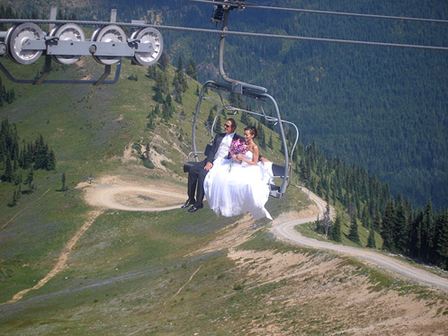
Source: Crystalmountainresort.com
Package deals: An ideal solution
Increasingly, resorts are turning to package deals. Packages help make a destination attractive to new visitors, increase business during the off season and draw regional clientele who are interested in shorter stays. In addition, packages fulfil the varied needs of multi-generational travellers and non-skiers.
Relaxing getaways
Spas have become synonymous with the mountain resort experience. Health and wellness are now part of resort marketing and can even provide the raison d’être for a get-together, such as this year’s Wanderlust yoga festival held at Squaw Valley USA, California.

Source: First Track
Some resorts are improving their culinary offerings, sourcing food from a variety of providers and focussing on regional products. Last winter, the Samoëns ski resort in the French Alps organized its first Winemakers’ Week. Winemakers from various regions in France set up kiosks and presented workshops to introduce tourists to their wines. In Québec, Mont Saint-Sauveur recently began a major renovation of its bar and restaurant to offer patrons a wide variety of healthy foods and ensure that the bistro is the area’s trendiest restaurant.
Online marketing, mobile apps and new technology
Web marketing is now one of the most vital promotional channels available and some resorts are using it to great advantage. Wild Mountain in Minnesota posted a deal on LivingSocial, a group purchasing site, offering a discount package of lift tickets and equipment rental. The goal was to attract a new clientele of novice skiers.

Source: Livingsocial
Snowbird in Utah, one of the first resorts to develop its own app, has implemented a social media strategy by including a community page on its site where visitors can share content.

Source: SnowBird
Brighton Resort in Utah has installed two automatic cameras on one run to photograph skiers and snowboarders, who can then download their performances on the resort’s Facebook page.
Vail Resorts has created EpicMix, an application for either mobile or online use that enables clients of its five ski resorts to share their stats on their social networks. The information provided is extensive and includes rate of descent, skier and snowboarder ranking, weather and real-time location of contacts. Last winter, 100,000 people activated an EpicMix account and 40% downloaded the mobile app.

Source: Epicmix
New technology has also had an enormous impact on resort operations. At the beginning of the 2011-2012 winter season, Mont Saint-Sauveur and Mont Avila will be installing a radio-frequency identification (RFID) system on their lifts to detect skiers’ cards so they don’t have to show them, just like the system already in place at Le Massif in Charlevoix.
A wide variety of lodging options
A great number of privately owned mountain resort rentals are available online. In Québec and British Columbia, such properties represent approximately 60% of the ads listed on HomeAway. These rentals help increase a destination’s potential customer base and many resort managers feel this type of accommodation complements rental condos and hotel rooms.
However, such rentals have not slowed the real estate developments of groups like Intrawest, Boyne Resorts, Aspen Skiing and Vail Resort. Furthermore, many people are buying second homes located at the base of ski mountains. Finally, resorts are also developing new projects. At Le Massif in Charlevoix, the La Ferme hotel complex will open for business in the spring of 2012, and Mont Sainte-Anne is planning to build a new four-season resort in the next few years.

Source: Le Massif de Charlevoix
Sustainable development as a key element of restructuring
The Whistler resort community has developed a long-term plan, entitled Whistler 2020. It defines various priorities and strategies for achieving the sustainable development of the resort and uses indicators to monitor its progress on its Website.

Source: Whistler 2020
The Quebec Golf Course Owners Association (ATGQ) launched a sustainable development initiative this summer with the creation of the ParTROIS program. This measure helps golf clubs take steps towards eco-sustainable certification.
 The National Ski Areas Association in the United States recently added a new component to Sustainable Slopes, its environmental charter for ski areas. Called the Climate Challenge, this friendly competition aims to reduce greenhouse gas emissions. With the help of experts, the employees of the eight resorts participating in the voluntary program took action to fight climate change.
Clientele looking for new experiences, threats of global warming, technological advances and the popularity of social media: the industry does not lack for challenges. However, it is these very issues that have led ski resorts to develop innovative ways of maintaining their attractiveness, and the recent projects launched in Québec hold the promise of a bright future for mountain destinations.
Sources:
– Bast, Morgan. “EpicMix gets nearly 100,000 activations in first season”, buzz.snow.com, April 22, 2011.
– Bergeron, Patricia. «Réaménagement à la base de la montagne- Mont Saint Sauveur se peaufine», carnetduski.com, 13 juillet 2011.
– Kahl, Rick. “Condos on the Cheap,” Ski Area Management, Vol. 50, No. 2, March 2011, p. 54.
– Morrison, Alastair M. “International Trends in Mountain Tourism, Marketing and Development,” Belle Tourism Consulting, 2010.
– Rufo, Samantha, Ken Castle, and Katie Bailey. “Best/Worst Marketing 2010-2011,” Ski Area Management, Vol. 50, No. 3, May 2011, p. 41-45.
– Ski Area Management. “Sustainable Slopes Report Highlights Resorts’ Green Efforts” saminfo.com, July 8, 2011.
– Ski Area Management. “Summer in the Mountains,” Vol. 50, No. 3, May 2011, p. 46-47.
– Urban Land Institute. “Ten Resorts Trends”, www.uli.org, consulted July 13, 2011.
– Watson, Tom. “Brighton offers freestylers an ancillary stoke,” National Ski Areas Association, Vol. 19, No. 3, July 2011.
– Wine Tourism in France. “L’oenotourisme, nouveau sport d’hiver”, winetourisminfrance.com, December 29, 2010.
– World Tourism Organization. “UNWTO congress to debate the future of snow and mountain tourism” www2.unwto.org, March 31, 2011.
See also:
Les activités hors saison pour les centres de villégiature: tendances et nouveautés
La tentation quatre-saisons des stations de ski


